The State of the Financial Services Market and What Leaders Are Doing About It
Estimated reading time: 4 minutes

by
If you’ve been trying to make sense of where the Financial Services market is heading, you’re not alone.
Depending on who you listen to, we’re either on the edge of a technology-led boom or heading into a period of prolonged pressure, margin squeeze, and slow decision-making. AI is everywhere in the conversation, but clarity is not.
That was exactly why we hosted this webinar.
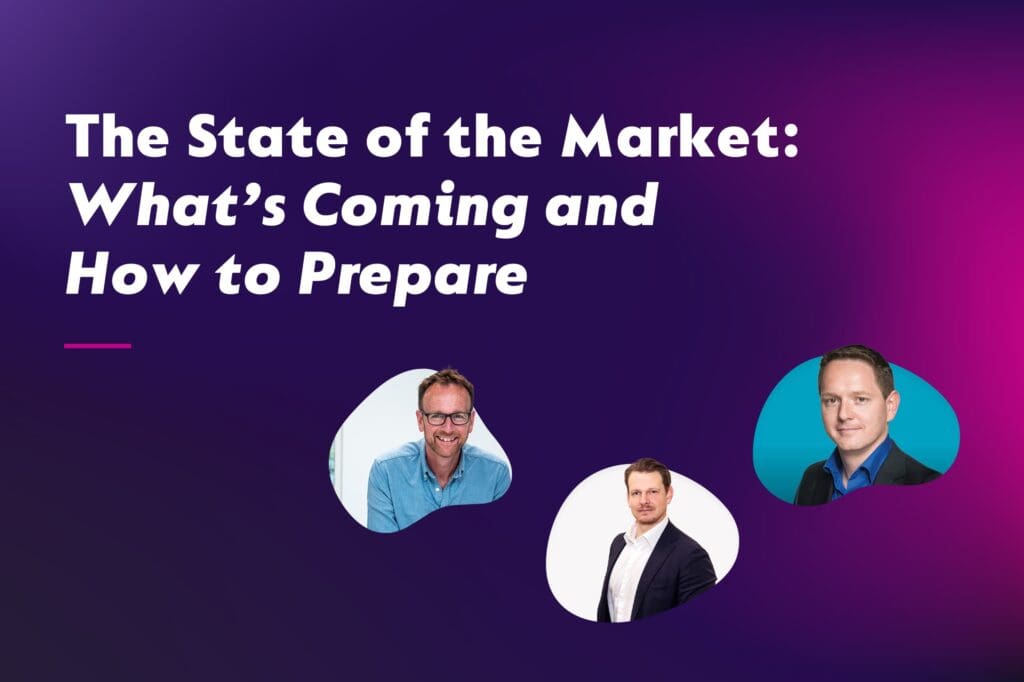
I was joined by Frank Hattann (CEO, Alpha BGS Commercial; ex Microsoft, LinkedIn, PayPal, Deutsche Bank) and Laurent Scherer (Managing Director, Juniper Square) for an honest, experience-led discussion on the state of the Financial Services market.
What followed was a refreshingly practical conversation about what’s changing, what isn’t, and where leaders are quietly adjusting their approach.
The gap between strategy and execution is widening
One of the strongest themes to emerge was the growing gap between what firms say they’re doing and what they’re actually investing in.
Many organisations talk about transformation, modernisation, and innovation. In reality, investment often stalls when it comes to the fundamentals – commercial capability, process maturity, and how teams are actually set up to operate day-to-day.
This gap is becoming more visible as pressure increases. When margins tighten and competition ramps up, weaknesses in execution are exposed quickly. Firms with clarity around their processes and commercial model can adapt. Those without it struggle to turn intent into action.
AI isn’t the shortcut many hoped it would be
AI featured heavily in the discussion, but not in the way you might expect.
Rather than positioning AI as a silver bullet, both Frank and Laurent were clear that unrealistic expectations are slowing progress. AI doesn’t work by default. It needs clearly defined processes, time to learn, and people who understand how to use it properly.
What’s holding many firms back isn’t access to tools – it’s how those tools are introduced, adopted, and embedded. Rolling out technology without training or clarity simply adds another layer of complexity.
The more effective organisations are using AI to improve productivity and decision-making, not to chase aggressive headcount reduction targets. That shift in mindset is becoming a key differentiator in the market.

Why the middle of the market feels the most pressure
Another important part of the conversation focused on how different parts of the market are experiencing change very differently.
Large institutions often have the scale, time, and resources to invest with a longer-term view. Smaller niche players can succeed by staying focused and highly specialised. It’s the mid-market – often private equity–backed – that feels the most pressure.
Growth through acquisition creates complexity fast. Integration takes time, and without clear ownership and alignment, organisations can end up fragmented internally and confusing externally. Clients feel it. Teams feel it. And commercial performance suffers as a result.
Understanding where your organisation sits – and what trade-offs that position creates – is critical when planning the next phase of growth.

Structural realities still shape what’s possible
A particularly valuable insight came from discussing why Financial Services hasn’t evolved in the same way as B2C platforms.
The assumption that financial services should be as frictionless as consumer tech ignores some hard realities: privacy, regulation, benchmarking challenges, and the bespoke nature of private markets. These aren’t technology problems alone, they’re structural.
That doesn’t mean progress isn’t possible. It means expectations need to be grounded in how the industry actually works. Leaders who recognise this are making smarter decisions about where to invest, what to automate, and what still requires human expertise.

What this means for leaders right now
If there’s one takeaway from the session, it’s this: the Financial Services market isn’t standing still – but progress is uneven.
The organisations making headway aren’t chasing every trend. They’re getting clear on where they are today, what they’re trying to achieve, and what genuinely helps bridge that gap. Often, that means improving processes, enabling people, and making incremental changes that build momentum over time.
There’s no one-size-fits-all answer. But there are better questions to ask – and that’s exactly what this conversation was designed to surface.

Watch the full webinar
This blog only scratches the surface of the discussion.
If you’re responsible for commercial strategy, growth, or leadership within financial services, fund administration, or private markets, I’d strongly recommend watching the full session.