
Season 5, Episode 2
Rosanne Darrow
VP of Marketing and Communications,
Siemens Healthineers
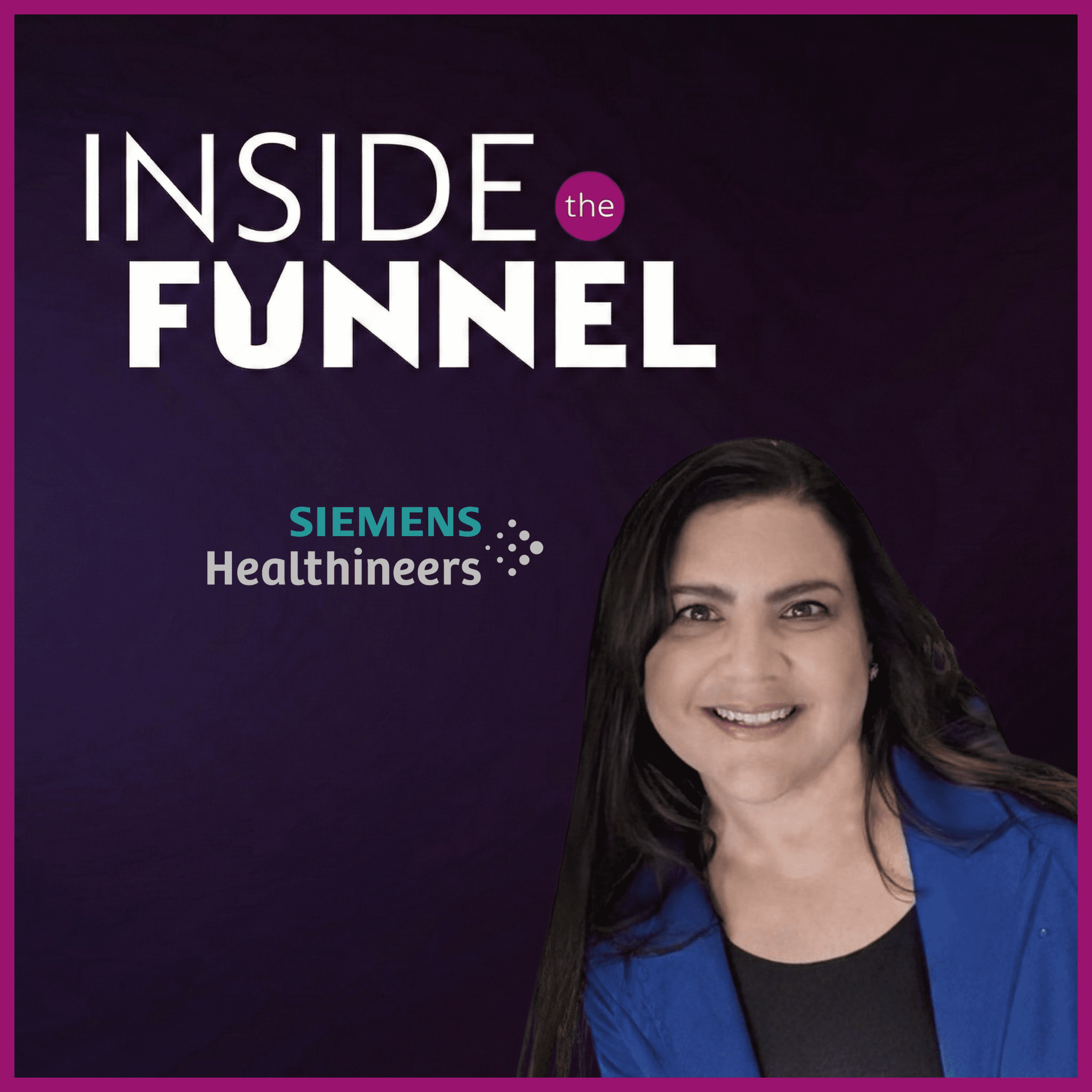
Why Siemens Healthineers Is Rethinking Demand Generation
Available on


In this episode of Inside the Funnel, Richard Lane sits down with Rosanne Darrow, VP of Marketing and Communications at Siemens Healthineers, to unpack how one of the world’s largest healthcare organisations is rethinking demand generation – and what it takes to drive commercial impact at scale.
Rosanne has spent over 20 years at Siemens, leading marketing across global and regional roles. Her focus today is simple: drive demand, enable sales, and deliver measurable commercial results.
But in a market that’s changing fast, that’s easier said than done.
Buyers are more digital-first than ever. In fact, 62% of medtech buyers now prefer a rep-free experience at the early stages of their journey.
At the same time, sales teams are under pressure to focus on high-value conversations – not chasing unqualified leads.
So how do you bridge that gap?
In this conversation, Rosanne shares how Siemens Healthineers shifted from a volume-driven marketing model to a more structured, end-to-end demand engine – one that prioritises qualification, nurtures opportunities properly, and delivers real pipeline impact.
We get into:
- Why traditional MQL models were breaking down — and frustrating sales teams
- How SDRs became a critical layer between marketing and sales
- The role of digital-first buying behaviour in reshaping go-to-market strategy
- How to prove a new model internally without disrupting your sales team
- What “good” looks like when it comes to alignment, content, and customer journeys
If you’re still measuring success by lead volume instead of revenue impact, this one’s worth your time.
Transcript
(0:05 – 1:38)
Welcome to Inside the Funnel by durhamlane. This is where we sit down with sales and marketing leaders and unpack what’s driving pipeline, what’s working, what’s not, and what they’ve learned along the way, one guest at a time. I’m Richard Lane, I’m co-founder and chief commercial officer at durhamlane.
I’ve always believed that if you ask better questions, you get better conversations, and that’s exactly what this podcast is about. So let’s get Inside the Funnel. I’m delighted to be joined on today’s episode by Rosanne Darrow.
Rosanne is VP of marketing and communications for North America at Siemens Healthineers. And I’m going to start with a bit of disclosure before I welcome Roseanne and get you to introduce yourself. But we’ve been a partner to Siemens Healthineers for a number of years, working through various programs, which we’re going to talk about today.
So I thought I’ll get that out early, and then we don’t have to introduce that bit later on. But Roseanne, we’ve had lots of wonderful conversations in the past, particularly around the worlds of sales, marketing, and how the two need to be seamlessly blended together. So I’m really thrilled to get you onto the podcast today.
Thank you for being with us. Much appreciated. Thank you.
Thank you for having me. Just to add a little more to my introduction, I’ve been with Siemens for 20 years and had various marketing and communications positions. My focus at Siemens is in the US, but in my history, I’ve worked globally from a marketing perspective.
(1:39 – 3:07)
My focus at Siemens is driving demand and commercial impact while developing high-performing teams that we’re showing that measurable result. At the end of the day, I always say to my team, our number one priority is enabling sales, and that is our focus. Just to give a little more about what Siemens Healthineers does, we’re a company, a global provider of healthcare equipment that includes solutions and services.
We have activities in more than 180 countries, and our products and services are in the areas of imaging, diagnostics, cancer care, and advanced therapies augmented by digital technologies and artificial intelligence. We have approximately 72,000 employees worldwide, and 17,000 of those employees are in the United States. Wow.
So truly an enterprise, an organization that I know everybody’s heard of, and that brings with itself complexities, doesn’t it, Roseanne? I think just to pick up on something you said there, which will make the theme and the thread of today’s conversation is your passion for driving demand and commercial impact. That’s exciting to us as an outsourced SDR organization. That’s what we’re in the business of helping our customers achieve.
(3:07 – 6:25)
When we were prepping for our conversation together, we were thinking of that discussion around the changing sales landscape, particularly in the medical device world. So I guess perhaps to get us started, could you share what you see as the change? What are you seeing as the change right now and the change that’s coming further down the line? It’s interesting because when I think of when I started at Siemens in 2005, we were doing direct mail and just talking about doing things digitally. And you think 20 years later, that technology continues to change rapidly.
I remember when my team came to me about ChatGPT, and I’m like, do we really think people are going to use that? And now look at it. We can’t live without it. So I think what we’re really seeing is the focus on digital.
And I think it’s changing. The landscape is changing in our everyday lives because of all the different generations. And whether we’re leaders and looking at driving employees or looking at things from a marketing and sales landscape, we know that by 2030, Gen Z and millennials are projected to represent approximately 70 to 75% of the global workforce.
And they want to be engaged in different ways. They have grown up with technology in different ways. And what we’ve learned with some of the research that we’ve done with different third parties, like Gartner, 62% of medtech buyers prefer a rep-free sales experience.
So when we started looking at things five years ago and doing things differently from a digital perspective for marketing, we also said, well, we have to use our sales team in different ways and prepare them to be able to interact with these different generations. Because whether they’re selling right now to baby boomers, Gen X, millennials, and then in time Gen Z, it’s a lot different than when I started. I mean, it’s really interesting.
I was sort of chuckling to myself, whereas as you said, back in 2005, we were doing direct mail because actually direct mail is quite effective again. I agree, yeah. Things come around in circles.
But yeah, you’re absolutely right. I mean, and that’s a really amazing stat that 62% of medtech buyers prefer a rep-free sales experience. And I guess we need to define what does rep-free mean, don’t we, as well? Because actually what we’re finding in our business is that we’re phone first and people, I know that there are SDR teams out there that don’t actually use the telephone.
Now that still works. It’s still our best medium. I guess what maybe they mean by a rep-free experience is that onsite interrupting consultations and sessions.
(6:25 – 10:40)
Is that what that means? How would you define that? The way I define it and I understand based on the research is exactly that, that if they are looking at their budget and they want to see what’s out there, they’re not going to pick up the phone and call their sales rep to have a discussion. They’re going to start doing research on their own. Why? Because it’s at their fingertips.
They’re going to, I mean, we do that too personally, right? Like if you’re in the market to buy a car or even a house, you’re like, well, let me see what’s out there first. Let me educate myself. And I’m not saying that some people wouldn’t still call their rep based on their relationship.
But we know that this digital first focus is going to be what people are looking to do for their first engagement. Yeah. So five years ago, you recognized the shift in how your customers were buying.
So could you maybe just talk us through what happened? What was the thought process? And what did you do to then start testing things? Yeah. So what we were doing is we were really looking at different channels and really from a marketing perspective, focusing on let’s do all these different multi-channel campaigns and get all these leads. And what we were doing was dumping everything on the sales executive, the account executive.
And we’re like, well, see, this customer is interested here, follow up. And what we realized is that we were overloading them with all these market qualified leads. And let me define what that market qualified leader MQL is and how we define it.
That is when someone through our channels will say, I want to talk to a sales rep. Sometimes you get that. And without qualifying it, it could be a student looking for more information on our technology.
Right. Yeah. So our sales team was like, you know, you’re, you’re wasting our time.
And not to say that all of them were a waste, because some of them were good qualified leads that then, you know, were transitioned and converted to a sales opportunity and a sales accepted lead. But we knew we needed to do something different. We needed a way to make sure we were passing on to the sales team, qualified leads, you know, something that was qualified.
And also what we were learning was through this journey of the customer, you know, they may be interested now, but they may not be able to purchase based on their budget right away. Sometimes with some of our products, it may be 18 months until you were, you know, going to, to sales. What we thought is we started understanding more in the tech space about SDRs or sales development reps and what, you know, what they could do in the way of qualifying, as well as nurturing.
And we started to look into that. And we started by looking and talking to different SDR companies and what they offered. And I love what you talk about.
And you’ve already mentioned, I believe, around marketing team’s number one priority is enabling sales. And I mean, I was with a customer just earlier this week, Rosanne, who have just inherited the sort of the generation piece of the business from, from marketing. There was no link with marketing and sales.
And, and so you can be successful by creating volume of stuff if you’re measuring on volume, but actually what you’re trying to do is put relevant, meaningful opportunity in front of the salespeople at the right time. And that’s, and that’s such an important differentiator. And I think you’ve always, ever since, you know, every time we’ve, we’ve talked, there’s been this, this link between marketing and sales and how the two have to work symbiotically together.
(10:40 – 16:02)
Absolutely. And at times, because I’m responsible for marketing communications, that even includes our internal communications and corporate communications. At times, I feel like I’m somewhat of an advocate for the sales team.
Like what everyone wants their mind share of the sales team, right? Because they’re going to sell your product, but we also have to make sure that they have the time and the space to do what’s most important. And that’s be with the customer. And also your sales resources at frontline that feed on the street are an expensive resource.
So why are you using them to do something cold calling or nurturing or qualifying where you can say, Hey, I know for sure this is a hot lead, go after it. Or in the case of how we work together, we took it to the process before we handed it off to sales, where the SDR actually set up an appointment for the sales team. And I, it was just such a great response that partnership we had.
And I think it’s also important as we were evaluating the companies to work with is, you know, some of them were just sales calling companies or more telemarketing companies. And there is a place for telemarketing. We still do telemarketing, but with an SDR company, the reason we picked durhamlane is because you all were thinking like we are, what is that end to end and that connection and alignment between marketing and sales? Because sometimes people are like, Oh, just give, you know, the sales team this or that and there, and that’s fine, but no, you have to nurture and you have to also have the right tech stack and the right content and the right messaging and all these different things for it to be successful.
And it comes back to that all being working as one team together to create commercial impact. Yeah. If we’re just interested in creating a lead, then we’re missing the point of the bigger picture.
And I think that was what was really transformational in the program that we, we work together with you is actually that real interest in getting to revenue and, you know, created tens of millions of return, which was fantastic. So hopefully we’ve got people listening, Roseanne, that are thinking, well, I’m in medical devices. I need to be doing something to move my, you know, to support and, and deliver to my sales, my sales team effectively.
What would be your recommendation in terms of getting started? I know we, we looked at white space, didn’t we? So is that, you know, why white space and maybe just chat about that for a second. So what, when we, we went to our head of sales with this idea and we said, listen, let us do a proof of concept. Let us do a pilot.
Let us target a white space that’s not heavily covered by our traditional sales model. Let’s focus on a leading product that we want to get into this white space and make sense. And let us prove to you, we’re not going to get in your way.
We’re not going to have issues where, you know, the sales rep is who’s calling my customer and you know, what do we got to lose? And so that’s what we did. And we engaged with two SDRs and we also looked at a direct sales channel that they would pass on the leads to and made sure that there was, they knew who each other was, that there, we were establishing that relationship. So we felt comfortable.
We also did market research to understand that target market we were going after and maybe some of the challenges they were having so that we could create the right content. We also understood, we did some research with our sales team to understand why they weren’t covering this white space and some of the challenges with that. Understanding the competition, also understanding our customers’ competition.
And I think we also had to train up the SDRs on the product, right? Because these are highly, you know, technical and clinical products. We took also an omni-channel approach with our digital marketing activities for that SDR approach. Yeah.
Thank you for that. And do you think that the white space focus was less confrontational for sales or was it, you know, was it less of an intrusion into what they know and an opportunity to prove that something works? Is that a fair comment? Exactly. It was.
And also too, you don’t, if they were active with their customers, they’re like, who’s calling me? Why are all these people calling me? So that was the other reason we knew that these targeted accounts that we were going after, you know, weren’t heavily being called upon. So exactly. It was our way to prove a concept that wasn’t going to be intrusive.
(16:02 – 16:25)
Yeah. So in terms of building out that pilot and the methodology for the pilot, you’re picking an area that is, there is less friction anyway, because it’s not being covered. So no one feels like they’re being threatened or there’s change, but it does present the opportunity to learn really fast and to create results, which you can then take back into the business and say, look what we’ve done, right? Absolutely.
(16:26 – 20:25)
Good. And we don’t need to get into the specifics of the program aside from, you know, it’s been really successful. So how, well, I guess two questions, Rosanne.
Firstly, how is the sales organization reacted to the success of the pilot? And two, where do you plan to take it and how are you going to take it forward? So the sales team, they were impressed by, you know, what the team was able to accomplish. And, you know, there also was that opportunity to establish a partnership and create different models of how that would work. So from a U.S. perspective, we’re looking at how do we do that internally, not just for specific campaigns or white spaces, but how we’re managing market qualified leads overall.
Because at the end of the day, we want our field sales team to focus on that customer relationship, right? So we want to focus on using our SDRs, whether internal or third party, to do that qualifying and that nurturing. So we’ve expanded that in the U.S. Like you said, we’re doing that internally and having those SDRs as part of our sales organization. However, globally, that may not make sense regionally.
And so our other regions are looking to expand based on our proof of concept with, you know, using durhamlane. Yeah. Well, fingers crossed.
Hopefully. Yeah. Yeah.
Lots of work being done there. And it sort of leads us back, perhaps, as we sort of draw this sort of as we start to conclude. But it draws me back in my mind to that whole commercial impact piece and prove the people that you will be selling to are changing because the generations are coming through.
You recognize that and you’ve built a new hybrid model of selling that is designed to engage there. So that’s been proven out and now is being rolled out more. What other changes do you see happening? Because that’s the sort of the words of digital selling means lots and lots of different things to different people.
So how do you define digital selling? Well, I think we need to have the right content for the right channel. I think, you know, and this is where I’ll put on my marketing hat, you know, before it even gets to a sales perspective is do you have the right tech stack? Are you engaging customers in the right way at the right time? And do you have the right content? And so what we’re looking at from a digital marketing and selling perspective is that customer engagement and how to make it personalized. Because you in the UK looking at a car and me in the U.S. looking at a car are going to look at things for different reasons in different ways.
So why would you market to us in the same way? So we have to do that also even within where I live, there are different hospitals or outpatient centers. We got, we can’t use the same way of marketing to everybody. And so for us, that’s where digital allows us to be more personalized and also allows us to interact with people differently.
So I think, you know, content is key. I think channels are key. I think having an end to end journey and strategy, you know, a lot of times people, when you talk about, oh, well, we need a tap into this market.
(20:25 – 24:24)
Okay. They go straight to the tactics. No, let’s take a step back and understand, you really need to, you know, look at that market research.
So I think together we’ve established a good way of doing the research, creating the content, doing the training and all those things, because it’s, you know, when, again, when I started back in the day, it was, let’s do a direct mail, let’s do a brochure, you know, maybe we would do a website. Now it’s looking at all those channels and personalizing it and, and having that journey. And what I, what I really like is it feels very customer centric to me.
You know, I still talk and see lots of organizations, talk with and see lots of organizations where it’s still very product focused at the expense sometimes of a customer. But I think what, what sort of struck me through this conversation is that everything that was put in place was about serving the customer as effectively as possible. And the product comes next.
And if you, if you can serve up to your sales colleagues, a qualified conversation with the right person in the right type of hospital company, whatever, ideally at the right time, then they should have an interesting conversation with them because they should be learning about their world and building a long term partnership rather than just trying to sell them something which is very transactional and very, very 1990s, 2000s, whatever you want to call it, I think. Absolutely. And I think too, it’s who they’re selling to, because sometimes in these accounts, they may be selling to multiple people.
They may be selling to the department head, they may be selling to the C level, and then they may be selling to the actual user. And we need to help them be able to do that in different ways. And it’s a, it’s not a one size fits all.
So because of digital marketing and digital selling, we have that opportunity to be more personalized and not be afraid of the technology. It’s, you know, a lot of it too, is also getting people to accept that and to train them effectively and doing things in a different way. So the right people, the right processes, the right technology, the right data, all of those things come together.
And I guess that’s what we bring to the party, all of those things in our durhamlane box, as it were. But you know, what you do need is the strategy to be thought through. You need to be knowing where you want to get to, why you want to get to there, and how you’re going to do it.
And then you can partner with the right organization to help achieve that. Is that a good summary? Absolutely. I think we’re just about at time, Rosanne.
But I firstly, really always appreciate conversations with you. And it’s great to get you onto the podcast. So thank you for being with us.
I know that listeners will have taken a lot away from just the walkthrough of the program that we’ve been on together. And if others are in a similar position, then I know there’ll be nuggets in there that they can use to help them build a better pilot. So on behalf of durhamlane and our team, but also our listeners, thank you very much for being with us and sharing your story.
Thank you so much. I appreciate the opportunity. And thank you to you, our listeners for joining us on Inside the Funnel.
If you found this conversation useful, or even just thought provoking, please give us a follow and share with someone in your world who you think will enjoy it too. And finally, if you’re curious about how we approach modern SDR programs and pipeline generation, you’ll find more at durhamlane.com. Until next time, see you then.
Recent Episodes
-
 Why Siemens Healthineers Is Rethinking Demand GenerationApril 2026
In this episode, we explore how Siemens Healthineers is rethinking demand generation – moving beyond MQLs and driving real commercial impact.
Listen now -
 15 Lessons from 15 Years in Sales and OutboundApril 2026
In this episode, Richard Lane and Lee Durham reflect on 15 years of building durhamlane – sharing 15 lessons that have shaped their approach to outbound, SDR performance, and pipeline growth.
Listen now -
 Brand, Content and Building Demand with Jessica CookFebruary 2026
Jessica Cook, Head of Marketing at Vector, joins Richard Lane to explore how brand, content and storytelling can strengthen pipeline performance and support sustainable B2B revenue growth.
Listen now
