

Measuring event ROI is something many B2B marketing teams try to do, but few manage to do it successfully. This is because the data required for calculating ROI, such as qualified leads tracked through to pipeline, pipeline tracked through to revenue, and with attribution agreed upfront, doesn’t get captured.
The outcome is a post-event report about registration numbers and a general sense of how it went, rather than numbers that prove the spend was justified. It’s a position no marketing or sales leader wants to be in. So what’s the solution?
Below is a practical guide to calculating event ROI properly, building a measurement framework that works across your marketing calendar, linking event activity to your sales pipeline, and improving returns before your next event. It covers both corporate events and trade shows, and draws on what we’ve seen work during our event sales support services.
How to calculate event ROI
Badge scans and registration numbers dominate post-event decks, but neither tells you much about commercial impact. Event ROI is a commercial measure: return relative to total cost, expressed as a percentage.
Event ROI (%) = ((Revenue attributed to event − Total event cost) / Total event cost) × 100
Applying that formula in B2B needs clarity on two things. The first is attribution. Few deals close during events. Instead, the event starts or accelerates conversations that convert over weeks or months. This means you need an attribution window long enough to capture the return, and a process for tracking and reporting on what happened to the contacts you met.
The second is the difference between an event-sourced and event-influenced pipeline.
- Event-sourced pipeline is net-new: contacts who are now active prospects as a direct result of the event.
- Event-influenced pipeline means existing opportunities in which the event played a meaningful role by re-engaging, deepening a relationship, or accelerating a decision.
Both have commercial value, and both need to be tracked, or events end up getting less credit.
A note about event ROI from trade shows
In a trade show, stand hire and floor space are straightforward to account for, but staff time, travel and accommodation, SDR hours on pre-event outreach, and collateral production are less so. Leaving them out creates a misleadingly favourable picture.
Ideally, a complete cost total should include:
- Exhibition floor space, stand build, and logistics
- Staff time: marketing, sales, SDRs, including prep, travel, and accommodation
- Content and collateral: brochures, demos, branded materials
- Technology: registration platforms, lead capture tools, CRM tagging setup
- Sponsorship or speaking fees, where applicable
Against that, your return metrics should include:
- Pipeline value sourced within an agreed attribution window (typically 30–90 days post-event)
- Pipeline influenced by the event — opportunities that progressed as a result of it
- Closed-won revenue within that period
- Interim measures: cost per sales-qualified lead, cost per meeting booked
For example, a trade show costing £8,000 all-in that produces 12 qualified meetings, four of which convert to opportunities averaging £25,000 each, has generated £100,000 in pipeline at £2,000 per opportunity. Whether that’s a good return depends on your average deal size and close rate, but it’s a commercial judgement you should make with data.For trade shows specifically, a meeting target should be agreed internally before the stand contract is signed. Often, the difference between hitting the target or not comes down to what happens before and after the event, not on the day itself.
A corporate event ROI measurement framework
If you’re trying to trace value retrospectively by matching contacts to opportunities weeks later and relying on memory, you’re guaranteed to have unreliable data.
Before the event: set objectives with numbers attached
First, define your primary goal. Is it lead generation, pipeline acceleration, or account re-engagement? Then, assign a specific target to it: meetings booked, contacts entered into CRM, opportunities created within 60 days, etc.
Next, agree the attribution window with sales before the event and set up CRM tagging in advance so every contact is captured and tagged at source.
If you haven’t already, establish what a qualified lead looks like and make sure marketing and sales share the same definition. durhamlane’s Magic 35 Diagnostic Toolkit provides a structured seven-criterion scoring model that gives both teams a consistent language for lead quality.
During the event: capture data in real time
Use one consistent lead capture method, such as a badge scan, form, or manual entry, and ensure every record includes a next-step action alongside contact details. Log meetings held, demos given, and any specific commitments made. Brief anyone attending on what to capture and where.
After the event: attribute, report, and learn
Because you did the heavy lifting first, reporting becomes far easier. Run pipeline reports at 30, 60, and 90 days filtered by your event tag. Calculate cost per qualified lead, cost per meeting, total pipeline generated, and your pipeline-to-cost ratio, or any other KPIs you track. Compare against the targets set before the event. Feed the findings into your next event brief. Run the same framework consistently, and the data compounds so each event becomes more informative than the last.
How to link event ROI to your sales pipeline
Last-touch attribution undervalues events in B2B because events are generally not where deals close. Use a linear or time-decay attribution model, which distributes credit across multiple touchpoints in the sales cycle, for a more accurate picture of an event’s contribution alongside other activity.
That said, attribution methodology is not the most important variable in whether event activity converts to pipeline. Follow-up speed is.
The 48–72 hours after an event are the period when intent is highest, and the conversation is most current. Having a structured SDR handoff in place before the event ends, with agreed ownership of leads, a defined follow-up SLA, prioritisation criteria, and event-specific messaging, is what determines whether warm contacts convert to meetings or go cold. Leaving follow-up to whoever has bandwidth that week will see conversion rates drop.
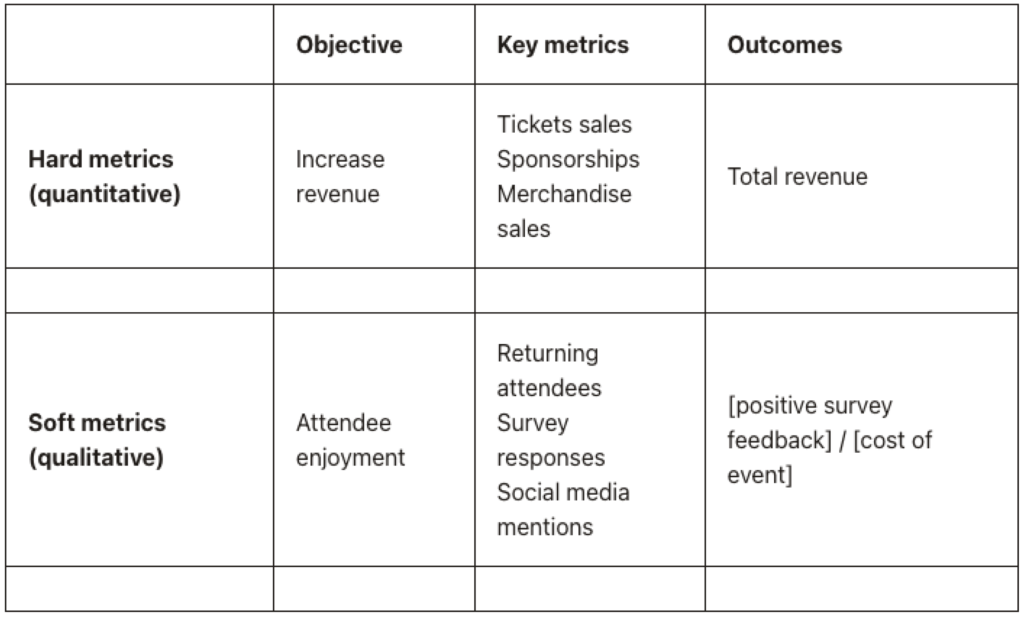
You can also use eventbrite’s ROI event template to look at hard metrics versus soft metrics:
B2B brands doing it right

Dreamforce by Salesforce
An experience that feel more like a festival for business minds, rather than a conference hall with slides and salespeople. Salesforce uses this event to deepen relationships and supercharge pipeline momentum.

Slush
An event where Startups meet investors in high-impact sessions designed for outcomes. The result? Billions in funding, thousands of meetings, and a reputation for being the launchpad where ideas get tractions, and deals get done.
The best strategies to improve event ROI quickly
Time-limited leaders can’t always manage a full process and reporting build, but these can be applied ahead of your next event.
Book meetings before the event opens. Think pre-event SDR outreach, such as personalised invites to priority accounts, targeted calls, and calendar-blocking before the floor opens. Pre-booked meetings have a higher qualification rate than walk-up conversations and ensure your team is spending time with the right people.
Score contacts before assigning follow-up. A badge scan is not a lead. Running contacts through a qualification framework before allocating SDR time means effort goes where it’s most likely to produce pipeline.
Follow up fast and with specificity. A message that references the conversation you had and proposes a clear next step will outperform a generic reconnect every time. SDRs should have event-specific messaging and a defined cadence ready before the event even kicks off.
Align sales and marketing on lead definition in advance. If marketing is measuring total contacts captured and sales is focused on meetings with decision-makers, the post-event debrief produces two different views of whether the event worked. One shared definition, agreed before you go, removes that friction.
Interrogate the format against the objective. A hosted roundtable with twelve well-targeted buyers often generates more pipeline than a trade show with thousands of attendees, at a fraction of the cost. Co-hosted events, partner webinars, and curated dinners tend to carry lower cost bases and higher qualification rates.
When durhamlane ran event SDR support for Domo and Manzeera’s webinar on ESG strategy, structured call cadences, automated email sequences, and prompt follow-up on warm prospects delivered 122 registrations against a target of 100 in ten weeks. The event performed because the process around it was taken as seriously as the event itself.
Source expert SDRs for your next event
If the gap in your current approach is the resource to execute pre- and post-event activity properly, durhamlane’s event sales support is built for that. Our SDR teams work alongside your marketing and sales function to book qualified meetings before events open, score and prioritise leads against a consistent framework, and run structured follow-up cadences in the 48–72 hours after (the period that makes the biggest difference to whether event spend converts to pipeline!)
To talk through event support, book a call with the team.