

Key Takeaways
- Sales outsourcing company lists can help with market orientation, but they do not show which provider model will create qualified commercial conversations.
- “Sales outsourcing company” is a broad label. Buyers should compare scope, qualification discipline, handoff, reporting, and fit before they compare vendor names.
- More calls, emails, leads, or booked meetings do not automatically create better pipeline. The key question is whether the provider protects sales time with better-qualified conversations.
- Outsourcing sales development works best when the buyer already has a clear ICP, proposition, sales ownership, and handoff process.

Searching for sales outsourcing companies usually produces lists, directories, “Top 10” posts, and provider pages. That is useful to a point, but it does not answer the harder question for B2B revenue teams: which type of support fits the sales problem behind the search?
Why provider model matters
The real buying decision is not simply which company sounds best. It is what kind of external help your pipeline actually needs. A provider may create more calls, emails, leads, or booked meetings, but if the work lacks qualification discipline, buyer context, and clean handoff, the problem has only moved downstream.
For that reason, this article uses a practical buying framework rather than a “best companies” ranking. Rankings can make the market look cleaner than it is. A framework helps you compare the kind of sales-development support you actually need.
Named provider lists can still help with early market orientation. They show the range of sales outsourcing companies a buyer might encounter, from lead generation and appointment-setting providers to larger outsourced sales, BPO, and technology-led models. But those lists are only useful once you know what kind of provider model you are actually comparing.
For complex B2B sales environments, a sales outsourcing company should be evaluated less like a vendor-list entry and more like a choice about support. The choice is whether to add external activity, external sales capacity, a lead generation supplier, an appointment-setting vendor, a full-cycle sales partner, an AI/tool-led workflow, or an SDR outsourcing function. Those options solve different problems.
The right partner depends on the sales problem you need to solve, the quality of your ICP, the maturity of your handoff process, the complexity of your buyers, and the level of judgement required before a conversation is passed to sales.
What sales outsourcing companies do – and why provider type matters
Sales outsourcing companies support some part of the sales process from outside the buyer’s organisation. That can include B2B prospecting, lead generation, appointment setting, SDR activity, new-market outreach, inbound lead conversion, and customer acquisition support. In some provider models, it can also cover a broader part of the sales cycle.
The category is broad, which is why it can be misleading. Salesforce’s overview of sales outsourcing shows how wide the label can be, from lead generation and customer acquisition through to wider sales operations support.
Different providers do different work
One provider may build lists and run campaigns. Others may book appointments, supply outsourced SDRs, or offer a managed sales-development team with coaching, reporting, qualification standards, and handoff discipline. Some are closer to a call-centre or BPO model. Others sell software or AI-supported outbound workflows rather than a human SDR function.
Treat “sales outsourcing companies” less as one market and more as a shelf of different provider models. Their websites may sound similar, but the work, incentives, management layer, and definition of success can be very different once the engagement starts.
The provider categories in this article are practical buyer-comparison buckets, not a formal industry taxonomy. Their purpose is to help you separate provider models before you start comparing individual vendors.
For a complex B2B team, the useful question is not “what is sales outsourcing?” in the abstract. It is “which part of our pipeline creation process is weak, and what kind of external partner can fix that without lowering opportunity quality?”
Provider type matters because each model carries different incentives. A lead generation agency may be useful when the buyer needs campaign reach or early-stage interest. An appointment-setting provider may be useful when the buyer has clear qualification rules and needs meetings booked against them. A managed SDR partner should be judged by whether it can create relevant conversations, qualify them properly, document context, and learn from sales feedback.
The same phrase, “sales outsourcing company,” can therefore describe very different levels of ownership. Before shortlisting vendors, define whether you need more activity, more capacity, more discipline, better qualification, better handoff, or a managed front-end sales-development function.
When outsourced sales activity fails to become usable pipeline
The easiest mistake in sales outsourcing is to buy visible activity and mistake it for commercial progress.
Activity is easy to report. Calls made, emails sent, contacts added, meetings booked, and dashboard charts can all look reassuring. But if the provider contacts the wrong accounts, runs shallow conversations, misses qualification, or hands over too little context, the activity does not become usable pipeline. You have paid for motion, but AEs may still need to clean up what lands in the pipeline.
Outsourcing tends to underperform when the provider focuses on activity rather than qualified commercial conversations and clean sales handoff. That risk is higher when the buyer has not defined what good-fit interest looks like before outreach starts.
A booked appointment can still be a poor-fit conversation. A prospect can accept a meeting without having urgency, authority, budget access, a relevant problem, realistic account value, or a clear next step. An AE can spend time in a meeting and still discover that the opportunity should never have been handed over.
Why qualification matters
This is why sales outsourcing needs qualification discipline. The work is not finished when a calendar slot is booked. It becomes commercially useful when the provider can explain why the conversation is worth sales time, what the buyer context is, what has been qualified, what remains unknown, and what should happen next. durhamlane’s Magic35 qualification framework is one example of how an SDR outsourcing partner can make that standard explicit before a conversation is handed to sales.
Broader outsourcing research makes the same governance point in a different language. Outsourced work performs better when the ways of working, oversight, and capability fit are clear. In sales development, that governance problem shows up as ICP clarity, SDR onboarding, qualification standards, call quality, reporting, handoff, and sales feedback.
The most common failure points are predictable. The ICP is too broad, SDR onboarding is too shallow, qualification criteria are vague, and scripts are generic. Reporting shows activity rather than opportunity quality, while sales feedback fails to change targeting, messaging, or handoff.
Complex B2B sales also requires judgement. Technology can support research, workflow, prioritisation, data quality, and documentation. AI can help trained teams prepare, organise information, and improve execution. But a signal is not qualification, and automation is not buyer understanding. The provider still needs human SDRs and managers who can interpret context, ask useful questions, qualify the conversation, and hand over something sales can trust.
The main types of sales outsourcing companies to compare
A provider-list article usually asks, “Which companies are best?” That can help a buyer build an initial shortlist, but it still leaves the harder question unanswered: “Which provider type fits the problem we are trying to solve?”
| Provider type | Best fit | Main risk | Questions to test before buying |
| Volume-led lead generation | Campaign reach, contact generation, demand capture, or early-stage interest. | Lead volume can move work downstream if the provider is not accountable for quality or handoff. | How do you decide whether a lead is worth sales time? |
| Appointment setting | Booking meetings against a clear ICP and agreed qualification rules. | The provider may optimise for calendar volume rather than sales-ready conversations. | What must be true before a meeting is handed to sales? |
| Outsourced SDR / managed sales development | Account research, outreach, initial conversation, qualification, reporting, and sales-ready handoff. | Weak management or loose qualification turns the model into activity outsourcing. | How are SDRs trained, coached, reviewed, and improved from sales feedback? |
| Full-cycle sales outsourcing | Situations where the buyer wants a partner to own more of the sales cycle beyond front-end development. | Scope confusion if the internal sales team still owns discovery, proposal, and closing. | Which stages do you own, and where exactly does handoff sit? |
| Call-centre or BPO-style support | High-volume, lower-complexity activity where speed and scale matter more than complex buyer judgement. | Volume becomes the operating model for complex B2B conversations. | How do you handle account intelligence, qualification, and buyer context? |
| AI/tool-led outbound | Research support, signal detection, prioritisation, workflow, documentation, and SDR productivity. | Autonomous activity is treated as a substitute for human qualification and buyer understanding. | Which tasks are technology-supported, and where do human SDRs or managers qualify, interpret, and hand off? |
How to use this comparison
Use this comparison to separate provider type, best-fit use case, main risk, and the questions to test before buying. Categories help satisfy provider-comparison intent without relying on unsupported named-provider rankings. The point is not to rank named vendors. It is to make the trade-offs visible before a shortlist is built.
Volume-led lead generation and appointment-setting providers
Lead generation agencies often support campaign activity, contact generation, demand capture, or early-stage interest. They may help build lists, run campaigns, create responses, or supply early-stage leads.
Appointment-setting providers focus more directly on booking meetings. That can be useful when the buyer has a clear ICP, strong qualification rules, and enough internal sales capacity to handle the next step.
The risk in both models is that the work can stop too early. A contact, form fill, campaign response, or booked meeting is not automatically a qualified opportunity. If the provider is not accountable for qualification, context, and handoff, the internal team may still have to do the hard commercial work after the “lead” or meeting arrives.
The key buying question is not only “how much activity can you create?” It is “how do you decide whether this conversation should reach sales?”
Outsourced SDR and managed sales-development partners
Outsourced SDR and sales development providers sit closer to the front end of the sales process. They may identify accounts, research buyers, run outreach, hold initial conversations, qualify interest, document context, and pass sales-ready opportunities to the internal team.
An SDR outsourcing partner should add structure around that capacity: SDR training, management, coaching, call review, qualification standards, reporting, feedback loops, and process improvement. This matters because SDR quality depends on coaching, call review, qualification standards, reporting, and feedback from sales.
For complex B2B teams, this model is often more relevant than simple lead generation or appointment setting because it focuses on the quality of the conversation before handoff.
Full-cycle, BPO and autonomous AI/tool-led providers
Some sales outsourcing companies support more of the sales cycle, including later-stage selling. This may fit some organisations, but buyers should still be clear on scope. If your internal team owns discovery, proposal, negotiation, and closing, you do not need a provider that implies broader sales ownership than you want to outsource.
Call-centre or BPO-style providers may be useful for high-volume, lower-complexity activity, but they are not automatically suited to complex B2B sales-development work. The risk is that volume becomes the main measure of success.
AI/tool-led outbound providers can support research, signal detection, prioritisation, workflow, and documentation. Some tools can make SDR work faster, cleaner, and more consistent. A different risk appears when providers present AI as a replacement for buyer conversations. A fully autonomous “AI SDR” can generate activity without understanding the market, proposition, account context, or handoff standard well enough for complex B2B sales.
In complex B2B, technology should support human SDR judgement rather than replace it. McKinsey’s B2B sales AI analysis makes a similar distinction: generative AI can support seller productivity and preparation, but trust-building, customer value creation, empathy, critical thinking, and complex problem-solving remain central to the seller’s role.
When outsourcing sales makes more sense than hiring in-house
Outsourcing sales development can make sense when the problem is not simply headcount, but timing, management capacity, market coverage, or conversion discipline.
A company may need to test a new market, territory, or vertical before committing to a permanent internal team. It may have inbound interest, event leads, or MQLs that are not being converted into useful sales conversations through inbound lead conversion. AEs may be spending too much time requalifying weak meetings. The business may need outbound capacity before hiring catches up. Or it may have no internal SDR management structure and does not want to build one from scratch.
In those cases, an external partner can help if the work is clearly scoped. The buyer still needs a defined ICP, a credible proposition, sales ownership, feedback from AEs, and agreement on what counts as qualified. Without those basics, outsourcing can amplify confusion.
Outsourcing is not the right fix when the underlying sales process is unclear. If the target market is undefined, the offer is not understood, sales cannot explain what good looks like, or no one owns follow-up, an outsourced provider may create activity without solving the real problem.
The decision should therefore be framed as build, buy, or hybrid. Build internally when you need long-term ownership and have management capacity. Outsource when you need specialist execution, faster coverage, managed SDR capability, or structured conversion of known demand. Use a hybrid model when internal sales owns the later-stage process and the external partner owns front-end development, qualification, and handoff.

How to evaluate sales outsourcing companies before you shortlist vendors
| Evaluation area | What to check | Why it matters | Ask before buying |
| Fit and scope | Market fit, buying-committee complexity, deal complexity, sales-cycle fit, and the exact service boundary. | “Sales outsourcing” is too broad unless ownership is operationally defined. | What do you own, what do you not own, and where does our team take over? |
| ICP and account intelligence | How the provider selects, researches, prioritises, and learns from target accounts. | Poor targeting wastes coverage and can lower opportunity quality before outreach starts. | How do you validate account fit before outreach begins? |
| Qualification criteria | The standard used before a lead or meeting reaches sales. | Qualification is the hinge between activity and usable pipeline. | What must be known before a conversation is passed to sales? |
| Handoff quality | The buyer context, account notes, unknowns, and next-step logic passed to the internal team. | A calendar invite without context forces AEs to requalify the work. | What exactly does sales receive before the meeting or next step? |
| SDR management and coaching | Training, call review, coaching, manager oversight, and improvement cadence. | SDR quality depends on coaching, call review, and manager oversight. | Who listens to calls, and how does coaching change execution? |
| Reporting and feedback loops | Measures beyond calls, emails, and meetings, plus how rejected meetings are analysed. | Activity reporting can hide poor-fit handoff and weak opportunity quality. | What do you report beyond activity, and how does sales feedback change targeting or messaging? |
| Technology and AI support | Which tools support research, data quality, workflow, preparation, reporting, and documentation. | Technology should improve SDR execution without replacing buyer judgement. | Which parts are AI- or technology-supported, and which require human qualification? |
| Commercial model and incentives | Whether the model rewards activity, booked meetings, accepted qualified opportunities, progression, or a balanced mix. | Incentives shape behaviour and can push a provider toward volume or quality. | What happens when sales rejects a meeting, and how are qualification disputes handled? |
Using the evaluation matrix
A useful evaluation matrix should focus on the areas that decide whether outsourced work becomes usable pipeline. That means fit and scope, qualification and handoff, management and reporting, and technology support.
These criteria are practical outsourcing governance controls, not nice-to-have questions. ICP clarity, qualification criteria, handoff process, reporting cadence, and feedback loops should be clear before a buyer signs.
Fit and scope
Start with the provider’s fit for your market. Ask what kinds of accounts, buying committees, deal complexity, and sales cycles they are used to supporting. A provider that works well for high-volume transactional activity may not be the right fit for complex B2B sales development.
Clarify exactly what the provider owns. Do they build lists, run outreach, book meetings, qualify conversations, support handoff, manage SDRs, provide reporting, or feed learning back into the sales process? “Sales outsourcing” is too broad as a service description. The scope needs to be operational.
Also test what they do not own. If the provider implies full-cycle responsibility but your internal team owns discovery and closing, that mismatch can create confusion. If the provider only owns early-stage activity, sales should not expect it to solve qualification or pipeline quality without clear rules.
Qualification and handoff
Qualification is the hinge between activity and pipeline. Ask how the provider defines a qualified conversation, what criteria a meeting must meet before handoff, how the team captures buyer context, and how they document unknowns.
A real handoff is not a calendar invite with a thin note. It should help sales understand why the account matters, who was reached, what was discussed, which problem or trigger came up, what the SDR qualified, what still needs discovery, and what next step makes sense.
This is where the Magic35 standard becomes most relevant in practice. The point is not to hand over a meeting because the buyer was polite, it is to apply a consistent qualification standard before sales receives the opportunity.
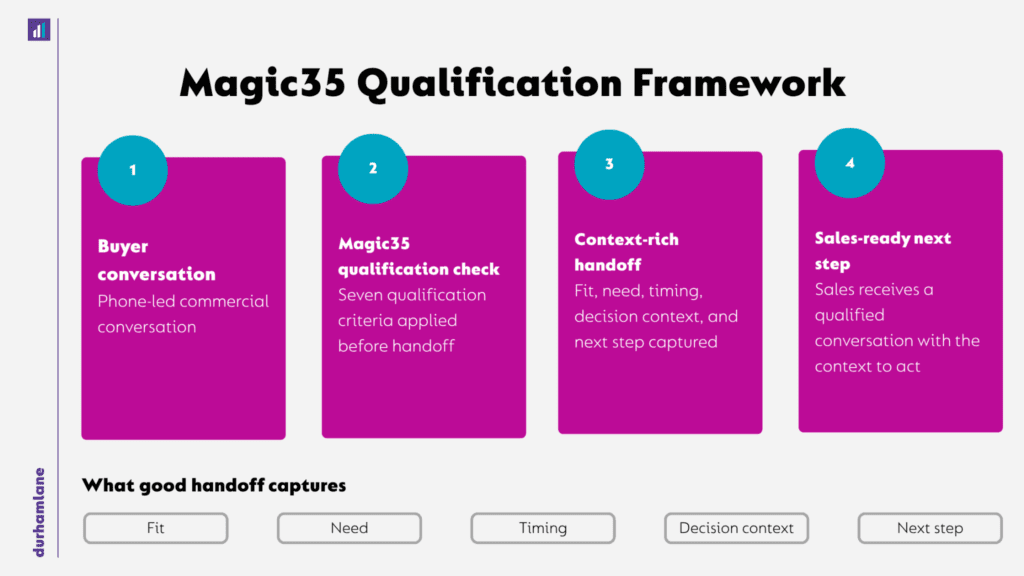
Poor handoff erodes trust. AEs begin to treat outsourced meetings as noise, and the revenue team loses confidence in the function. Good handoff makes the external team feel connected to the sales process rather than bolted onto it. It also protects AE time by filtering for customer fit, deal-size relevance, sales-cycle fit, retention potential, and whether the next conversation has enough commercial substance to deserve follow-up.
Management, reporting and technology
SDR quality depends on management. Ask how the provider trains, coaches, reviews, and improves SDRs. Also ask who listens to calls, how feedback works, how messaging changes, and how the team analyses rejected meetings.
Reporting should show more than activity. Calls, emails, and meetings matter, but they are not enough. The useful questions are whether the provider reaches the right accounts, whether conversations move toward qualified opportunities, whether sales accepts the handoff, and whether feedback improves execution..
Technology and AI should support that work. They can improve research, prioritisation, data quality, CRM workflow, preparation, reporting, and documentation.
Pricing, contracts and commercial model questions to ask
Pricing questions matter, but they should not push the buyer toward the cheapest visible activity.
Different commercial models reward different behaviour. A retainer may support a managed team and ongoing improvement. A commission or performance-linked model may create stronger outcome pressure, but it needs clear definitions and controls. Pay-per-meeting or pay-per-lead models may look simple, but they can encourage volume if quality standards are weak.
Pricing is easier to judge when you look at what the model incentivises. Read the model like a compensation plan because behaviour follows the incentive. Does it reward activity, booked meetings, accepted qualified opportunities, progression, or a mixture of inputs and outcomes? What happens when sales rejects a meeting? How are qualification disputes handled? What reporting is included? What happens to data, CRM notes, and handoff material? How quickly can targeting or messaging be changed when feedback shows a problem?
Do not judge the model only by cost. A cheaper provider that creates weak meetings can consume AE time, damage account trust, and fill the calendar with conversations that never had the right fit, value, urgency, or path to progression. A more structured provider should be evaluated by whether its model supports qualification, management, handoff, and learning.

What an SDR outsourcing partner should do differently
An SDR outsourcing partner should make front-end sales development more reliable, rather than just add more external activity.
That starts with account intelligence. The provider should understand which accounts matter, why they fit, who to reach, what signals or triggers are relevant, and what message is commercially credible. Preparation matters because complex B2B buyers rarely respond well to generic outreach.
The work then depends on human conversation. Phone-led sales development does not mean crude call volume. It means trained SDRs use live conversation to understand context, test relevance, ask questions, and decide whether the buyer’s situation is worth passing to sales. Email, LinkedIn, CRM workflow, data, and AI can support that motion, but they should not replace it.
Sales-ready handoff
The final step is sales-ready handoff. A useful handoff gives the sales team context, not just a booked meeting. It should explain why the account is relevant, what the buyer said, what the SDR qualified, what still needs discovery, and what next step makes sense.
That handoff should also help sales understand commercial quality. Is this the right kind of account? Is the problem large enough to matter? Does the likely deal profile fit the company’s revenue expectations? Does the buyer’s timing fit the sales cycle? Is there enough substance to protect AE time and justify a next conversation?
The partner should also learn from feedback. If sales rejects meetings, the provider should be able to analyse why. Was the ICP wrong? Did the qualification standard feel too loose? Was the message weak? Did the handoff feel incomplete? That feedback loop is what separates a managed function from outsourced activity.

How durhamlane fits this sales outsourcing decision
Once the buyer has separated provider types, evaluation criteria, and handoff risk, durhamlane becomes relevant for one specific model: SDR outsourcing support for complex B2B conversations. It should be considered when the buyer needs qualified opportunity creation, account intelligence, and context-rich handoff rather than generic lead volume.
durhamlane fits this decision when the buyer is not just looking for generic sales activity, but for SDR outsourcing support for complex B2B environments.
The relevant use cases include outbound sales development, customer acquisition, event follow-up, MQL or inbound lead conversion, new-market outreach, and situations where internal sales teams need better-qualified conversations before AEs spend time on discovery.
durhamlane’s fit is strongest where the buyer needs account intelligence, phone-led human outreach, qualification discipline, reporting, feedback, and sales-ready handoff. That makes it different from a provider whose main value is raw lead volume, cheap outsourced labour, or booked meetings without enough context.
Where durhamlane fits best
durhamlane is most relevant when the buyer already has a clear market, proposition, and sales process, but needs help turning target accounts or existing interest into qualified conversations. That may mean supporting a campaign, following up event leads, converting MQLs, opening a new vertical, improving outbound coverage, or adding managed SDR capacity without building the whole function internally.
The important point is that durhamlane should be evaluated as an SDR outsourcing partner, not as a generic “sales outsourcing company” in the broadest possible sense.
What durhamlane is not
durhamlane should not be confused with a pay-per-lead vendor, call centre, cheap BPO supplier, standalone AI SDR tool, generic lead generation agency, or full-cycle sales partner. It is also not a shortcut around unclear sales ownership, weak proposition, or poor follow-up.
durhamlane uses AI and technology to support trained SDRs, managers, research, preparation, workflow, role-play, reporting, and execution discipline. That is different from buying a fully autonomous AI SDR replacement and asking it to create qualified pipeline without human judgement.
Buyers should ask whether they need SDR outsourcing support that creates qualified commercial conversations and gives sales enough context to act.

FAQs
What do sales outsourcing companies do?
Sales outsourcing companies support part of the sales process from outside the buyer’s organisation. That can include lead generation, appointment setting, SDR activity, market-entry outreach, inbound lead follow-up, or broader sales support, depending on the provider model and scope.
Are sales outsourcing companies the same as lead generation agencies?
Not always. Lead generation agencies often focus on creating early-stage interest, contacts, or leads. Some sales outsourcing companies go further by providing SDR capacity, qualification, handoff, reporting, and managed sales-development support. The distinction matters because lead volume is not the same as sales-ready opportunity.
What is the difference between appointment setting and managed sales development?
Appointment setting focuses on booking meetings. SDR outsourcing focuses on the process around those meetings: account research, outreach, qualification, SDR management, handoff quality, reporting, and feedback. The difference is whether the provider is measured mainly by calendar volume or by sales-useful conversations.
Should you outsource SDRs or hire in-house?
Hire in-house when you need long-term ownership and have the management capacity to train, coach, and improve SDRs. Outsource when you need external capacity, specialist execution, market coverage, or a managed SDR function. Many B2B teams use a hybrid model where internal sales owns later-stage selling and the partner owns front-end development.
How should you evaluate a sales outsourcing company?
Evaluate fit, scope, qualification criteria, handoff quality, SDR management, reporting, technology support, and feedback loops. Ask what the provider owns, what it does not own, how it defines a qualified opportunity, and how sales feedback changes execution.
How much do sales outsourcing companies cost?
Cost depends on scope, team structure, market, geography, service model, management depth, contract terms, and qualification expectations. Instead of comparing price alone, ask what the model incentivises and whether it supports quality, handoff, and learning rather than only activity volume.
Can AI replace outsourced SDRs?
AI can support SDR research, prioritisation, preparation, workflow, reporting, coaching, role-play, and documentation. It should not replace human judgement in complex B2B sales development. A signal, enrichment record, or automated workflow is not the same as a qualified buyer conversation.
Conclusion
Choosing between sales outsourcing companies is not mainly a search for the longest provider list. It is a decision about where your pipeline process needs support and what kind of partner can improve it without lowering opportunity quality.
Many providers can sell more activity. The narrower question is whether you need an SDR outsourcing function that protects sales time, qualifies the conversation properly, and hands over enough context for the next step to be useful.
If your team needs more than activity, including account intelligence, phone-led outreach, qualification, reporting, feedback, and sales-ready handoff, the useful next step is to assess whether an SDR outsourcing partner is the right fit for the problem you are trying to solve.