


Key takeaways
- The true cost of an in-house SDR is higher than you think and includes hidden expenses like management time and tech licenses.
- Traditional, script-based BPOs often create a “double charge” for your business because your expensive account executives have to waste hours re-qualifying the poor leads they’re sent.
- Managed SDR models eliminate the “tech integration tax” by turning complex software stacks into a predictable, monthly operating expense (OpEx).
- A strategic partner like durhamlane can cut the time it takes to generate your first qualified meeting from the 45-day industry average down to just 20-22 days.
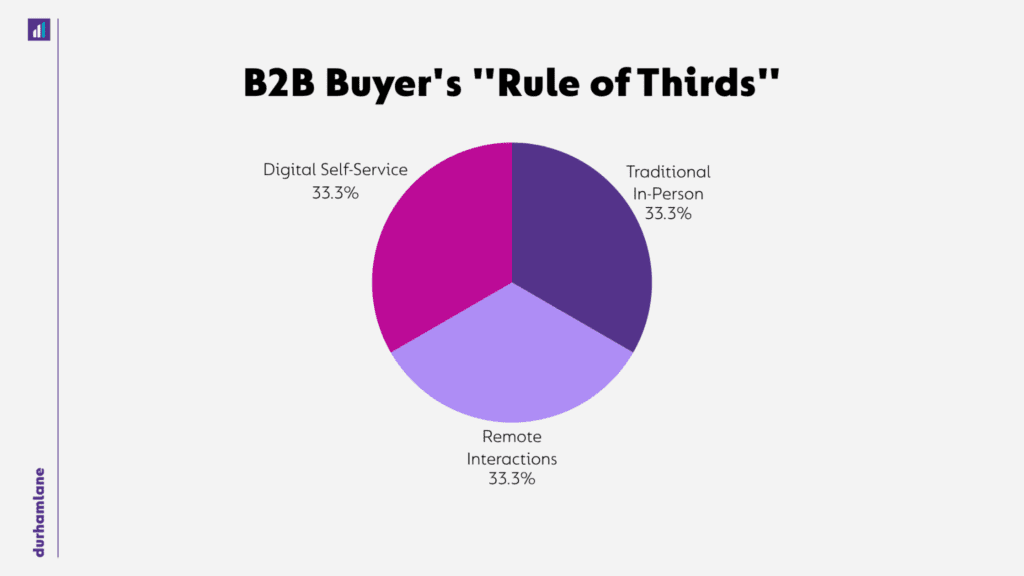
The way businesses buy from each other has fundamentally changed. These days, B2B purchasing committees average 6 to 10 decision-makers, which has naturally made sales cycles much longer than they used to be. According to McKinsey’s “rule of thirds,” modern buyers want to split their journey evenly across:
- Traditional in-person interactions
- Remote interactions
- Digital self-service channels
To survive in this complex market, sales outsourcing has had to grow up.
It’s evolved from cheap, script-based call centres into highly strategic revenue architectures. If you don’t want your company to fall behind, you have to invest intelligently.
The hidden mathematics of in-house vs. outsourced sales
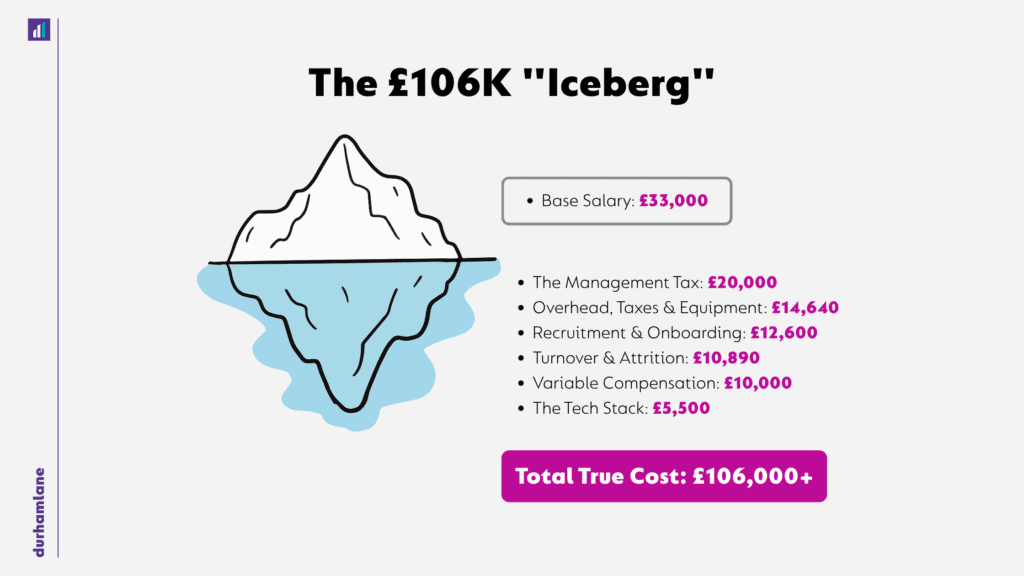
When most leaders think about building an outbound engine, they fall into a financial trap. They assume a £33,000 base salary covers the cost of an internal SDR. It’s a dangerous illusion because an SDR is actually one of the most resource-heavy employees in your entire company.
When you calculate the true cost of ownership, the real price to field a single in-house SDR includes:
- The management “tax” (£20,000): This is the cost of your senior leaders spending their time coaching and auditing junior reps instead of focusing on big-picture strategy.
- Recruitment and onboarding (£12,600): This combines the fees to find the talent and the initial training to get them up to speed.
- Turnover and attrition (£10,890): This is the financial penalty you pay when reps leave right as they’re finally becoming productive.
- The tech stack (£5,500): These are the mandatory licenses for your CRM, data intelligence, and conversation analytics.
- Overhead, taxes, and equipment (£14,640): This includes everything from national insurance and pensions to office space and laptops.
And that’s assuming you have the essentials, without too many extras and nice-to-have additions on the tech stack.
You’re looking at over £106,000 per rep, per year in total. Traditionalists say this builds your company’s intellectual property, but the reality is much harsher: Industry benchmarks show that 76% of companies fail to hit their quotas simply because of poor software adoption. Paying for expensive enterprise licenses that just gather dust is just sinking money into a pit.
Quota risk and the turnover penalty
Investing in a new hire is ultimately a coin toss. Data from the School of SDR shows that 61.3% of SDR teams are falling below 70% quota attainment. If your internal rep fails or decides to resign, your entire initial investment is wiped out.
The bleeding doesn’t stop there. Replacing a failed B2B sales rep costs over $100,000 per employee when you factor in lost pipeline and recruitment, according to Maestro. By outsourcing, you transfer this massive financial risk off your books and onto the agency.

The time-to-impact trade-off
Time is the most expensive asset you have. It takes roughly three months for a new internal SDR to just finish their ramp-up phase. On top of that, complex enterprise sales cycles usually take 9 to 18 months to close. If you start building an internal team today, you’ll lose a huge chunk of the fiscal year before you ever see a return on your money.
Many companies believe they need prolonged internal immersion to sell technical SaaS or complex products, but that myth costs millions in lost opportunities. Waiting nine months to see an actionable pipeline is an unacceptable risk.
A strategic partner like durhamlane changes this timeline by using pre-trained talent and established methodologies. They can bypass the learning curve and generate a real commercial impact in just 30 to 60 days.

Average costs by service type
| Metric | The “Do-it-yourself” in-house model | Fully managed outsourcing |
| Cost to ramp | £106,000+ massive up-front capital expenditure per rep | Fixed, scalable monthly operational subscription |
| Time to impact | 6 to 9 months lost to recruitment, training, and pipeline building | 30 to 60 days utilising pre-trained, sector-aligned talent |
| Technology risk | High tech bloat. 76% miss quota due to poor software adoption, turning CRMs into dead repositories | Zero tech headaches. You inherit a fully utilised, pre-optimised enterprise tech stack |
| Quality & conversion | The activity trap. Reps rely on random dialling, yielding the standard 3%–7% industry connection average | Intent-led targeting. Filtering out mere interest boosts connection rates to 20%–30% |
The software trap
The B2B sales landscape has shifted, and the complexity of the modern buyer is now the biggest hurdle for growing teams. According to Forrester, today’s buyers have more digital tools and options than ever before, which significantly stretches the length of your sales cycle. You can’t just give a rep a phone and a basic CRM and expect them to win in this environment.
To keep up, a modern sales team needs a well-honed ecosystem of specialised software, including AI conversation analytics and intent data signals. The tech stack burden and the “integration tax” start with a base cost of roughly £5,500 per representative. However, the real drain is the time and money spent on RevOps personnel just to make sure these different systems actually talk to each other.
When you throw expensive software at an internal team, you often run into the seller-administrator paradox. Gartner reports that 49% of sellers feel overwhelmed by the number of tools they’re forced to use. That overload in turn makes reps 43% less likely to hit their sales quotas.
By forcing your SDRs to manage complex software, you’re accidentally turning your sales team into highly paid system administrators. A fully managed solution removes this friction by rolling the entire cost of the technology into a predictable monthly fee. You’re no longer stuck with idle licenses or inflexible annual contracts; you instead pay for results.
A premium agency ensures you inherit a data architecture that’s already optimised, which lets you bypass the learning curve entirely. You’re choosing methodology over mechanics by using a proven framework to turn digital noise into real human conversations. This strategic alignment ensures your technology supports your revenue goals rather than getting in the way of them.

Which pricing model is right for your business?
There isn’t a single correct way to scale your revenue. The right choice depends on how complex your market is, how much capital you have, and your risk tolerance. When you’re looking at outbound operations, you’ll generally choose between three distinct setups.
1. Building in-house (the control & CapEx model)
Think of this like building your own custom car from scratch because you want to choose the exact shade of thread for the seat stitching. It’s rewarding to see it finished, but you’re the one paying for the garage, the specialised tools, and the months of labor before it even leaves the driveway.
- Best suited for: This is usually for companies that have a lot of financial runway, established RevOps teams, and a desire for total, micro-level control.
- The trade-off: While you get total transparency, you also absorb 100% of the up-front capital expenditure. You take on the full weight of base salaries, recruitment fees, and the software “integration tax.”
You also have to plan for a six- to nine-month lag before new hires are fully productive, making this the slowest path to market.
2. Traditional staffing/BPO (the high-volume model)
This is the megaphone approach to sales. You pay someone to stand on a corner and shout your name. It’s cheap and loud, but it’s not going to convince a busy executive to stop and have a meaningful conversation about their business strategy.
- Best suited for: This option works best for transactional sales with short cycles where volume matters more than deep industry expertise.
- The trade-off: The model relies on low-cost, script-based execution. It often leads to generic “spray and pray” outreach that can actually fatigue your total addressable market (TAM).
BPOs also usually work in a vacuum. They act like an isolated vendor rather than a true partner. You pay for activity but don’t get any frontline market intelligence back. That creates a disconnected journey for your buyers and leaves your marketing team without a feedback loop.
3. Managed SDR service (the strategic revenue architecture)
Imagine hiring a professional racing team that shows up with the car, the pit crew, and the driver already trained. They’re part of your brand, but you didn’t have to build the engine or hire the mechanics. You just focus on the finish line.
A managed SDR partner works as a transparent extension of your own team. It establishes a continuous feedback loop where frontline intelligence like buyer objections and competitor mentions is shared with your marketing department in real time.
- Best suited for: This is the ideal fit for mid-market and enterprise organisations that need to scale complex B2B sales quickly. It’s perfect for leaders who don’t want to inflate their internal headcount or risk their brand reputation.
- The value proposition: You get to deploy a pre-built enterprise tech stack and use intent-led targeting to boost connection rates to 20%–30%. By using strict qualification frameworks, the team acts as a shield. This ensures your AEs spend zero time on “tyre kickers” and 100% of their time closing real commercial opportunities. This type of omni-channel orchestration is exactly what the modern market demands.
The ROI of each model
1. Building in-house
The fully loaded expense of an internal SDR goes far beyond their base salary. When you factor in recruitment fees, enterprise software licenses, taxes, and management overhead, you’re looking at a massive upfront capital expenditure.
The biggest financial drain for an in-house model is time. You’re essentially subsidising a long ramp-up period where the company sees zero return on its investment. Forbes reports the average cost to replace a single B2B salesperson is over $97,000, and that’s compounded by a 3.7-month delay just to find a replacement.
On average, it takes an internal hire 45 days to generate their first qualified meeting, which means you pay full price during a prolonged trial-and-error phase.
2. Traditional BPO
Traditional BPOs look incredibly cost-effective on paper. Hourly rates in offshore segments usually range between $8 and $15, which averages out to about $110 per rep per day. This produces an attractive monthly baseline of roughly $2,439.
That structure creates a dangerous false economy, though. Because these agents rely on strict scripts rather than deep qualification, the financial impact is brutal, with 67% of lost sales opportunities stemming directly from reps qualifying leads incorrectly. Without a rigorous qualification framework, win rates collapse, making those “cheap” leads incredibly expensive in the long run.
This model prioritises vanity activity over sustainable margins. It’s the equivalent of buying a generic, low-cost multi-tool; it’s cheap and has a lot of gadgets, but when you actually need to fix a complex problem, the blade is dull, and the pliers break. You saved money at the checkout, but you’re still stuck with a broken machine and a lot of wasted time.
3. Managed SDR service
For a predictable operating expense that typically ranges between £8,600 and £13,000 per month, a managed partner absorbs the entire burden of recruitment, tech licensing, and management.
This model fundamentally changes your timeline. By deploying pre-trained specialists and proven playbooks, the time required to generate your first deeply qualified meeting is slashed from the industry’s 45-day average to 20-22. You get to bypass the setup lag and enter the market immediately.
The focus is on pipeline acceleration and strict qualification, so a managed approach works as a revenue multiplier rather than a cost center. In practice, this model allowed Sodexo to generate over £11 million in closed-won revenue, proving that strategic alignment delivers returns that volume-based models can’t match.

7 Financial leaks that kill outsourced programs
Even if you choose the right model, execution is everything. When outsourced programs fail, it’s rarely because of a lack of activity. It’s usually a structural leak of capital. Here are seven critical errors that destroy your campaign’s ROI.
1. Rushing the launch
Launching outreach without a rigorously defined ICP just to start fast is a recipe for disaster. Your team must have absolute clarity on qualification criteria from the first day. If you don’t agree on what makes a conversation worthwhile, you’ll burn through your budget on the wrong targets. This breaks trust between teams and plummets the quality of your handoffs.
Think of this like opening a new restaurant and inviting the whole city before you’ve even finalised the menu or trained the chefs. You might get a crowd on opening night, but they’re not coming back, and they’re definitely telling their friends to stay away.
2. Subjective qualification
Failing to implement a predictable, data-driven methodology to qualify leads will ruin your forecasting. When a program operates on gut feeling rather than a proven framework, your pipeline gets bloated with false opportunities. This makes it impossible to measure your true ROI.
3. Paying for vanity metrics
Paying a partner based purely on booked appointments rather than a qualified pipeline is a dangerous trap. This structure rewards volume over intent. You’ll end up with a calendar full of meetings that’ll never close, which is a mathematically guaranteed negative ROI.
4. The handoff gap
Poor qualification forces your expensive AEs into a screening role. You’re essentially paying twice for the same prospect: once to the agency for the lead, and again for your best employee’s wasted time. That’s a massive drain on your resources.
5. Burning the TAM
Relying on script-based, high-volume tactics will alienate your total addressable market (TAM). Once you damage your brand equity, your internal marketing team has to spend exponentially more in the future just to win back market trust.
6. The micro-management tax
If your revenue leader is spending hours every week auditing calls or rewriting messages, the program isn’t truly managed. You have to add your executive’s high hourly rate to the agency’s final invoice to see the real cost. A true partner should lift this burden, not add to it.
7. Redundant tech spend
Engaging a vendor that requires you to buy extra CRM seats or software licenses is a hidden cost. This turns a predictable OpEx into a hidden capital expenditure (CapEx). You should inherit a pre-optimised tech stack rather than a new bill.

When comparing gains against expenses, outsourcing comes out on top
Every day you wait to fix your outbound engine is a day you’re losing market share. If your current setup takes more than 30 days to generate a genuinely qualified pipeline, you’re actively bleeding capital. To scale sustainably in today’s complex B2B world, you have to demand more. You need a model that provides both a complete enterprise tech stack and a data-driven methodology to guarantee a positive ROI.
Choosing the right option for your sales outreach isn’t just about comparing the price tags on invoices. It’s about understanding the hidden costs of management, the risk of turnover, and the high price of cheap leads that never close. Whether you’re building in-house, using a high-volume BPO, or partnering with a managed service, your goal is predictable, sustainable revenue.
At durhamlane, we provide the enterprise-grade tech stack and the data-driven methodologies needed to ensure you’re getting a real return on your investment from day one. If you’re ready to stop guessing and start growing, book a call with our team today to see how we can accelerate your time-to-revenue.

FAQs
How much does it cost to outsource sales?
A managed partner typically charges between £8,600 and £13,000 per month. This fee isn’t just for a body in a seat, though. It includes recruitment, management, and a pre-optimised tech stack. The final price usually shifts based on how complex your market is or the specific requirements of your campaign.
What is the average cost of outsourcing?
Offshore BPOs frequently cost an average of $110 per rep per day, which yields a monthly baseline of almost $2,500. However, that often hides a “false economy” where low-quality outreach fatigues your market and forces your expensive closers to do the agency’s work.
What is the BPO pricing model?
Most BPOs charge an hourly rate for offshore segments, commonly offering FTE-based (per employee), transactional (per lead), or performance-based rates. They focus on volume and script-based execution rather than deep industry expertise. The aim is to align the provider’s incentives with a client’s ROI goals to avoid excessive overhead.
How do I calculate outsourcing costs?
Many agencies offer a cost calculator to simplify estimating. To do it yourself, you need to calculate the total cost of engagement, which comprises expenses for setup, fixed fees multiplied by 12 months, and variable commissions according to volume. Account for “soft” costs as well like management time, CRM integration, and the productivity ramp-up time. Compare these figures against internal expenses, including benefits, taxes, and recruitment, to determine the true ROI and cost per acquisition versus maintaining an in-house team.