



Key takeaways
- Treat B2B sales strategy as a commercial decision model. Leadership has to choose which accounts are worth pursuing, which accounts should be left alone and what route to market fits the buying reality before scripts, cadences or tools can do useful work.
- Make the trade-offs visible. A strategy should clarify target market, ICP, account mix, sales motion, qualification standard, capacity, metrics and review rhythm so sales, marketing and RevOps work from the same commercial logic.
- Activity only matters when it turns into qualified pipeline. Meetings, MQLs, outbound touches and CRM movement need to reach the right accounts, support proper qualification and give sales enough context to act.
- Match the strategy to the segment. SMB, mid-market and enterprise motions require different levels of selectivity, proof, account intelligence, stakeholder coverage and sales-cycle patience.
- Keep strategic ownership inside the business and pressure-test execution capacity. An SDR outsourcing partner becomes relevant when the chosen strategy exposes gaps in account coverage, inbound follow-up, qualification discipline, SDR capacity or sales-ready handoff.
Many B2B teams are not short of motion. Campaigns are live. Accounts are sitting in the CRM. Salespeople are prospecting, SDRs are chasing follow-up, events are producing conversations, and the tool stack is logging it all. The uncomfortable part is that the pipeline still does not convert reliably into qualified opportunities.
The effort is there. What is missing is the commercial logic that tells the team where that work should go, which accounts deserve it, and what has to be true before the opportunity is worth sales time.
A B2B sales strategy has to make those decisions before the team starts arguing about scripts, cadences or tools. Which customers are worth pursuing? Which accounts should be ignored? What mix of deal sizes can support the revenue target? How do those buyers decide? What sales motion fits the economics and buying process? What should count as qualified before sales accepts the opportunity?
That is where strategy separates itself from organised activity. Harvard Business Review’s “What Is Strategy?” is useful context for this distinction between strategy and operational effectiveness. Doing more, or doing it more efficiently, does not replace the need for a clear position and deliberate commercial choices. In B2B sales, the same logic applies. Cadences, scripts, events, outreach tools and qualification methods only become useful when they serve decisions the business has already made about market focus, revenue shape, account quality and sales capacity.
The rest of the article stays at that strategic level. It defines what a B2B sales strategy should settle, where B2B differs from B2C, how the choices change across SMB, mid-market and enterprise, what belongs in the strategy document, and how to tell whether the plan can actually be executed.
What is a B2B sales strategy?
At its simplest, a B2B sales strategy is the commercial decision model behind the sales effort. It defines which business customers the company is choosing to pursue, why those accounts are worth the effort, how they are likely to buy, what sales motion fits that buying reality, what qualifies an opportunity, and what capacity is needed to turn sales and marketing activity into qualified pipeline.
It sits above the execution assets. Tactics describe actions, playbooks make repeatable work explicit, funnels show movement through buying stages, and sales process sets the workflow. Strategy gives those layers their commercial direction.
A company can have a detailed B2B sales playbook, visible CRM stages and plenty of recorded activity without having made the harder strategic choices. The test is whether the strategy creates selectivity. Where the team focuses, where it stops spending effort, what a good opportunity looks like, and what execution model the business can actually support.
Why B2B sales strategy is different in practice
The B2C comparison only needs to go so far. B2B sales strategy has to account for account fit, multiple stakeholders, longer consideration, internal buying risk and the handoff between marketing, sales development and sales.
That means a B2B strategy cannot be judged by activity volume alone. It has to decide which accounts are worth pursuing, what makes a buyer qualified, what evidence should trigger follow-up, who owns the next step and how sales-ready opportunities are passed on without losing context.
The point is simple. If the ICP is vague, qualification is weak, or the marketing-to-sales handoff is unclear, more outreach will not fix the strategy. It will just make the wrong motion happen faster.

The commercial choices a B2B sales strategy has to settle
A B2B sales strategy becomes useful when it forces leadership to choose. It makes some markets, segments, channels and account types more important than others, and gives the team permission to stop treating every possible source of revenue as equal.
The choices compound. Target market shapes account mix. Account mix shapes the sales motion. The sales motion shapes qualification. Qualification shapes handoff, and handoff shapes the capacity sales needs. Metrics and review rhythm then determine whether the strategy can learn from execution or harden into a static document.
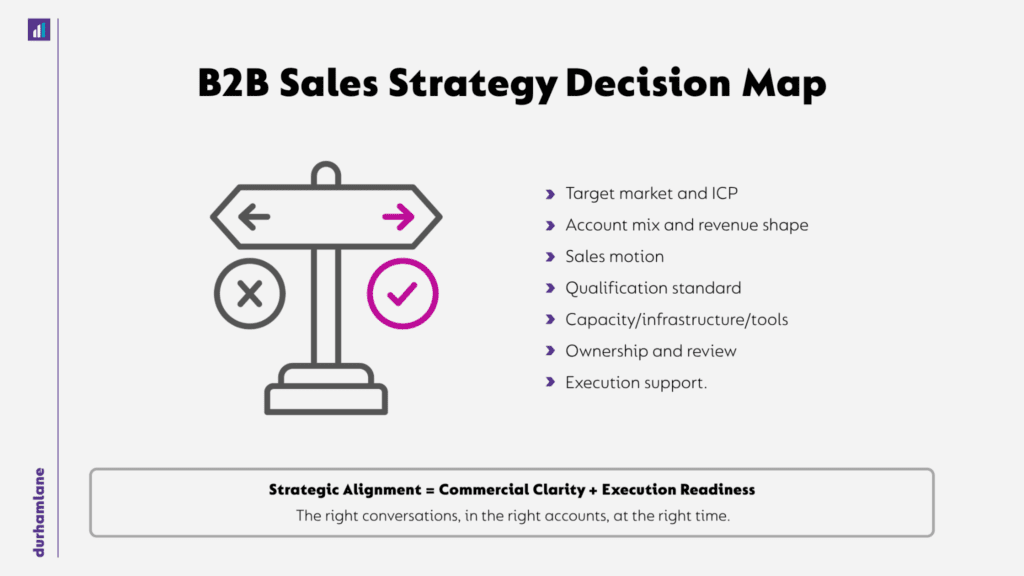
Target market and ICP
The first strategic choice is who the business is actually set up to pursue.
The target market sets the broad commercial territory. That may include industry, company size, geography, maturity level, operating model or use cases where the business has a credible reason to win. The ICP sharpens that picture by identifying the account characteristics, buyer roles, pain patterns, trigger events and fit signals that tell the team which accounts deserve attention.
A loose ICP creates problems downstream. Marketing can generate interest from accounts that sales was never likely to convert. SDRs can spend time on companies that look active but have little commercial fit. Sellers can end up accepting meetings without enough evidence of need, timing or stakeholder relevance.
A good ICP is a commercial filter. It should shape prioritisation, messaging, qualification, campaign design, outbound targeting and sales-ready handoff. The real test is whether it changes decisions in the day-to-day work. A vague ICP leaves those decisions almost exactly where they were.
Account mix and revenue shape
A revenue target only tells the business what it wants to reach. It still has to decide which kinds of accounts can realistically get it there.
That is the work of account mix. The business may need a handful of larger accounts, a higher volume of smaller accounts, or a portfolio that deliberately blends the two. Each route puts different pressure on the sales system.
Larger-account strategies usually ask more from the system. Deeper account intelligence, more patience, stronger proof, broader stakeholder coverage and tighter qualification. Smaller-account strategies tend to need sharper fit criteria, clearer prioritisation and lower process overhead. A blended strategy has to be explicit about which motion belongs to which account tier.
The right account mix depends on the company’s offer, market position, delivery capacity, price point, buying process and target customer health. Before channels, scripts or outreach sequences enter the conversation, leadership needs a clear view of the account economics behind the revenue target.

Sales motion and channel logic
Sales motion is the route the business uses to create, progress and convert opportunities. For one company, that may mean inbound demand. For another, proactive outbound, account-based development, event-led acquisition, partner-supported selling, customer expansion or a deliberate hybrid model.
The motion has to earn its place from the account strategy. A company chasing named enterprise accounts will need a different route to market from one converting steady inbound demand or expanding existing customers. McKinsey’s work on B2B growth is useful context here because it connects growth to coordinated channels, data, customer insight and selling motion working as one commercial system.
The execution problem changes with the motion. Clear inbound demand may put more pressure on qualification and sales-ready handoff than on additional top-of-funnel activity. Named-account strategy usually asks for deeper account research, sharper messaging and consistent coverage. Event-led acquisition often depends on what happens after the room clears. Timely follow-up, preserved context and post-event qualification.
The strategy should define why a motion fits the target account, deal economics, buying process and internal capacity. A channel list only becomes useful once that commercial logic is clear.
Qualification and sales-ready handoff
Qualification is where strategy protects sales time.
Without a shared view of lead qualification, sales can receive activity with too little opportunity context. Marketing may see movement, SDRs may see engagement, and sales may see a conversation that is too early, too thin or too far from the ICP. Pipeline language inflates while the handoff itself stays weak.
A strategic qualification standard should make the evidence visible. Fit, need, timing, stakeholder context, commercial relevance, next-step clarity and the reason the account matters now all help determine whether the opportunity deserves sales attention. The threshold can change by segment and motion, but sales still needs a qualified conversation with enough context to act.
The handoff should carry the commercial context forward. Sales needs to know why the account fits, what problem has surfaced, who is involved, what has already been discussed and what the next conversation needs to achieve.
Value proposition and buyer-relevant messaging
A B2B sales strategy also has to settle the commercial argument the team takes to market.
That argument has to do more than decorate the website. It should explain why the chosen buyer should care, why the problem matters now, why the company’s approach is credible, and what kind of business outcome or operational improvement the buyer is trying to reach.
The message also has to match the buying context. An SMB buyer may need clarity and fit. A mid-market buyer may need stronger proof that the offer applies to their operating reality. An enterprise buyer may need risk reduction, stakeholder-specific relevance and confidence that the business can support implementation.
Messaging weakens when it drifts away from ICP and account economics. Generic claims about growth, efficiency or transformation rarely help a seller understand why this account, why this buyer and why now. The message has to give the team a commercial reason to pursue the conversation.
Capacity, infrastructure and tools
Even a strong market choice can break down when the execution system cannot support it.
Capacity has to be measured against the work. A team may have enough people on paper and still lack the management attention, research time, calling time, follow-up discipline and qualification judgement the motion actually requires. A simple inbound follow-up motion, a targeted outbound motion and a named-account enterprise motion all place different demands on the same team.
To make capacity practical, the strategy should include a basic capacity model rather than a generic headcount line. Start with the reporting shape: who owns the motion, who manages SDRs or sellers day to day, who reviews call quality, who inspects qualification evidence, who approves handoff and who feeds market signals back into marketing or RevOps.
A small team may run through one commercial or sales leader. As the team grows across more reps, motions or segments, one leader may no longer be able to coach conversations, inspect CRM quality, maintain follow-up discipline and protect sales-ready handoff at the same level. The strategy then has to show whether the business needs a dedicated SDR manager, team lead, RevOps support or external sales development support.
Rep capacity needs the same treatment. The strategy should state the expected active-account load per rep, research depth before outreach, call and follow-up expectation, CRM capture requirement, qualification standard and handoff evidence. A rep working a narrow inbound follow-up motion can usually carry a different workload from a rep expected to research named enterprise accounts, build stakeholder context and preserve a longer account narrative.
The capacity question is whether the current team can cover the priority account universe at the quality standard the motion requires.
If the plan requires more coverage, faster follow-up or tighter qualification than the current team can deliver, leadership has to change the model. That may mean narrowing the ICP or account universe, adding internal SDR or management capacity, strengthening RevOps or marketing support, or using an SDR outsourcing partner for the execution layer.
An SDR outsourcing partner becomes relevant when the strategy is clear, but the internal team is struggling to create enough qualified conversations, maintain follow-up discipline or hand sales-ready context over properly.
Infrastructure is the part that makes the strategy visible in daily work. The team needs usable data, CRM discipline, account intelligence, workflow visibility, reporting and clear ownership. Without that, tools can make the system look mature while the underlying process stays unclear.
Technology and AI belong in support of the strategy. They can help with research, preparation, role-play, coaching, data quality, workflow, reporting and execution discipline. The judgement still sits with human SDRs, sellers and managers who interpret context, read nuance and decide whether an opportunity is genuinely worth sales attention.
Metrics and review rhythm
A B2B sales strategy needs a way to show whether the chosen motion is working. Activity is easy to count. The harder question is whether the right accounts are being reached, qualified properly and handed to sales with enough context to do something useful.
Activity still matters, but it is only an input signal. The real test is whether that activity is producing qualified conversations, creating accepted handoffs, moving viable opportunities and surfacing feedback that should change the strategy.
The review rhythm depends on the sales cycle, campaign pace and motion complexity. A fast inbound or event-led motion may need tighter daily and weekly inspection. A longer enterprise or account-based motion may need more emphasis on weekly, monthly and quarterly pattern review. A good review rhythm gives each layer of the team a clear job. Managers inspect execution quality. Marketing and RevOps check fit, follow-up and data quality. Leadership looks for patterns that should change the account mix, qualification standard or resourcing model.
| Review level | What to review | Likely rhythm | If this looks weak |
| SDR / sales execution | Priority-account activity, follow-up completion, conversation outcomes, qualification evidence and next-step clarity | Daily or weekly, depending on motion pace | Reprioritise accounts, tighten follow-up ownership or coach conversation quality |
| SDR / sales management | Qualified conversations, accepted and rejected handoffs, account coverage, opportunity context and capacity pressure | Weekly, with tighter checks during live campaigns or events | Refine qualification, adjust coverage, improve handoff discipline or remove poor-fit segments |
| Marketing / RevOps | Source quality, enquiry fit, campaign response, follow-up conversion, CRM completeness and data quality | Weekly or monthly, depending on campaign pace and motion complexity | Tighten ICP targeting, improve feedback loops, clean data or fix reporting gaps |
| Commercial leadership | Pipeline quality, account mix, customer fit, stage movement, sales-cycle pressure and capacity assumptions | Monthly or quarterly, and when core assumptions change | Change segment focus, stop low-fit activity, revisit account mix or strengthen the sales development layer |
A short-cycle inbound push, an event follow-up motion and a longer enterprise pursuit should not be reviewed in the same way. Review only matters if it changes decisions about which accounts to prioritise, which handoffs to accept, which motions to continue, which assumptions to test and which activity to stop.

How B2B sales strategy changes across SMB, mid-market and enterprise
Segment choice changes the shape of the strategy. SMB, mid-market and enterprise motions place different demands on account economics, buying pattern, account coverage, proof, qualification threshold and sales-cycle patience.
Each segment can be commercially valid when it fits the company’s offer, revenue target, proof base, capacity and appetite for complexity. The strategic question is which segment the business is actually equipped to win and serve well.
SMB / mid-market / enterprise strategy comparison
| Segment | Buying pattern | Likely strategic emphasis | Qualification risk | Execution implication |
| SMB | Usually more direct, with fewer formal layers than larger accounts | Clear fit, timely prioritisation, simple value articulation and disciplined account selection | Spending too much effort on accounts that cannot support the economics | Keep qualification focused and avoid process weight the deal cannot justify |
| Mid-market | A mix of repeatable needs and account-specific context | Selectivity, repeatable coverage, buying triggers and stronger handoff discipline | Treating every account like simple volume or like a bespoke enterprise pursuit | Build enough structure to repeat what works without over-customising every pursuit |
| Enterprise | More likely to involve stakeholder, proof and risk concerns | Account intelligence, patience, stakeholder coverage, proof and internal alignment | Pursuing large accounts without the evidence, capacity or patience required | Invest selectively and qualify strongly before committing significant effort |
SMB strategy: speed, focus and fit
An SMB strategy usually needs sharper focus and cleaner economics. Heavy customisation, long pursuit cycles or complex stakeholder mapping can quickly outweigh the value of the deal. That does not make SMB buyers simple or low-value. The strategy has to protect effort by defining which accounts fit, which triggers matter and which conversations deserve deeper sales attention.
For SMB motions, qualification needs to support timely decisions. The team should know when to progress, when to nurture and when to disqualify. The discipline is to keep the motion light enough for the economics while still filtering out poor-fit conversations.
Mid-market strategy: selectivity and repeatability
Mid-market strategy often sits between volume and complexity.
There may be enough deal value to justify tailored engagement, but not enough to treat every account as a bespoke enterprise pursuit. The strategy should define which accounts are attractive, which buying triggers matter, which problem patterns indicate fit and what level of account research is required. It needs a repeatable coverage model with enough structure to repeat what works, but enough account sensitivity to avoid generic outreach and weak qualification.
Enterprise strategy: patience, account intelligence and stakeholder coverage
Enterprise strategy often requires more patience, stronger account intelligence and better stakeholder coverage.
Larger accounts often look attractive because of potential contract value. The pursuit also brings real demands on time, coordination and proof. The business may need to understand account structure, current priorities, relevant stakeholders, procurement or technical concerns, internal change pressures and the evidence required to reduce perceived risk.
The strategic question is whether the organisation is equipped to pursue enterprise accounts well. That means stakeholder mapping, context management across a longer buying path, a coherent account narrative and qualification strong enough to prevent months of effort going into accounts that were never likely to move.
Enterprise pursuit is valuable when the strategy is honest about the infrastructure behind it.
Common and hidden sales strategy shortfalls
A B2B sales strategy may look sensible on paper and still break down in execution. The signs usually appear later as poor pipeline quality, weak handoff, inconsistent follow-up or a mismatch between account mix and revenue goal.
Common shortfalls
Broad ICPs create the first visible cracks. Too many accounts look plausible. Prioritisation turns subjective. Sales and marketing drift into different definitions of quality. SDRs start pursuing accounts because they are available, rather than because they match the strategy.
Revenue targets create another problem when they are left disconnected from account mix. The business may know the number it wants to hit without knowing which account profile or segment mix can realistically support it.
Generic messaging creates another leak. The value proposition starts to sound plausible for almost any buyer, so the team loses the reason this account should act now. Messaging has to reflect the ICP, buying context and proof needs.
Unclear follow-up ownership turns into a strategic weakness. Inbound demand, event conversations and campaign responses lose value without timely qualification, context preservation and handoff discipline.
Weak qualification compounds the problem. The team celebrates activity while sales receives opportunities that are poorly matched, under-contextualised or too early.
Hidden shortfalls
The hidden shortfalls sit closer to the operating model.
One is enterprise ambition with SMB-level infrastructure. The company wants larger accounts without the patience, proof, stakeholder coverage, account intelligence or management discipline required to pursue them properly.
Another hidden shortfall is treating MQL volume as strategy. Marketing may generate interest while the harder questions stay unresolved. Are the right accounts engaging? Do they fit the ICP? Does sales receive enough context? Does the handoff create useful conversations?
A third shortfall is assuming sellers can do everything. Prospecting, qualifying, closing, account management, CRM discipline, internal coordination and follow-up all take time. The real strategy then becomes whatever sellers can fit into the week.
Tool-first planning creates a similar problem. Leadership buys software before process, data quality and ownership are clear. Technology works best inside a disciplined motion. It cannot make the missing commercial choices on the company’s behalf.
Market feedback is the last quiet gap. SDRs, sellers and customer-facing teams hear objections, timing signals, fit issues and messaging gaps. Without a route back into the strategy, old assumptions persist.

What to include in a B2B sales strategy document
A B2B sales strategy is hard to execute while it lives only in leadership conversation. It needs to be documented clearly enough for executives, sales, marketing, RevOps and frontline teams to work from the same commercial logic
The document should not become a full sales playbook. It does not need scripts, cadence templates, discovery-call questions or detailed process instructions. It should define the choices that those execution assets will serve.
What the B2B sales strategy document should clarify
| Strategy document section | What it should clarify |
| Strategic decisions | Target market, ICP, priority segments, account mix, revenue-shape assumptions and sales motion. |
| Execution assumptions | Qualification standard, handoff definition, account coverage model, capacity, CRM/data needs and proof assets. |
| Governance rules | Named owner, review rhythm, health metrics, assumptions to re-check and triggers for a strategy update. |
| Team-facing version | Which accounts to prioritise, what qualifies an opportunity, how handoff works and what feedback returns to strategy. |
Strategic decisions
The first part of the document should record the strategic decisions.
It should capture the commercial objective and the revenue shape behind it, then connect those goals to target market, ICP, priority segments and account mix assumptions. The reader should be able to see whether the company is pursuing SMB, mid-market, enterprise or a deliberate blend, and why that choice fits the offer and available capacity.
The strategy also needs to name the chosen sales motion, whether that is inbound demand, proactive outbound, account-based development, event-led acquisition, customer expansion, partner channels or a hybrid approach. It should link that motion to key buyer roles, buying triggers, pain patterns and the commercial narrative behind the pursuit. The team needs to understand why these buyers, why this problem and why this route to market.
Execution assumptions
The second part should define the assumptions required to execute.
Those assumptions include the qualification standard, sales-ready handoff definition, account coverage model, manager coaching expectations, SDR and sales capacity assumptions, rep workload assumptions, CRM and data requirements, reporting needs, and proof assets required by the chosen segment.
An outbound-led strategy needs clear ownership of research, prioritisation, contact, qualification and handoff. An inbound-led strategy needs the same clarity around lead review, follow-up, sales-ready evidence and the route by which sales feedback returns to marketing.
Technology and AI belong in this section as supporting infrastructure. The document should show how tools help with research, workflow, reporting, data quality, coaching or preparation while keeping qualification judgement, buyer interpretation and human conversation in the hands of the team.
Governance and review rules
A strategy needs governance because the assumptions behind it will change.
The document should name the strategy owner, define who joins the review, identify the metrics that matter and explain which changes would trigger a strategy update. It should also make the stop-doing list visible, because a strategy change only matters if it changes where effort goes.
Governance should make the strategy inspectable. Leadership needs visibility into account reachability, qualified conversations, sales acceptance of handoffs and the market feedback that may need to change the plan.
Executive version and team-facing version
A useful strategy usually needs an executive version and a team-facing version.
The executive version should explain the commercial logic behind target segment, account mix, revenue-shape assumptions, investment needs, risks, trade-offs and route to market. The team-facing version should translate that logic into daily choices around account prioritisation, qualification, handoff, messaging, reviewed metrics and feedback sharing.
Both versions should tell the same strategic story at different levels of detail.
Who should own, review and communicate the strategy?
B2B sales strategy reaches beyond the sales team.
Commercial leadership owns the strategic trade-offs because those choices affect revenue shape, investment, market focus and operating priorities. Sales leaders then turn that logic into execution priorities, from account focus and qualification rules to seller acceptance standards and management review.
Marketing belongs in the strategy because it shapes ICP, demand generation, content, messaging, campaign targeting and lead-quality definitions. HubSpot’s explanation of sales and marketing roles is useful background for the basic division of labour between the two functions. In the strategy itself, that relationship becomes practical: sales and marketing need the same view of account quality, qualified opportunity context and handoff expectations.
RevOps carries the data, workflow, reporting and visibility needed to inspect execution. Finance or executive leadership may need to test whether the account mix and resource model fit the commercial objective. Customer success, delivery or account management can show which customer types are healthiest to serve after the sale.
Communication should match the audience. Sales needs account focus and qualification clarity, marketing needs the account and problem focus behind demand generation, RevOps needs the measurement requirements, and executives need the route-to-market rationale.
The strategy needs both. People have to understand how it changes their work, and someone has to remain accountable for the choices behind it.
How to know whether your B2B sales strategy is executable
A commercially attractive B2B sales strategy can break down in execution.
The execution test belongs before the business commits heavily to a motion. It also belongs back on the table after weak pipeline quality, rejected handoffs, poor inbound conversion or outbound activity that produces thin conversations.
A practical execution-readiness check should put pressure on the assumptions behind the plan.
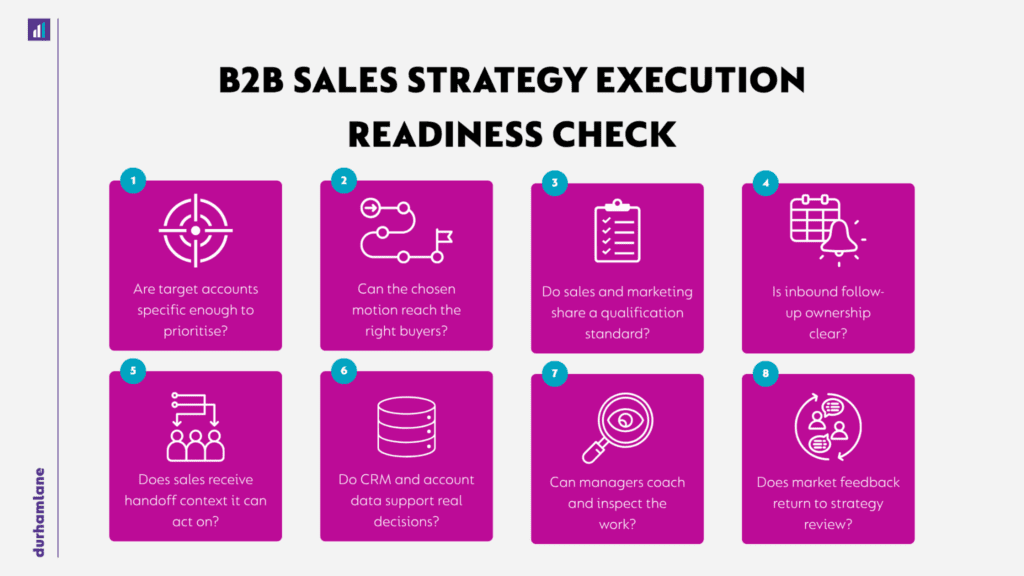
Unclear answers point to an execution-design problem. The ambition may be reasonable. The system behind it may be underbuilt.
This is where the distinction between strategy and execution matters. The business keeps ownership of market focus, account mix and revenue shape. Support may be needed in the sales development layer if the strategy requires more consistent account coverage, sharper qualification, stronger follow-up or cleaner handoff than the internal team can currently provide.
Where an SDR outsourcing partner like durhamlane can help
An SDR outsourcing partner sits on the execution side of the strategy. The business still owns the strategic choices. A partner becomes relevant after target accounts, sales motion and qualification standards are clear, and the remaining gap sits in execution.
durhamlane is a phone-led SDR outsourcing partner for complex B2B teams. We help businesses create more qualified commercial conversations through stronger account coverage, better inbound conversion, consistent follow-up, and higher-quality sales handovers. AI and technology support the process, while conversations and qualification stay human-led.
For proactive account coverage, outbound sales development can support research, prioritisation, calling, qualification and commercially credible conversations with target accounts.
Strong inbound demand with poor conversion points to a different gap in lead review, follow-up ownership, qualification and handoff discipline.
New markets, campaign response and event-led acquisition put pressure on customer acquisition activity that turns target-account interest and market signals into structured sales development action.
Unclear strategy or an undiagnosed execution problem calls for a diagnostic step first. A sales audit can help locate the issue across targeting, qualification, follow-up, handoff, data, management rhythm and sales development capacity.
AI and technology sit underneath that work as support. They can help with research, preparation, role-play, coaching, data quality, workflow, reporting and execution discipline. Human SDRs and managers still interpret buyer context, conduct conversations, judge nuance, qualify opportunities and hand off sales-ready information.
That distinction matters. A serious B2B sales strategy depends on account quality, credible conversations, a clear qualification standard and useful handoff context. Appointment volume only has value when it serves those conditions.
A gap in that layer is where durhamlane can become part of the execution answer. The strategy itself still belongs to the business.
Conclusion: Strategy should make execution clearer, not busier
A useful B2B sales strategy gives the team clearer commercial direction. It clarifies which customers matter, what account mix supports the revenue goal, how different segments buy, what sales motion fits the market, what qualification standard protects sales time and what capacity the organisation needs to execute.
That clarity is what makes tactics useful. Outbound, inbound, events, account-based development, sales playbooks, tools, metrics and processes all need the same commercial logic behind them.
The strongest strategies also make trade-offs visible. They show which accounts to ignore, which opportunities should stay out of the sales pipeline, which motions exceed current capacity and which assumptions need review as market feedback comes in.
Clear strategy can still leave a practical execution question: does the business have the sales development capacity, qualification discipline, account coverage, follow-up ownership and handoff quality required to make the strategy work?
A gap there is a reason to speak to durhamlane about the sales development layer.
FAQ
What is a B2B sales strategy?
A B2B sales strategy is the commercial decision model behind the sales effort. It defines which business customers to pursue, how those buyers buy, what sales motion fits, how opportunities should be qualified and what capacity is needed. Tactics, playbooks, funnels and process then serve those strategic choices.
What should a B2B sales strategy include?
A B2B sales strategy should cover target market, ICP, account mix, revenue-shape assumptions, sales motion, qualification standard, value proposition, sales and marketing alignment, capacity, data and tool requirements, metrics, ownership and review rules. Its job is to guide execution, rather than become the full playbook.
How is B2B sales strategy different from B2C sales strategy?
B2B sales strategy usually needs more emphasis on account fit, buying-committee context, qualification, sales development capacity and handoff quality. B2C strategy is usually closer to individual demand and direct conversion. In B2B, the practical question is how the team turns the right accounts into qualified commercial conversations and sales-ready opportunities.
How does sales strategy change between SMB, mid-market and enterprise?
Segment choice changes account economics, buying process, coverage model, proof requirements and qualification threshold. SMB strategy usually emphasises speed, fit and focus. Mid-market strategy often needs selectivity and repeatability. Enterprise strategy usually requires more patience, account intelligence, stakeholder coverage and proof before a serious opportunity develops.
Who should own a B2B sales strategy?
Commercial leadership should own the sales strategy because it involves market focus, revenue shape, resource allocation and route-to-market trade-offs. Sales, marketing, RevOps, finance, executives and customer-facing teams should contribute where their work affects execution. The strategy needs leadership authority and enough clarity for frontline use.
How often should a B2B sales strategy be reviewed?
A B2B sales strategy should be reviewed at a rhythm that matches the sales cycle, campaign pace and motion complexity. Frontline activity and follow-up may need daily or weekly inspection, while pipeline quality, account fit, handoff quality, capacity pressure and strategic assumptions usually need weekly, monthly or quarterly review depending on the motion.
When should a company consider an SDR outsourcing partner?
A company should consider an SDR outsourcing partner once the target accounts, sales motion and qualification standards are clear, and the remaining problem sits in execution. A partner may help with outbound coverage, inbound conversion, account research, follow-up, SDR capacity, qualification discipline or sales-ready handoff. The strategic choices still belong to the business.