

What is a B2B sales playbook?
A B2B sales playbook is the documented operating blueprint for repeatable sales development execution. It defines who the team should pursue, what problems to listen for, what to say, how to qualify, when to disqualify, what to record, how to hand over, and how the team keeps improving.
That makes it more than a template. A useful playbook connects strategy to daily sales behaviour. It gives SDRs, sales managers, AEs, marketing, RevOps, and leadership a shared reference for target accounts, buyer context, messaging, outreach, discovery, qualification, CRM discipline, handoff, coaching, and review.
Most mainstream sales playbook guides converge on the same basic ingredients, including personas, selling strategy, internal best practice, sales plays, scripts, process guidance, CRM expectations, and update rhythm. Salesforce makes a similar point in its guide to sales playbooks, where the playbook is treated as a broad reference for customer personas, selling strategies, internal team practices, and sales plays. That checklist is useful, but the real test is operational. Does the playbook change how the team sells tomorrow?
What a sales playbook is not
A sales playbook is related to several other documents, but it should not collapse into any one of them.
Strategy decides which markets, accounts, segments, and routes to market matter. The playbook documents how the team acts on those choices.
The sales process gives stages and expected actions. The playbook adds the working detail around messaging, discovery prompts, qualification standards, examples, CRM rules, and handoff expectations.
Scripts belong in the playbook, but a script bank is not a playbook. Reps still need to know when to use each script, how to adapt it, and what buyer signal they are trying to uncover.
Collateral can also sit inside the playbook, but only when the team understands which proof matters for which buyer, objection, stage, or commercial situation.
Onboarding material is part of the picture, but the playbook cannot stop at onboarding. It has to stay useful when reps are calling accounts, managers are coaching live behaviour, sales is challenging handoff quality, and the team is learning from the market.
Get the sales logic clear before activity scales
The easiest mistake is to scale the visible activity before documenting the thinking underneath it.
More sequences will not fix an unclear ICP. More calls will not fix weak value articulation. More SDR capacity will not fix poor disqualification. More CRM fields will not fix vague handoff. More AI-generated messaging will not fix a team that has never agreed what a good conversation sounds like.
In our episode on Graphic Sales, Tom Stearns and Peter Cleary discuss the playbook as the written expression of the thinking behind outbound and prospecting execution, including ICP, value, messaging, examples, onboarding, process detail, and one place where the team can find the operating logic. For B2B teams, the lesson is practical. Sales development activity becomes harder to manage when the reasoning behind it is scattered across Slack threads, CRM notes, manager memory, old decks, and individual rep habits.
A playbook forces choices into the open. Which accounts are worth the effort? Which buyer problems justify outreach? Which signals show fit rather than curiosity? Which objections should reps expect? What context does sales need before accepting a handoff? Where does the rep record that context? Who reviews whether the standard is still working?
Without that discipline, scaling activity can make the problem louder. The team does more, faster, with less shared judgement.

What should a B2B sales playbook include?
The exact shape of the playbook will depend on the company’s segment, sales motion, deal complexity, channel mix, and team structure. A founder-led enterprise sales motion does not need the same playbook as a high-volume mid-market SDR team. Still, most B2B sales development playbooks need to define the following operating categories.
A useful B2B sales playbook has a narrower job than capturing everything the business knows. It makes the core execution choices clear enough for SDRs, managers, sales, marketing, and RevOps to work from the same standard.
| Playbook area | What it should define | Why it matters |
| ICP and account selection | Which accounts fit, which do not, and how priority is judged. | Reps avoid spending time on accounts that cannot support the sales motion. |
| Buyer context and messaging | Who is involved, what they care about, and how the value proposition should be framed. | Conversations stay relevant instead of becoming generic outreach. |
| Channel and cadence guidance | How calls, email, LinkedIn, video, events and follow-up work together. | Reps get a clear standard for outreach without sounding like they are reading from the same script. |
| Discovery, disqualification and qualification | What to ask, what to listen for, when to stop pursuing, and what makes an opportunity sales-ready. | Teams stop confusing interest with fit. |
| CRM, data and handoff rules | What must be recorded, where it goes, and what context sales needs next. | Handoff, reporting and coaching become reliable. |
| Sales plays and coaching examples | Repeatable actions for common situations, supported by real calls, objections, wins, losses and review notes. | New and existing reps learn from proven patterns instead of improvising every time. |
| Review and update rhythm | Who owns the playbook, how often it is reviewed, and what field evidence changes it. | The playbook stays current rather than becoming a stale document. |
A playbook earns its keep when reps stop guessing. Account selection, messaging, qualification, and handoff no longer depend on whoever happens to be working the lead.
The component table gives the team a practical execution check. Each section has to help a rep make a better decision about the account, conversation, qualification, CRM note, or handoff. Anything that does not help those decisions probably belongs somewhere else.
How to build a B2B sales playbook your team will actually use
A useful playbook starts with leadership intent, then gets tested against field reality. Leadership sets the commercial direction, but the playbook has to survive contact with real calls, CRM notes, objections, sales feedback, win/loss patterns, and manager coaching.
The mistake is to write down an idealised sales motion that nobody actually follows. The better route is to document how the team should sell, then keep checking that standard against what reps hear, record, and hand over in live sales development work.
Start with leadership intent and customer reality
Start by documenting the commercial choices already made upstream. Which accounts are worth pursuing? Which segments are too small, too slow, too complex, or too expensive to serve? Which buyer problems matter enough to create urgency? Which stakeholders normally influence the decision? Which proof points are credible for each buyer context?
This is where customer value matters. Strategyzer’s work on B2B value propositions is useful because it pushes teams away from leading with capabilities alone and towards translating those capabilities into stakeholder-specific value. A playbook should do the same. It should give reps the language and judgement to connect the company’s offer to the buyer’s real situation.
Pull scattered sales knowledge into one place
Most teams already have pieces of the playbook. They are just badly distributed.
The best opener is buried in one rep’s call recording. The best objection response sits in a Slack thread. The real disqualification rule lives in a manager’s head. Marketing owns the latest proof point. RevOps owns the CRM field logic. Sales knows which handoffs waste time. None of that helps if a new SDR cannot find it, apply it, or get coached against it.
The playbook brings those fragments into working order. Reps need to see the standard in use through strong and weak emails, call openers, discovery prompts, qualification notes, handoff examples, and manager comments.
Define qualification, disqualification, and handoff before sales receives the opportunity
Qualification and handoff are the point where a playbook starts to matter commercially.
The SDR needs a clear standard for what must be known before a conversation is ready for sales. The playbook also needs rules for when an account deserves more work, when it should be paused, and when it should be disqualified. Disqualification protects sales time. In complex B2B sales, polite interest is not the same as commercial fit.
durhamlane’s Magic35 qualification framework gives this part of the playbook a clearer standard. Used properly, it helps define the context sales needs before accepting an opportunity. It should not read like a criteria dump, an AI score, an automated qualification system, or a performance guarantee. The useful test is simple. SDRs and AEs should not be interpreting “sales-ready” in different ways.
Use real examples and manager reinforcement
Managers have to coach from the playbook for it to become useful.
That means the playbook needs real examples as well as rules. In a one-to-one, a manager should be able to show the account type the team prioritises, the opener that fits that situation, a weak handoff note, a stronger version, the reason an account was disqualified, and the pattern showing up in recent calls.
Used that way, the playbook becomes a coaching baseline. Reps are no longer being trained from memory, preference, or whatever example the manager happens to remember that week.
How sales plays fit inside the playbook
Sales plays are repeatable actions for specific commercial situations. A sales playbook guide from Highspot makes the useful distinction between the broader playbook and the individual plays that sit inside it. The playbook gives the team the operating standard. A sales play gives reps a repeatable way to handle a specific scenario.
A play might cover post-event follow-up, MQL conversion, reactivation, a stalled opportunity, a competitive displacement conversation, or outreach into a new vertical. The playbook explains when to use that play, what buyer signal triggers it, what message to lead with, what proof to use, and what next action should follow.
How to keep the playbook current
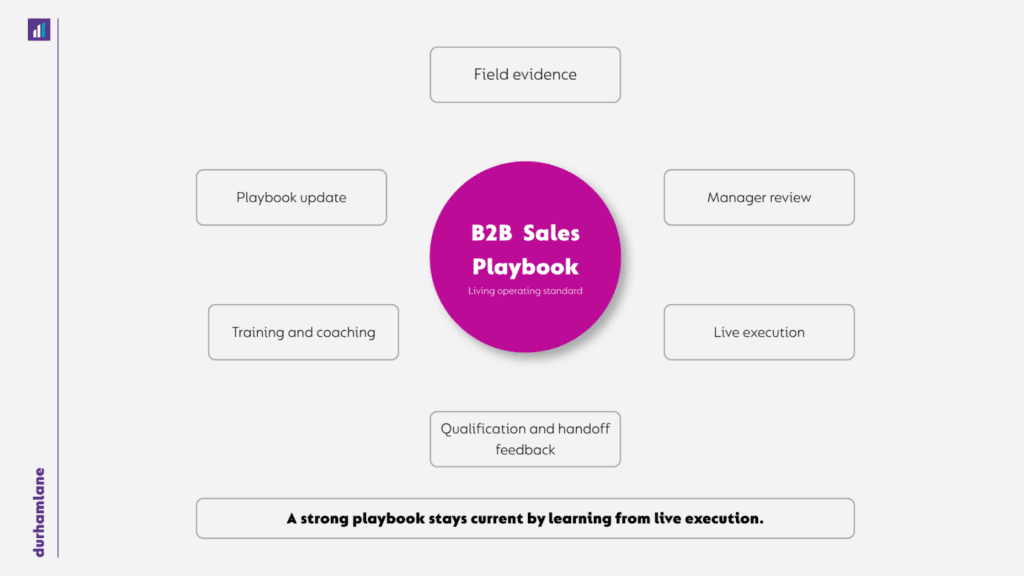
A B2B sales playbook should have an owner, a review rhythm, and a clear rule for what evidence changes it.
That evidence might come from call recordings, CRM notes, conversion-quality feedback from sales, common objections, campaign learnings, win/loss patterns, manager coaching, or changes in ICP and market focus. If the team keeps hearing a new objection, the playbook should change. If sales keeps rejecting handoffs for the same reason, the qualification section should change. If a sequence works only for one segment, the cadence guidance should change.
The playbook should be stable enough to create consistency and flexible enough to reflect reality.
Where AI and sales tools belong
AI and sales tools belong after the operating logic is clear.
They can help with account research, buyer-context summaries, role-play, call review, messaging variation, CRM hygiene, documentation, reporting, and playbook updates. They can make the playbook easier to use and easier to maintain.
AI and sales tools need a defined sales motion to work against. When ICP, value message, qualification, disqualification, handoff, and CRM rules are vague, the technology mostly gives the team a faster way to repeat the same uncertainty. More messages go out. More notes get produced. The underlying judgement still has not been made.
Turning the playbook into live sales development behaviour
Once the playbook sets the standard, the hard part is running it consistently.
In complex B2B sales environments, that takes capacity, management, coaching, account intelligence, phone-led conversations, CRM discipline, qualification, disqualification, feedback loops, and sales-ready handoff. The gap often appears after leadership has clarified the model. The team knows how the motion should work, but does not have the SDR capacity or management structure to run it every week.
That is where SDR outsourcing can become part of the answer. As a phone-led SDR outsourcing partner, durhamlane helps teams generate qualified commercial conversations and better sales handovers. AI helps improve research, training, coaching, documentation, and consistency, but the conversations themselves stay human-led. In complex B2B sales, understanding nuance, context, and buyer intent still matters.
The thinking still belongs to the business. durhamlane’s role is to help execute that thinking with the structure, management, and feedback needed to turn the playbook into live sales development behaviour.
Make the playbook part of how the team sells
A B2B sales playbook earns its place when it changes daily sales behaviour.
It gives SDRs a clear view of which accounts to pursue, which accounts to leave alone, what buyer problems to listen for, what to say, how to qualify, when to disqualify, what to record, when to hand over, and how managers will review what is working.
Build that standard before activity scales. Otherwise, sales development execution drifts back into personal habits, disconnected tool workflows, and good intentions that are difficult to coach or repeat.
For specialist SDR support, talk to durhamlane.