



Key takeaways
- A broken marketing-to-sales handoff distorts pipeline coverage, affects forecast accuracy, and drives up sales costs, making it a sales leader’s problem as much as marketing’s.
- Handoffs break down because nobody has agreed what “qualified” means, so context gets lost, ownership is ambiguous, and there’s no feedback loop to fix it.
- A strong handoff needs six things in place: a jointly owned lead definition, full context with every lead, a response-time SLA, automated routing, a two-way feedback loop, and a regular joint review.
- Speed matters, but only once qualification and context are solid.
- Technology doesn’t replace the agreement between sales and marketing leaders; it enforces it, through a single CRM source of truth, automated routing, SLA alerting, and shared dashboards.
The marketing-to-sales handoff is the moment a lead moves from marketing’s world into sales’ world, and it’s where your B2B pipeline is either fuelled or limited. At this stage, lead ownership, context, and accountability are meant to transfer cleanly from one team to the other… but they usually don’t.
For a sales leader, this gap isn’t a problem to leave at marketing’s door. It sits squarely inside your remit too, because a broken lead handoff distorts your pipeline coverage, undermines your forecast, and lowers your lead conversion rates. The issue is shared, and the solution is too.
This article sets out what a clear marketing-to-sales handoff should involve, why it can break down, and a process you can take into a conversation with your marketing colleagues.
What is a marketing-to-sales handoff?
A marketing-to-sales handoff is the structured process by which a lead moves from marketing’s nurture activity into sales’ active pipeline, along with the context, data, and accountability needed for a seller to act on it effectively. A strong handoff includes the transfer of a story: who this buyer is, what they’re trying to solve, what they’ve already engaged with, and why now is the right moment to talk to them.
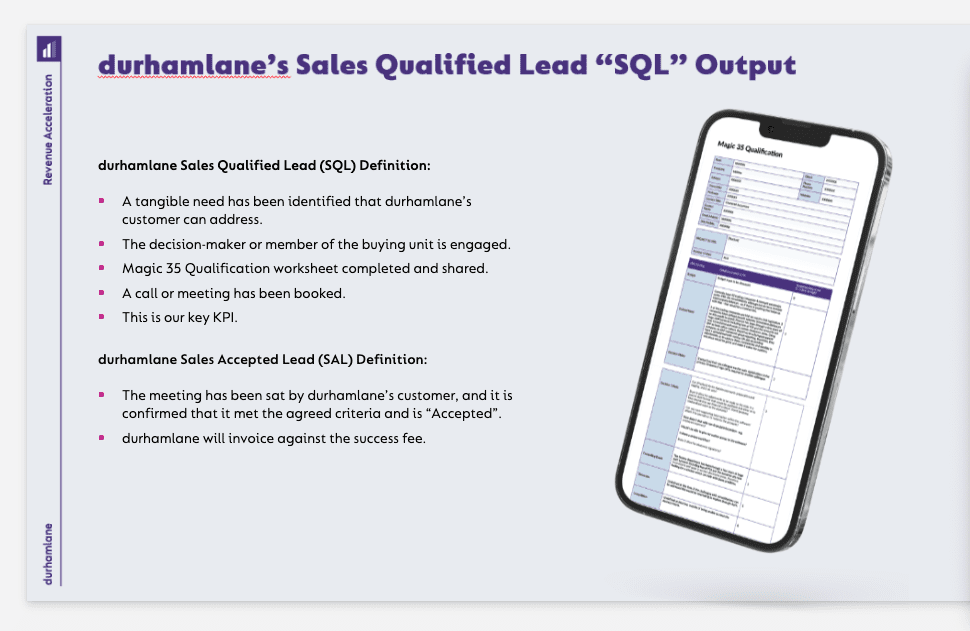
B2B businesses use some version of MQL (marketing-qualified lead) and SQL (sales-qualified lead) to describe this journey. The handoff is the point at which an MQL is accepted, worked, and ideally converted into an SAL (sales-accepted lead) or qualified opportunity.
At durhamlane, we think about this moment as the shift from “Find” to “Create”; the point where an identified signal of intent becomes an actively owned conversation. But for this shift to work, what gets handed over needs to be rich enough for a sales development rep to sell effectively.
Why the handoff is crucial
Sales and marketing alignment has been talked about for years, often as a cultural issue. You don’t need me to parrot the fact that sales and marketing teams should be collaborative, because you’re already seeing the need for that operationally. It shows in your numbers.
A poor handover process:
- Distorts your pipeline and your forecast. A lead sitting untouched in the CRM, or one logged as “contacted” when nothing meaningful happened, inflates the appearance of coverage while doing nothing for actual conversion. When the ratio of MQLs to SQLs is unreliable, so is everything you base it on, such as hiring decisions and reporting.
- Drives up your cost of sale. When SDRs spend their time re-qualifying leads or chasing down basic context that marketing already had, you’re paying sales team labour costs to do marketing’s job.
- Restricts the SDR to buyer conversation. SDRs can appear weak at converting or closing leads when really, they’re working from a poor starting position.
The marketing-to-sales handoff is a competitive moment. B2B buyers now do most of their research before they ever speak to a seller, and their attention span for a generic or delayed follow-up is shorter than it’s ever been.
Research finds that responding to a lead within five minutes makes a seller dramatically more likely to close them, yet many B2B sales teams still take the best part of two days to make first contact. By which point, the buyer has likely spoken to competitors.

What breaks the marketing-to-sales handoff
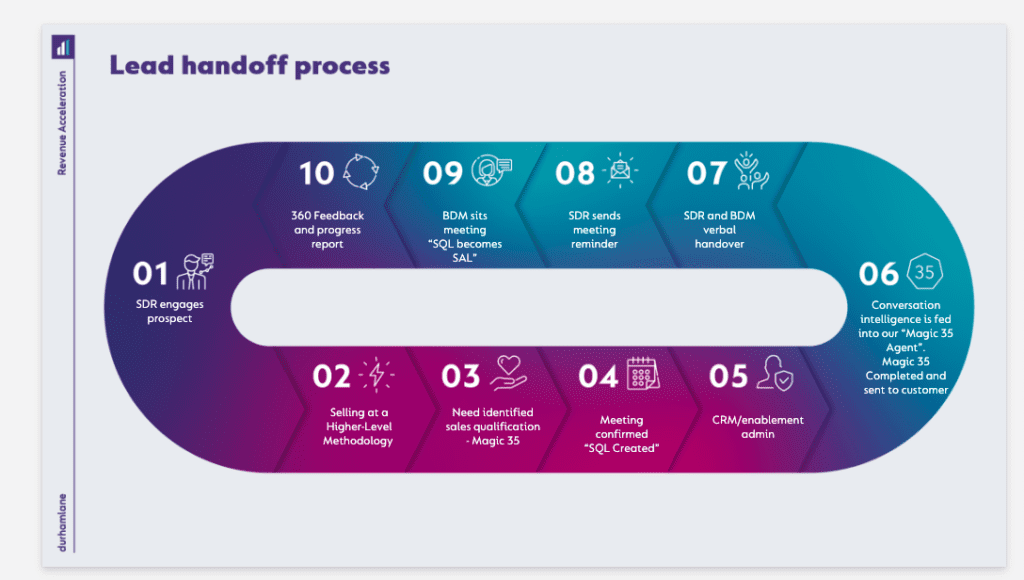
Firstly, nobody has agreed what “good” looks like, so team members are making assumptions instead. In our experience running outbound and inbound lead conversion services for clients, a handful of patterns show up time and again. These are:
- There’s no shared definition of “qualified lead.” Marketing and sales are often working from different criteria without realising it. Marketing counts a lead as qualified once it crosses an engagement threshold, while sales judges qualification on budget, authority, and intent to buy. There’s a mismatch between MQL and SQL definitions.
- Lead context gets lost. A name and a job title land in the SDR’s CRM, but the context isn’t included. This may be due to poor platform integration or poor process, but either way, the SDR has no record of what the prospect downloaded, which web pages they kept returning to, or what question they asked on a webinar. These are all details that enable winning sales teams to open with relevance when making sales calls.
- Nobody owns the next move. Without a defined response window and a named owner, leads sit in limbo. Limbo is exactly where buyers disengage, and where a sales leader loses visibility over what’s happening to the leads marketing is generating.
- The feedback loop doesn’t exist. Sales rejects or deprioritises leads without logging why. Marketing keeps optimising for volume because it’s the only signal available to them. Without feedback on what converts, both teams invest effort in the wrong place.
- The technology doesn’t enforce what’s agreed. Even where a definition and a process exist on paper, manual handoffs and disconnected systems mean the agreed standard isn’t what actually happens day to day.
What to include in the marketing-to-sales handoff
A jointly owned lead definition
Sales and marketing leadership need to agree, in writing, what counts as an MQL and an SQL. This should be a working agreement that gets revisited as your market, campaigns, and Ideal Customer Profile (ICP) evolve.
Context for every lead
Standardise what moves with a lead: firmographic fit, engagement history, the specific content or questions that signalled interest, and the source campaign. This enables sales teams to open a conversation with insight rather than a cold introduction, and boosts win rates.
A response-time SLA with named owners
Every handoff needs an agreed response window and an escalation path for when it’s missed.
Automated routing logic
Decide how leads get assigned (by territory, by segment, round robin, etc.) and build it into your systems. Teams shouldn’t need a manager’s judgement every time.
A two-way feedback loop
Sales reports back on conversion and rejection reasons; marketing uses that information to refine targeting and scoring. This is how the whole process improves.
Regular joint review cadence
Markets shift, campaigns change, and ICPs evolve. A handoff process needs a recurring forum (even a short one!) where both teams look at the same data and adjust together.
Free download: Sales and Marketing Alignment Blueprint
B2B marketing-to-sales handoff checklist
| Stage | Owner | What good looks like | Key metric |
| 1. Align on definitions | Sales & marketing leadership | Both teams independently define MQL/SQL, then reconcile differences into one agreed standard | Time to agreement |
| 2. Qualify against shared criteria | Marketing, with sales sign-off | Leads are scored consistently against the agreed framework | MQL-to-SAL acceptance rate |
| 3. Package the context | Marketing/MarTech stack | Every handoff includes engagement history, fit data, and the buying signal that triggered it | % of handoffs with complete data |
| 4. Route and respond within SLA | SDR team | Leads are assigned automatically, and the first response happens inside the agreed window | Time to first contact |
| 5. Work the lead at the right cadence | SDR team / BDM team | The conversation is consultative and grounded in the context provided | Conversion to qualified opportunity |
| 6. Report back and refine | Both teams jointly | Rejection reasons and conversion outcomes are logged and reviewed regularly | MQL-to-SAL trend over time |
At durhamlane, our Magic 35 framework gives sales teams a structured set of criteria to qualify against, so a lead either meets the bar or it doesn’t.
What experience with inbound lead conversion tells us
We run lead conversion campaigns for enterprise and mid-market sales teams. Our “Find and Create” principle is built around engaging a prospect while their intent is still strong, rather than letting it cool while a lead sits in a queue. That principle only works because the qualification criteria, the data package, and the routing logic are agreed in advance.
Free download: How to Buy a Sales Outsourcing Solution Guide
We’ve seen the same lead arrive in two different states. In one version, it lands with a job title and an email address, and the SDR starts the conversation from zero. In the other, it arrives with the page they returned to three times, the specific question they asked on a webinar, and a clear signal of where they sit in their buying journey. The second conversation starts from relevance, and it shows in how quickly trust builds and how much faster the opportunity moves.
Technology supports a strong handoff
Agreement between sales and marketing leaders is the starting point, but it only holds at scale if your systems support it. With the right tech stack, you’ll have:
- A single source of truth. Both teams need to be working from the same CRM record, the same field definitions, and the same lead status taxonomy. When marketing works in one system and sales reports from another, the numbers will never reconcile, and neither team will fully trust the other’s data.
- Lead scoring and automated routing. Remove manual judgement calls from day-to-day handoffs. If a routing decision depends on someone being available to make a call, it isn’t a system yet.
- Alerting that enforces the SLA. A response-time commitment should be backed by a notification that fires the moment a lead crosses the threshold.
- Shared dashboards. Both teams should have the same visibility over MQL-to-SQL conversion, time-to-first-contact, and handoff acceptance rate.
This isn’t a problem sales can solve alone, and it isn’t one marketing can solve alone either, but getting it right is one of the fastest ways to improve leads and sales.
If you want help diagnosing where your own handoff is breaking down, our Audit & Diagnostic can help with this kind of operational gap. Get in touch to find it.
FAQs
What is a marketing-to-sales handoff?
It’s the structured process by which a lead moves from marketing’s nurture activity into sales’ active pipeline, including the context, data, and accountability needed for a seller to act on it effectively.
What should a marketing-to-sales handoff process include?
A jointly owned lead definition, a standard context package for every lead, a response-time SLA, automated routing logic, a two-way feedback loop, and a regular joint review between sales and marketing.
How do you fix a broken marketing-to-sales handoff?
Start by getting sales and marketing leaders in a room to compare definitions of “qualified.” Agree the highest-impact fixes first (definition, SLA, and feedback loop), then put technology in place to enforce them, and review progress on a fixed cadence.
What’s a good response time for a high-intent lead?
As close to immediate as your process allows. Research consistently shows that responding within minutes rather than hours dramatically increases the likelihood of converting a lead into a real conversation.
Who should own the marketing-to-sales handoff process?
Both teams jointly. Marketing typically owns qualification and context; sales owns response and conversion, but the definitions, SLA, and feedback loop need sign-off from leadership on both sides.