



Key takeaways
- A sales handoff process transfers a qualified lead from an SDR to the BDM or AE running the meeting, carrying across context and trust.
- Technology is essential for admin, but relationships are the multiplier: a strong SDR-to-BDM relationship drives more, better opportunities than process alone.
- Spreading SDR support too thinly across too many BDMs is a structural problem that hits win rates and revenue.
- A strong handoff has many steps: agree on qualification criteria, document context, hand over verbally, decide if the SDR joins the first meeting, stay in the loop, and give feedback.
- As AI automates more of the funnel, the human handoff becomes more valuable.
In every sales engagement, there’s a point at which a sales development rep passes a qualified opportunity over to the business development manager or account executive who’ll run the meeting and, eventually, try to close the deal. This sales handoff process might seem like a minor detail, but it can influence sales-accepted leads and win rates.
When you do a sales handoff well, the prospect doesn’t notice the change of hands. But get it wrong, and you can lose weeks of relationship-building thanks to a single clumsy introduction.
Advice about the sales handoff process often treats it as a logistics problem with a technology solution. Usually, SDRs focus on getting the right fields and meeting details into the CRM, and automating the routing to the BDM. Job done. While this admin is important, it’s incomplete.
A sales handoff process that runs purely on technology will move information efficiently, but it won’t necessarily give the full deal context or transfer trust. And in complex, high-value B2B sales for enterprise and mid-market firms, trust is what closes the deal.
This post shares what a strong sales handoff process includes, drawing on our own experience running SDR teams that hand opportunities to client-side sales teams every day.
A quick note on scope before we start. This post is about the handoff between an SDR (or BDR) and the BDM or account executive who takes the meeting forward. It isn’t about the separate, and equally important, handoff between marketing and sales. That’s a related topic, but a different one, and worth its own post.
What is a sales handoff process?
A sales handoff process is the structured transfer of a qualified lead or booked meeting from the person who found and qualified it, typically an SDR, to the person who’ll run the sales conversation and take it to close, typically a BDM or account executive. Done well, it carries across not just contact details and a calendar invite, but the context, relationship groundwork, and momentum already built with the prospect.
Pipeline coverage, conversion rates, and forecast accuracy all depend on opportunities surviving the transition between teams. If your current handoff loses information, slows momentum, or arrives without context, it’s affecting the numbers you’re accountable for.
There are, broadly, two extremes we see in practice. At one end, the handoff is little more than a calendar invite lobbed over the fence: an SDR books a meeting, sends the details, and moves straight on to the next prospect. It’s very clinical.
At the other end (where durhamlane sits), the handoff is treated as an ongoing relationship between SDR and BDM, where information, context, and trust all come together. Most businesses sit somewhere in the middle, usually closer to the first than they’d like to admit.
The cost of getting sales handoff wrong
Across the industry, response time is one of the most consistently cited factors in lead conversion, and the risk compounds with a delayed handoff, however small. When an opportunity sits unclaimed, or arrives with an AE who has to re-qualify from scratch, all the effort taken to build a relationship with the prospect disappears.
For example, an AE who spends the first ten minutes of a call re-establishing facts the SDR already uncovered is an AE who isn’t selling, and may well be alienating the lead. A team that loses a handful of opportunities a quarter to handoff friction will have a pipeline coverage ratio that looks worse than the underlying lead generation effort would suggest.
Particularly in enterprise businesses, a small SDR team may be supporting a large number of BDMs or account executives across an account, particularly a strategically important one; the handoff inevitably becomes thinner and more transactional. If six SDRs are feeding twenty sellers, the volume of opportunities reaching any individual seller will be low, and the relationship between that seller and the SDR team will struggle to develop any real depth.
Spreading SDR capacity too thinly to build any meaningful relationship is a structural issue that can impact win rates and revenue.

Two pillars of a strong sales handoff process
An effective sales handoff process relies on two pillars: technology and relationships.
Technology is the floor
Getting the practical foundations for handoff right includes:
- A shared qualification framework. SDR and BDM teams need a common definition of what “qualified” means before any opportunity moves between them. Without it, the SDR is qualifying against one bar and the AE is judging against another, and that mismatch is the single most common source of friction in any handoff. At durhamlane, our Magic 35 qualification framework gives every conversation seven core criteria to work through, so a lead arrives qualified against a shared, structured standard.
- Accurate CRM fields. Move contact details, company information, and a record of the qualifying conversation automatically, not get rebuilt by hand. This is administrative housekeeping that, when missing, costs real selling time.
- Calendar automation and clear ownership. A booked meeting should generate a calendar invite immediately, with ownership of the next step clearly assigned. Ambiguity over who owns the prospect between the booking and the meeting is a problem.
- Service level agreements for response time. Defining how quickly an AE is expected to respond after a handoff, and holding the process to that standard, protects the momentum the SDR worked to build.
Relationships are the multiplier
The strength of the relationship between SDR and BDM has a direct, measurable effect on the quality and volume of opportunities that a BDM ends up working.
If a BDM trusts their SDR, picks up the phone to them without thinking twice, and knows that what gets handed over will be accurate and useful, the BDM will actively want to work with the SDR. They’ll give them the benefit of the doubt on a borderline lead. They’ll tip them off when a previously unresponsive contact resurfaces. They’ll pull the SDR in on opportunities that never would have crossed their desk otherwise.
We’ve seen this play out clearly in our own teams.
One of our SDRs working with a major customer was consistently generating four to five times the opportunity volume of colleagues working similar accounts, not because the leads available to him were any better, but because of how he worked the relationship with his AE. He’d get on the phone first thing, ask what the AE needed help with that day, and the AE would hand him specific, actionable requests in return: contacts who’d gone quiet, follow-ups from an event the week before, accounts worth another look. The relationship itself became a source of opportunity that no process diagram would have generated on its own.
A framework for a smooth sales handoff process
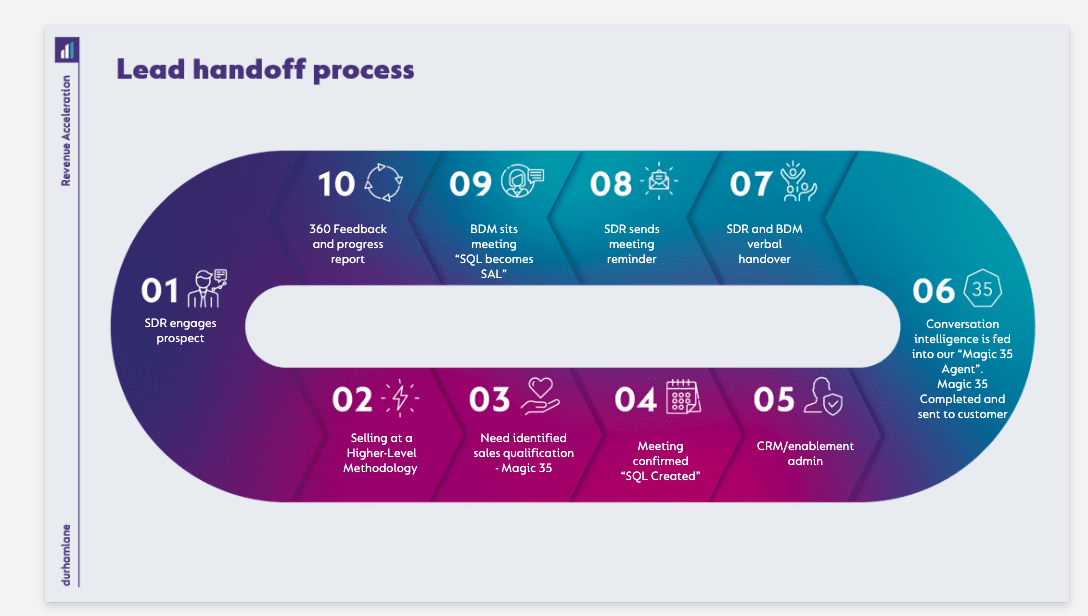
With both pillars in mind, here’s a strong handoff process, broken down into the steps.
| Free download: How to Buy a Sales Outsourcing Solution Guide |
Step 1: Agree what “qualified” means before anything else
Before a single lead changes hands, SDR and BDM teams need to agree on the criteria a lead must meet to be considered ready. This is a standing agreement that gets revisited as the market and the proposition evolve. A structured, multi-criteria framework, something like our own Magic 35 approach, gives both sides a shared language for what “qualified” means, so a BDM never has to guess whether a lead has been properly vetted.
Step 2: Document context, not just data
CRM fields capture data: name, title, company, perhaps a note on budget, but they should also capture the context of a conversation; what’s already been promised, which topics landed well, which ones to avoid raising again.
Step 3: Make the verbal handover happen
In the strongest version of a handoff, the SDR doesn’t just complete the CRM admin and fire off a calendar invite. They will pick up the phone, or send a message in whatever format that particular BDM prefers (text, voice note, whatever), and talk the seller through what’s coming: who the prospect is, what’s been discussed, what to expect, and what, if anything, needs double-checking before the meeting.
Step 4: Decide whether the SDR should join the first meeting
There’s a long-running debate in sales development circles about whether the SDR who books a meeting should sit in on it. There’s no single right answer, and it depends on how complex your deal is and how you structure your team. But in longer, more complex B2B cycles, particularly at the enterprise level, having the SDR present for the first call can help build trust. It signals continuity to the prospect, gives the BDM a second pair of ears, and gives the SDR direct visibility into how the opportunity is progressing, which makes the next handoff easier still.
Step 5: Keep the SDR in the loop after the handoff
If a BDM uncovers a new stakeholder mid-deal or realises three more people need to be brought into the conversation, the SDR should be the natural person to put back to work. This is what separates a transactional SDR function from one that operates as an extension of the team: the willingness to keep contributing after the formal handoff has technically happened.
Step 6: Close the loop with feedback
Feedback sessions continue to build qualification accuracy and alignment between SDR and BDMs. A BDM who takes the time to explain why an opportunity didn’t close is investing in a relationship that will pay off on the next ten leads.
The human element as AI reshapes the funnel
As more prospecting and early qualification get automated through AI-led sales development, note what this changes, and what it doesn’t.
AI can identify intent signals, score leads, and draft outreach faster than any human team could manage alone. It can’t build the kind of relationship between an SDR and a BDM that turns a handoff into a source of ongoing opportunity.
If anything, the rise of AI in the early funnel makes the human element of the handoff more valuable, not less. As automation handles more of the repetitive groundwork, the moments where a person genuinely engages with another person, understanding what both the buyer and a BDM need, picking up on context a system would miss, become the differentiator.
Buyers are dealing with an increasing volume of automated, impersonal outreach. A handoff that feels personal and continuous, rather than clinical, earns long-term retention and account expansion.
Common sales handoff mistakes to avoid
Here’s a snapshot of where this most often goes wrong:
- Ignoring how the BDM prefers to communicate. A handoff delivered in the SDR’s preferred format, rather than the BDM’s, is more likely to be missed or ignored altogether.
- Treating the handoff as a single event. A calendar invite and a CRM update aren’t a relationship; they’re an administrative task. The handoff works best when it’s the start of an ongoing exchange.
- Letting CRM data substitute for verbal or written context. Fields capture facts. They rarely capture nuance, and nuance is usually what makes the difference in a sales conversation.
- Spreading SDR support too thinly. Supporting too many BDMs or AEs at once prevents any single relationship from developing the depth that makes a handoff genuinely valuable.
- Skipping a shared definition of “qualified.” Without one, the BDM ends up re-qualifying from scratch, and the SDR’s work counts for less.
- No feedback loop. Without a regular review, the same friction repeats every cycle, and nobody on either side learns from it.
How to know your sales handoff process is working
| Signal | What it tells you |
| Meeting-to-sale conversion rate | Whether the qualification and context passed across is useful to the BDM |
| How often SDRs get pulled back into an account post-handoff | A reasonable proxy for how much the BDM trusts and values that relationship |
| BDM satisfaction with handoff quality | A quick, qualitative pulse-check that can surface issues early |
| Pipeline coverage stability over time | Whether handoff friction is hampering coverage ratios |
There’s also a simpler, more telling test. If your BDMs push back hard against losing their SDR support, the relationship side of the handoff is working as it should. If they wouldn’t particularly notice, it probably isn’t.
Bringing it together
A strong sales handoff process needs both pillars to function properly: the technology that moves essential data quickly, and the relationship that moves trust along with it. Many enterprises have invested heavily in the first and largely overlooked the second.
Get the practical foundations right, but don’t mistake them for the whole job. The relationship between SDR and BDM is what survives account losses, team changes, and the ongoing disruption AI is bringing to the top of the funnel. It’s also, frankly, the part that’s much harder for a competitor to copy.
At durhamlane, this is how we build handoffs as standard practice, combining our Magic 35 qualification framework with a verbal handover between SDR and seller on every opportunity.
To see how this works for your team, get in touch, and we’ll talk you through it.