



B2B sales techniques are often treated as shortcuts. Usually as better openers, smarter scripts, sharper questions, or more persistent follow-up. That is where the advice starts to drift from the real commercial problem.
In real B2B sales, a technique only matters if it improves the commercial quality of the seller’s judgement and the buyer interaction. A seller can follow a cadence, ask discovery questions, send polite follow-ups, and still create weak pipeline if the conversation never tests fit, urgency, impact, buying context, decision reality, or the next step. Activity may look healthy while opportunity quality stays poor.
Key takeaways
- Useful B2B sales techniques are repeatable seller behaviours, not tricks or script polish.
- The strongest techniques improve account choice, relevance, discovery, qualification, objection handling, follow-up, and sales-ready handoff.
- For complex B2B sales, better technique only matters when it creates better evidence, including clearer fit, stronger urgency, cleaner context, and a more credible next step.
- Useful techniques help sellers prepare before outreach, open with relevance, diagnose the buyer’s situation, qualify the opportunity, handle objections with judgement, and pass clean context to the next person in the sales motion.
What B2B sales techniques actually are
B2B sales techniques are seller behaviours inside a wider sales strategy.
A B2B sales technique is a repeatable behaviour a seller uses in a specific commercial situation. It might happen before cold outreach, during a live conversation, after an objection, during qualification, or when handing a lead over to sales.
That definition matters because “technique” is often used too loosely. Active listening, for example, is a valuable skill. The technique is what the seller does with that skill. A seller might hear a vague answer about timing and ask, “What has made this a priority now?” or “What happens if this stays unresolved for another quarter?” The behaviour turns listening into commercial diagnosis rather than polite note-taking.
In durhamlane’s language, this is part of being professionally curious. The seller asks to test the commercial reality behind the answer. The point is to understand whether the problem matters, whether the timing is real, whether the buyer can act, and whether the opportunity deserves to move forward.
The same applies to personalisation. “Personalise your outreach” is weak advice on its own. A stronger behaviour identifies a relevant account trigger, connects it to a likely operational pressure, and opens with a reason the buyer may recognise. Relevance is what makes the personalisation worth the buyer’s attention.
Techniques are different from skills, methodologies, playbooks, funnels, and processes
A technique is not the same thing as a sales strategy. Strategy decides which markets, accounts, buyers, offers, and routes to market matter. Techniques are the behaviours sellers use to make that strategic direction show up in account-level decisions and buyer conversations.
A golf swing is a technique. It is not the strategy for playing the course. The same is true in B2B sales. A discovery question, objection response, or follow-up behaviour only works when it serves the wider commercial strategy.
A technique is also different from a sales process. Process defines the workflow, including stages, ownership, CRM movement, handoff points, and next actions. Techniques live inside those stages and determine whether the stage produces usable commercial evidence. A process may say “run discovery.” The technique determines whether discovery actually reveals impact, timing, decision context, and qualification strength.

Why B2B sales techniques need commercial context
Complex B2B sales involve more judgement than generic tips allow
B2B buying is rarely one interested person deciding after one tidy conversation. Buyers may research privately, compare options before they speak to sales, involve colleagues informally, worry about risk, and delay decisions because other priorities are louder. Gartner’s work on the B2B buying journey is useful here because it treats buying as a set of non-linear jobs instead of a tidy march from first touch to decision.
That is why generic advice breaks down. “Build rapport” says little about account fit. “Ask good questions” can still leave the commercial weight of the problem unclear. “Handle objections” only helps when the seller knows whether the issue is timing, authority, risk, budget, or lack of perceived value.
B2B sales techniques need context because sellers constantly judge account fit, buyer seriousness, stakeholder reality, and what should be captured for handoff.
Strip that judgement out, and techniques become theatre because the seller performs the motion while the account remains under-qualified.
Better techniques make activity more commercially useful
Sales teams often respond to weak pipeline by increasing activity. More calls. More emails. More sequences. More meetings booked. More visible effort.
That only helps when more activity produces better conversations. Generic outreach creates more noise. Shallow discovery adds uncertainty to the meeting load. Weak qualification turns handoffs into disappointment for sales.
Better techniques help sellers spend more time on accounts that fit, open sales calls and conversations with stronger relevance, ask questions that reveal the real situation, and avoid passing weak interest forward as pipeline. The result should be activity that earns better commercial conversations rather than louder contact attempts.
| durhamlane’s Selling at a Higher Level methodology frames inside sales as a structured journey across five stages: Find & Create, Define & Understand, Propose, Recommend & Present, Close Out, and Serve & Grow. Watch: Selling at a Higher Level with Richard Lane, Co-Founder of durhamlane The most relevant stage here is Define & Understand. The seller’s job is not to rush into a pitch or demo. It is to ask high-impact questions, listen carefully, and understand whether the buyer has a real reason to change. That is where a sales technique becomes commercially useful. It helps the seller move from activity to judgement, and from a surface-level conversation to a better-qualified next step. |
B2B sales techniques by commercial function
The clearest way to think about B2B sales techniques is by the commercial function they serve. The same seller may use several in one conversation, but each improves a different part of the sales-development motion.
| Commercial function | Technique | What it improves | What goes wrong when it is missing |
| Preparation | Account research | Relevance before outreach | Outreach feels generic. |
| Opening | Problem-led first touch | Reason to talk | The buyer hears a pitch before they see a problem. |
| Live conversation | Phone-led questioning | Real-time judgement | The seller misses hesitation, fit signals, or useful objections. |
| Discovery | Problem and impact questions | Quality of diagnosis | Discovery becomes a checklist. |
| Qualification | Clear qualification standard | Opportunity quality | Interest is mistaken for sales readiness. |
| Stakeholder navigation | Identify influence and decision risk | Deal reality | One contact is mistaken for the buying group. |
| Objection handling | Diagnose before responding | Buyer confidence | Rebuttals miss the real concern. |
| Follow-up | Contextual next step | Momentum | Follow-up becomes “just checking in.” |
| Handoff | Capture commercial context | Sales continuity | The next seller restarts the conversation. |
Preparation techniques improve account relevance before outreach
Research the account before the first touch
Preparation is where technique begins, even though it happens before the buyer sees anything.
Good account research is not trivia collection. The seller is looking for commercial context, including whether the account fits, what pressure may exist, what trigger makes the timing plausible, who is likely to care, and what problem the first message should connect to.
Read next: How to Run High-Converting B2B Sales Calls (With Stats)
A weak version of research produces lines such as “I saw your company is growing” or “I noticed your recent announcement.” Those may be true, but they are often too thin to earn attention. A stronger version asks what the trigger might mean for the buyer’s team. Growth may create onboarding pressure. A new market may create sales coverage issues. A hiring pattern may suggest capacity constraints.
The seller does not need to know everything before the first touch. They need enough context to avoid sounding interchangeable and to make the first question worth answering. Otherwise, the buyer hears a product pitch instead of a reason to talk.
Prioritise around triggers, fit, and commercial context
Preparation also helps sellers decide where not to spend commercial time.
A seller who treats every account as equally worth pursuing will burn effort on poor-fit conversations before qualification has even started. Activity may look strong, but the return is weak because the accounts cannot support the motion, do not have the problem, or are not ready to act.
The behaviour here is to prioritise around fit, trigger, and context. Fit asks whether the account resembles the kind of customer the business can serve well. Trigger asks why the account might care now. Context asks whether the seller has a plausible reason to believe the problem exists.
The seller is not setting the full commercial strategy here. They are applying strategic direction at account level so outreach becomes more selective. If this discipline is missing, a downloaded asset, company update, or job title can become enough reason to pursue.
Conversation-opening techniques create a stronger reason to talk
Open around a problem, trigger, or operational pressure
The first touch should give the buyer a commercial reason to continue. That reason is rarely the seller’s product.
A problem-led opening connects outreach to something the buyer may already recognise, whether that is a trigger, a role-specific pressure, an operational gap, or a commercial consequence. The seller is not trying to prove everything immediately. They are making the conversation relevant enough to earn a response or a live exchange where fit can be tested.
A weak opening says, in effect, “Here is what we sell.” A stronger opening says, “Here is the problem we often see in situations like yours.”
When this is missing, the seller forces the buyer to connect the dots. Many buyers will not bother. They may simply have no clear reason to invest attention.
Opening with relevance
A stronger first touch does not try to explain the offer immediately. It gives the buyer a reason to recognise the problem, then creates enough space to test whether there is a real conversation to continue.
| Weak opening | Stronger durhamlane-style opening |
| Leads with what the seller does. | Starts from the problem the buyer may recognise. |
| Treats a trigger as personalisation. | Connects the trigger to a likely commercial pressure. |
| Tries to explain the product too early. | Creates enough relevance to test whether the buyer wants to talk. |
| Waits for a surface reply. | Uses phone-led conversation to hear hesitation, objection, and context in real time. |
| Pushes for a meeting before there is evidence. | Uses professional curiosity to understand whether there is a real reason to continue. |
The opening earns attention by making the problem recognisable before the seller asks for more time.
Use phone-led conversation to test relevance in real time
Live conversation gives the seller information that a message cannot. Tone, hesitation, immediate objections, uncertainty, and unexpected context all matter.
Phone-led technique is not the same as making more calls. It uses the call to test relevance in real time. The seller can ask a sharper follow-up, slow down when the buyer hesitates, clarify what the objection means, and decide whether the conversation deserves more time. This is where durhamlane’s proactive outbound sales development positioning matters. The phone is treated as a live judgement channel, not a call-volume badge. Activity volume matters only if it helps the seller hear better signals and qualify the next step more accurately.
Relying only on surface responses weakens judgement. Interest is easier to overread, objections are easier to misread, and fit signals are easier to miss.
Discovery techniques uncover the problem behind the interest
Ask questions that move beyond surface need
Discovery has to diagnose the buyer’s situation before any pitch has commercial meaning.
A buyer’s first stated need is often incomplete. They may describe a symptom, a preferred solution, or a general frustration. The seller’s job is to understand what sits behind it. What is happening now? Why is it a problem? Who is affected? What has already been tried? Why is this being discussed now? What would make change worthwhile?
Good discovery questions move from surface interest to commercial context. They help the seller understand whether there is a meaningful problem, whether the problem is urgent enough to matter, and whether the buyer has a path to act.
The seller is not interrogating the buyer. They are asking questions that make the conversation more useful for both sides. Weak discovery leaves the seller filling in the blanks with optimism, which is how weak pipeline starts to look acceptable.
Listen for impact, urgency, decision criteria, and consequences
Discovery is as much about interpreting the answer as asking the question. The seller needs to hear what the buyer’s answers imply.
Impact tells the seller whether the problem has weight. Urgency tells the seller whether there is a reason to act now or soon. Decision criteria reveal what the buyer will compare, defend, or worry about internally. Consequences show what happens if the issue stays unresolved.
A buyer saying “we are reviewing our outbound” is a starting point. The seller needs to know whether that review is about poor meeting quality, weak qualification, slow lead follow-up, SDR capacity, budget scrutiny, or pressure from leadership. Each answer points to a different conversation.
The useful move is to follow the signal until it becomes commercial evidence. If the buyer mentions internal pressure, ask where it is coming from. If they mention quality, ask what poor quality means in practice. If they mention timing, ask what is driving it. Otherwise, discovery can be technically complete while still commercially thin.
Qualification techniques separate curiosity from real opportunity
Qualify fit, need, authority, timing, and commercial context
Qualification is where many pipeline problems begin. A buyer can be curious, polite, engaged, and still not be sales-ready.
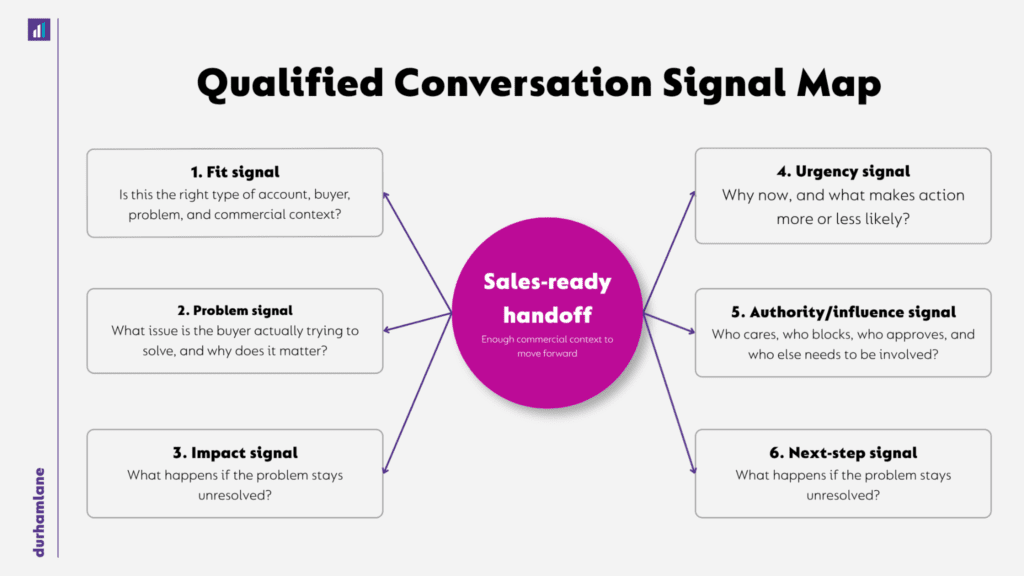
A qualified opportunity needs more than interest. The seller should understand whether the account fits, whether there is a real need, whether the contact has authority or influence, whether timing is credible, and whether the commercial context supports a next step.
The seller should test these areas without turning the conversation into a rigid interrogation. Fit comes through account context and problem match. Need comes through impact and current pain. Authority comes through understanding who else is involved. Timing comes through asking what has changed and what happens if nothing changes. Commercial context comes through priority, risk, and internal momentum.
Good qualification protects both sides of the handoff. It prevents sellers from pushing weak conversations forward just because the buyer agreed to a meeting.
Weak qualification turns curiosity into pipeline language before the opportunity is ready. Sales receives meetings that sound promising in the CRM but lack context, urgency, or a real buying path.
Use a clear qualification standard before handoff
A qualification standard makes seller judgement more consistent. Without a shared standard, every seller applies their own threshold for what counts as “ready.”
Qualification should not become mechanical. The team still needs a shared view of what must be understood before a lead or meeting moves forward. The seller should know what evidence is needed, what uncertainty can remain, and what would make a handoff premature.
A structured framework, such as durhamlane’s Magic35 qualification framework, can help organise this discipline. Magic35 is not there to reduce the buyer to a score or to make the handoff feel more scientific than it is. It helps keep discovery, qualification, and handoff anchored in commercially meaningful information rather than vague enthusiasm.
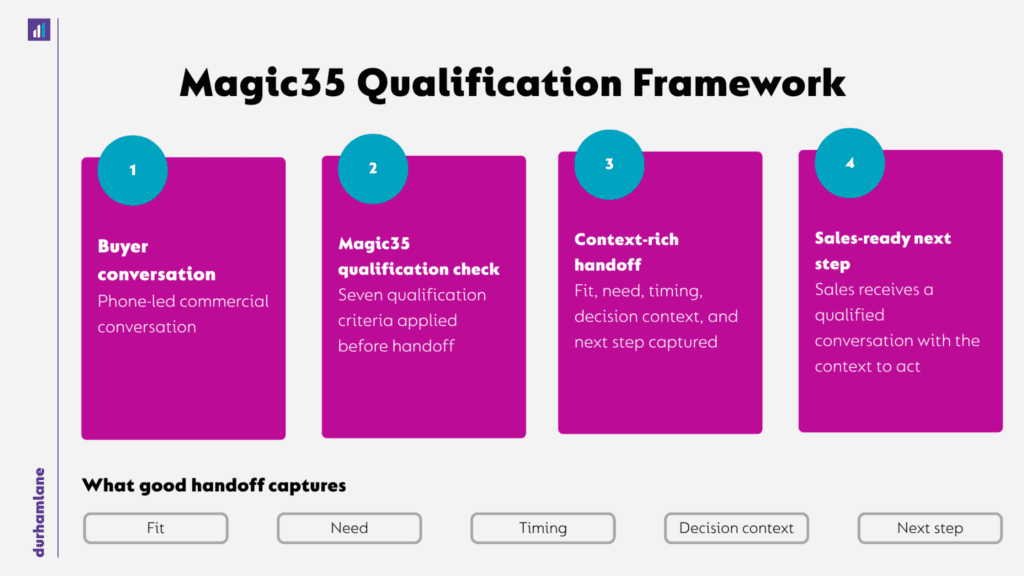
A clear standard also improves sales coaching. Managers can review whether sellers are asking the right questions and capturing the right context. In its absence, qualification gets reduced to personal preference.
Stakeholder and objection techniques keep complex deals honest
Identify who influences, blocks, or approves the decision
One interested contact is not a buying path.
In B2B sales, the first contact may be a user, evaluator, recommender, budget holder, technical reviewer, operational owner, or someone gathering information for someone else. The seller does not need to map the whole organisation in the first conversation, but they do need to understand whether the conversation has a route to decision.
The seller can ask how decisions like this are usually made, who would need to be involved, what concerns might appear internally, and what would make the next step useful for the buyer’s organisation.
Skip that stakeholder check and one person’s interest can be mistaken for organisational momentum. The deal may look alive until an unseen stakeholder blocks it, delays it, or reframes the problem.
Use objections to diagnose before you rebut
Objection handling is often taught as response practice. Buyer says X. Seller replies Y. That can make sellers sound prepared while making them miss the real issue.
An objection is useful commercial information. “We do not have budget” may mean no budget, but it may also mean the problem is not important enough. “Now is not the right time” may mean timing, or it may mean the buyer does not see enough value. “We already have a provider” may mean satisfaction, inertia, contract lock-in, or fear of switching.
The seller should diagnose before responding by clarifying what sits underneath the objection, whether that is priority, risk, authority, timing, fit, or misunderstanding. Only then does a response make sense.
Reflexive objection handling pushes sellers to argue with the surface statement. They may overcome nothing because they never understood the actual concern.
Reframe value around business impact, risk, or cost of inaction
Value framing is the seller’s ability to connect the offer to the pressure the buyer has already acknowledged.
The seller should translate features or service descriptions into buyer-recognisable consequences. Weak lead follow-up may require more disciplined qualification and cleaner context for sales. SDR capacity pressure can point to trained execution without waiting for internal hiring. Poor meeting quality often needs better qualification before handoff.
This should be done carefully. Sellers can make value clear without invented ROI claims. The conversation needs a direct line between the buyer’s stated problem and the business consequence of solving it.
If that line is missing, sellers describe what they do and leave the commercial reason to act underdeveloped. The buyer hears capability, but not enough reason to move.
Follow-up and handoff techniques protect momentum after the conversation
Follow up with context, not generic persistence
Follow-up earns value by carrying the conversation forward. Frequency alone does not do that.
A contextual follow-up reflects what was discussed, what matters to the buyer, what was agreed, what remains open, and what the next useful step should be. It should carry the conversation forward, not sound like the seller is tapping the glass from outside the buyer’s office.
“Just checking in” is usually a sign that the seller has run out of context. A stronger follow-up might refer to the problem discussed, the stakeholder concern raised, the timing issue, or the information needed before the next conversation.
A follow-up with no context becomes noise. The buyer may not object. They may simply stop responding because nothing new or useful is being added.
Capture the commercial context the next seller needs
Handoff is often treated as administration. In B2B sales development, it is where technique either preserves commercial context or loses it.
A good handoff gives the next seller enough context to continue the conversation without restarting it. That includes why the account matters, what problem was discussed, what impact or urgency was identified, who was involved, what was qualified, what remains uncertain, what objections appeared, and what next step was agreed. durhamlane’s inbound lead conversion work points to the same mechanism. Conversation handling and qualification only matter commercially if they create sales-ready context for the next step.
This protects the buyer experience and the credibility of the next seller. Few things weaken confidence faster than explaining the same problem again because the internal handoff was thin. Meetings are booked, but the commercial thread is fragile.
Where AI can support B2B sales techniques without replacing human judgement
AI can support the preparation and review around B2B sales techniques. It should not become the commercial actor.
Used carefully, AI can help sellers research accounts, summarise context, prepare questions, role-play scenarios, review call notes, improve CRM documentation, and identify patterns for coaching. But live B2B sales still depends on human judgement. A seller has to hear hesitation, decide whether an answer is commercially meaningful, clarify an objection, sense when a buyer is disengaged, and know when not to push. AI can support that work. It should not replace the human judgement that makes the technique commercially useful.
Listen Graphic Sales: Why Your Playbook Comes Before AI
durhamlane’s Inside the Funnel episode explains why the playbook has to come before AI in outbound sales. For this article, the useful point is simple. AI can support research, sequencing, coaching, and review, but seller judgement still depends on a clear ICP, message, examples, outcomes, and real conversation behaviour.

Technique execution as a capacity problem
Knowing the techniques is easier than applying them consistently.
A team can agree that sellers should research accounts, open with relevance, ask better discovery questions, qualify properly, handle objections diagnostically, follow up with context, and capture clean handoff notes. The hard part is making that behaviour consistent across accounts, campaigns, sellers, managers, and live buyer conversations.
This is where technique execution becomes a managed-capacity problem. It requires trained people, account intelligence, call discipline, coaching, review, qualification standards, and clean handoff. It also requires enough management attention to keep quality from drifting when activity pressure rises.
That is where durhamlane fits. We help B2B organisations improve sales development through phone-led, human-led SDR support, backed by AI and technology. Our focus is not high-volume appointment setting, but better conversations, stronger qualification, deeper account insight, consistent coaching, and sales-ready handovers.
The bridge matters because teams often fail when the behaviours that make activity commercially useful are hard to maintain at scale.
Better techniques make sales activity more commercially useful
The strongest B2B sales techniques are repeatable behaviours. They improve seller judgement at the moment a conversation starts producing usable evidence.
They help sellers choose better accounts, open with a stronger reason to talk, ask questions that reveal the real problem, qualify before handoff, understand stakeholder reality, diagnose objections, frame value clearly, and protect momentum after the conversation.
That is what makes them commercially useful. They do not replace strategy, process, playbooks, or methodology. They make those things show up in the selling moments where pipeline quality is created or damaged.
More activity may create more chances. Better technique makes those chances more worth sales time.
FAQs about B2B sales techniques
What are B2B sales techniques?
B2B sales techniques are repeatable seller behaviours used in specific commercial situations. They help sellers improve account relevance, conversation quality, discovery, qualification, follow-up, and handoff. They are not tricks, isolated tips, or script polish. A useful technique changes what the seller does and makes the conversation more commercially meaningful.
What is the difference between B2B sales techniques and B2B sales strategy?
B2B sales strategy decides where the company competes, which accounts matter, and what commercial direction the sales motion should follow. B2B sales techniques are the behaviours sellers use inside that strategy, such as researching an account, opening around a problem, qualifying fit, diagnosing objections, and following up with context.
What is the difference between B2B sales techniques and sales methodologies?
Sales methodologies are broader frameworks that shape how a team approaches selling. Techniques are the specific behaviours sellers use in the moment. A methodology may influence discovery or qualification, but the technique is what the seller actually does, including the question asked, the signal tested, or the next step confirmed.
How do you know whether a B2B lead is qualified?
A B2B lead is not qualified just because someone shows interest, answers questions, or agrees to a meeting. Qualification should test account fit, need, authority or influence, timing, commercial context, and next-step relevance. A clear qualification standard, such as durhamlane’s Magic35 framework, helps separate curiosity from sales readiness.
Partner with durhamlane for revenue growth
Outsourcing to sales consultants or SDR teams isn’t always the right choice, but for enterprise and mid-market businesses with ambitious pipeline targets and longer, considered sales cycles, they tend to be a faster and more cost-effective route to qualified revenue in the zero-to-twelve-month horizon, where an in-house hire is still recruiting, ramping, or finding their feet.
Book a call to discuss whether durhamlane is the right sales partner for you.