



Summary
Hiring enterprise sales development representatives in UK SaaS involves navigating 2026 salary benchmarks of £45,000–£60,000 basic with around £80,000 OTE, but matching OTE figures can mask significantly different commission rules. Beyond base pay and commission, employers must account for total first-year cash costs exceeding £112,500—or over £133,100.
Key takeaways
- UK SaaS salary guides include a 2026 enterprise SDR benchmark of £45,000–£60,000 basic, with OTE around £80,000. Check what you’ll be doing for that money and how you’ll earn the commission.
- Matching OTE figures can hide very different commission rules. Two £80,000 packages can pay £73,000 and £66,000 at the same 80% attainment.
- Enterprise prospecting takes good research and useful conversations. The seller needs the buyer’s problem, the people involved and an agreed next step. Coaching helps the SDR ask better questions.
- A £45,000 base plus £35,000 target-commission example needs about £112,500 in extra first-year cash. Count the share of existing management, space and admin the rep uses and the cost comes to about £133,100.
- A manager with time to spare and an unused software licence can keep the hiring bill down. If another rep means hiring a manager or buying several licences, budget for all of it.
For enterprise SDRs in UK SaaS, a 2026 salary guide gives £45,000–£60,000 basic and around £80,000 OTE. OTE means on-target earnings, your basic salary plus the commission you earn when you hit target. That gives you somewhere useful to start. The next job is getting under the bonnet of the offer.
Are you approaching established accounts or helping open a new market? Do you need German-language fluency or enough technical knowledge to speak with developers? What earns the commission? An impressive package can come with quite a different job attached.
For the leader making the hire, there’s a second set of numbers behind the pay packet. Someone must recruit the rep, equip them and find time to help them improve. We’ll walk you through those costs too, including the management and facilities your business may already be paying for.
UK enterprise SDR pay
Your basic salary is the fixed part of the package. The commission depends on what you’re expected to achieve. Put the targets beside the OTE and check whether the deal stacks up.
UK base pay and OTE at a glance
Timberseed puts enterprise SDR basic pay at £45,000–£60,000, with around £80,000 OTE, in its 2026 UK SaaS guide. The commission range is £20,000–£35,000. Ask your employer to spell out the basic salary and the extra you’d earn at target in pounds.
On a £45,000 basic, you’re looking at £3,750 gross a month. A £60,000 basic gives you £5,000. That’s before tax, employee National Insurance and pension deductions. Earned commission comes on top, paid on the dates in your agreement.
London, Belfast and UK-based remote roles
Here’s the salary-guide figure alongside four job adverts covering London, Belfast and UK-based remote roles.
| Role and location | Annual basic salary | OTE and commission |
| Timberseed salary guide UK SaaS enterprise SDR | £45k–£60k | Around £80k OTE |
| Maxwell Bond vacancy Senior outbound SDR, London | £40k–£50k | £80k–£90k OTE, uncapped |
| Coder Senior German-speaking SDR, UK remote | Estimated £54k–£74k | Base plus 30% variable |
| Tremendous Founding DACH SDR, UK remote | Estimated £45k–£52k | £65k–£78k OTE |
| Barclay Communications B2B SDR, telecoms/IT, Belfast | Up to £35k | Uncapped commission, OTE not stated |
*Pay figures checked in September 2026.
The London job comes with £40,000–£50,000 basic and £80,000–£90,000 OTE, plus equity. You’d be prospecting into major enterprise brands for an AI SaaS business and heading into the office five days a week. There’s a commute to price in, as well as a commission agreement to get your head around.
With Coder’s remote role, there’s some technical homework to do. The estimated £54,000–£74,000 basic plus variable pay comes with German-language requirements and conversations about developer technology. You research the accounts and set up qualification calls for an Enterprise Account Manager to run. Ask Coder what you’d earn in total at target.
At Tremendous, the £65,000–£78,000 UK OTE is made up of £45,000–£52,000 basic and £20,000–£26,000 commission. This is a founding role, helping shape how the company approaches a new market and what it says to prospects. DACH in the title means Germany, Austria and Switzerland. Both positions are remote, with rather different jobs behind the salary.
In Belfast, Barclay’s telecoms and IT SDR role comes with up to £35,000 basic plus uncapped commission. You’d find out what business customers need and book qualified meetings for the business-development team. The advert asks for at least two years in sales or telesales.
Experience, benefits and the next step
For a first SDR job, the UK SaaS salary figures are £31,000–£40,000 basic and around £45,000 OTE. Moving into enterprise prospecting can mean more homework on complex accounts, technical conversations or helping open a new territory. Check which of those you’d be expected to handle.
Have a proper look at the benefits too. You’ll see share options, development funds, home-working support and private medical insurance among the packages. Check what’s in your offer. With share options, ask when you gain the right to buy the shares and what you’d have to pay for them. Keep their potential value separate from the cash you expect to earn this year.
Ask the manager, “What do I need to do for a pay rise, and when could I get one?” Then pin down the next role, the skills you’d need to show and who makes the call. “Great career prospects” sounds lovely in an advert. A manager who can explain the next step gives you something to aim for.
Read the small print on your enterprise SDR OTE
OTE is what the package pays when the agreed target is met. It isn’t guaranteed income. Below target, thresholds and other commission rules determine earnings. Above target, an uncapped scheme may keep paying, according to its terms.
For a candidate, a larger fixed share means less income is dependent on results. A bigger variable element puts more weight on the quota and the rules for earning it. Compare the guaranteed amount with the regular income you need, then examine the potential upside.
Same OTE, £7,000 apart
Take two hypothetical offers, each with £45,000 basic and £35,000 commission at target. Plan A earns commission from the first part of the target. Plan B starts paying above 50%, then catches up to the full £35,000 at 100%.
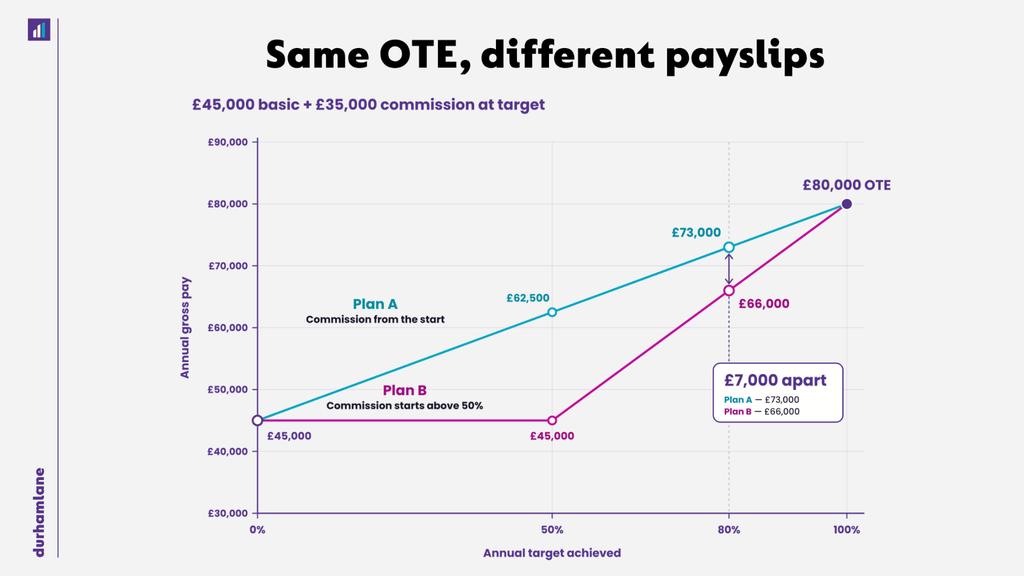
That’s a £7,000 reason to read the commission agreement.
Questions worth asking before you sign
Get answers to these three questions before accepting an offer:
- What do I earn commission on?
Does a booked meeting count, or does the buyer have to turn up? Is it an opportunity sales accepts, pipeline created, revenue, or a mix? Ask who decides whether an opportunity qualifies. Then check what happens if a buyer doesn’t show, sales turns the opportunity down or a commission payment is taken back. - What happens while I’m finding my feet?
Ask about your starting target and any guaranteed payment while you settle in. A recoverable draw is an advance, so pin down when and how the employer will recover it. For a guarantee, ask whether it tops your earnings up to a minimum or comes on top of the commission you earn. - What will I actually earn, and when will I get it?
Ask the employer to run the numbers below, at and above target. Find out what reps in similar roles earned and how many hit quota. Get the threshold, any higher rate above target (an accelerator), and any earnings cap in writing. Then check which payday the commission lands on. You might earn it when sales accepts an opportunity and receive it in a later month.
Now you’ve got something concrete to negotiate. Talk about the basic salary you need, a sensible starting target and how the commission builds up. If you’re hiring, try explaining the offer to someone new. Can they follow it without three follow-up calls?
What are you paying an enterprise SDR to do?
From the first call to a useful handover
Budget for account preparation as well as calls. In a technical role like Coder’s, the rep needs to understand the company’s situation well enough to start a credible conversation, then arrange the qualification call the Enterprise Account Manager will run. The next response may bring more people into view.
Forrester’s 2026 business-buying research reports 13 internal stakeholders and nine external participants influencing an average purchase. Its evidence comes from nearly 18,000 global buyers surveyed in 2025. The external participants are outside the buying organisation. For an SDR, the useful question is who shapes this particular decision and how the current contact fits into it.
Imagine an operations director agrees to a meeting and the CRM note says “interested in a demo”. Your account executive opens the record and has a fair bit of digging to do. What’s wrong with the current process? Has IT already been consulted? What did the director actually agree to discuss?
A good handover lets the seller pick up the conversation. It records the problem the buyer described, the people involved and the next step agreed. That takes research, careful listening and follow-up questions before anyone gets near a proposal.
Coaching time with a job to do
Recognising a missed opening takes practice. A manager might replay the moment a buyer mentions an approaching contract renewal, ask what the rep heard and rehearse the next question. “Good call” or “try harder next week” gives the seller very little to build on.
When I asked Kevin Beales, founder and CEO of MySalesCoach, about deal reviews being called coaching, he described how pressure to progress current opportunities crowds out developing the seller. The quarter-end number grabs the diary. Time spent practising a difficult conversation is easier to put off.
Kevin also recommends starting with a clear coaching plan and looking for changes in skills and behaviour before the revenue result. In the renewal example, the manager could listen to later calls for better timing questions and check whether the agreed next step makes it into the handover. There’s now something specific to develop and review.
Finding that time is part of the hiring decision. In Salesforce’s 2026 survey, 40% of sales-rep respondents said their manager’s lack of time hindered enablement. A budget line for management needs a corresponding space in somebody’s week.
What does an enterprise SDR cost beyond the pay packet?
We’ve run the numbers for a rep on £45,000 basic plus £35,000 commission at target. The first-year cash bill comes to £112,520.23 when a manager, workspace and admin are already available. Add the share of those existing resources the rep uses and the total reaches £133,148.60.
The first-year budget, line by line
The business pays for recruitment and initial training, buys the rep’s equipment and covers the software and data they’ll need. Those are fresh bills. The manager, desk space and admin are already paid for, with room for one more person.
| First-year item | Extra cash for this hire | Cost including existing support |
| Basic salary | £45,000.00 | £45,000.00 |
| Target commission paid | £35,000.00 | £35,000.00 |
| Employer National Insurance | £11,249.39 | £11,249.39 |
| Employer pension | £1,320.84 | £1,320.84 |
| Recruitment | £6,750.00 | £6,750.00 |
| Initial training | £6,000.00 | £6,000.00 |
| Equipment | £1,700.00 | £1,700.00 |
| Technology and data | £5,500.00 | £5,500.00 |
| Share of workspace | £0.00 | £3,700.00 |
| Share of admin | £0.00 | £1,500.00 |
| Share of management | £0.00 | £15,428.37 |
| First-year total | £112,520.23 | £133,148.60 |
*The £80,000 package is paid monthly, with employer pension contributions of 3% of qualifying earnings. Employer NI is shown before Employment Allowance.
That £80,000 package comes with another £12,570.23 in employer NI and pension. For 2026/27, standard Category A employer NI is 15% on monthly earnings above £417. We’ve used the minimum 3% employer pension contribution on monthly qualifying earnings between £520 and £4,189. That works out at £110.07 a month, or £1,320.84 a year. NI is worked out and rounded each payday.
The training, equipment, tech, office and admin figures come from our 2025 report on what an SDR team costs. We’ve put recruitment at 15% of the £45,000 basic, which adds £6,750.
For the manager, we’ve used £60,000 basic and £80,000 total earnings at target. Add employer NI and pension and their loaded annual pay comes to £92,570.23. Spread that across six SDRs and it’s £15,428.37 a head. Use the share of their time your SDR will actually need.
In year two, removing the initial recruitment, training and equipment purchases takes £14,450 off the budget. With all other inputs unchanged, recurring annual spending is £98,070.23, or £118,698.60 including the existing resources used.
What’s a new bill, and what’s already covered?
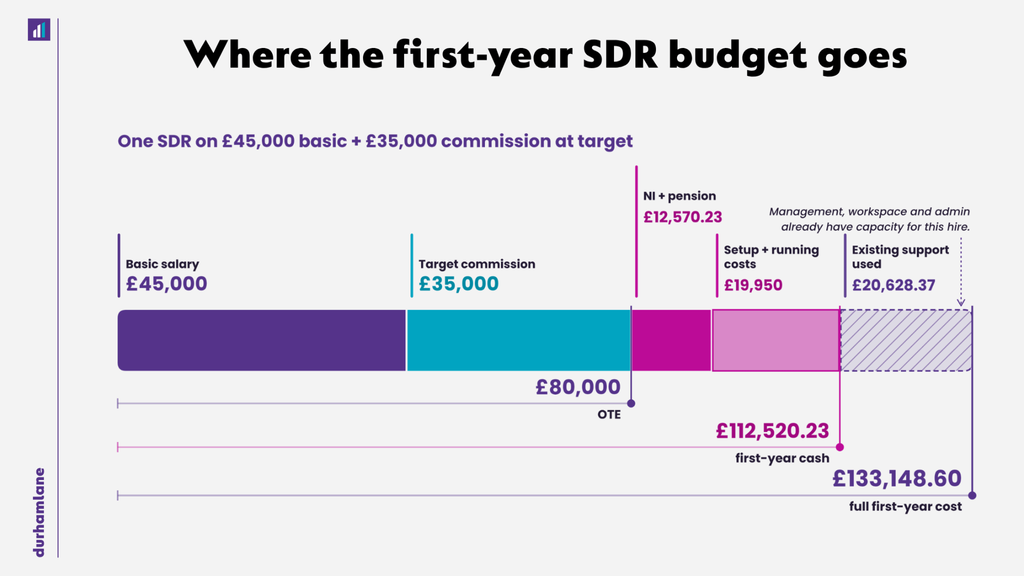
Check that with the people involved. Has the manager actually got time for another rep’s call reviews and coaching? Can admin take on the extra tasks, and is there desk space? Put the coaching sessions in the diary before counting that time as available.
If you need another manager, budget for the whole cost of employing them from the date they join. Dividing their salary across six future SDRs won’t pay this month’s bill. Software deserves the same check. An unused licence you’ve already paid for may cover the new rep. If the supplier sells licences in bundles, budget for the whole bundle.
Build your own SDR budget in five steps
To work out your own budget, take these five steps:
- Start with the pay packet:
Put in the basic salary and commission at target. Then run a below-target, on-target and above-target case using the actual payout rules. Add the dates the money will be paid. Calculate the variable amount separately from the fixed salary. - Add what the employer pays on top:
Work out NI and pension using the right category and scheme. If the business can claim Employment Allowance, check how much is left after covering employer NI for the rest of the team. - Split the one-off bills from the running costs:
Recruitment, initial training and equipment go in when you buy them. Software, data, ongoing training and benefits need an ongoing budget. Add any VAT you can’t reclaim. - Check what you’ve already got:
Is there time in the manager’s diary for coaching? Are admin, workspace and software licences ready for another rep? Agree what the coaching should help them improve, then price any extra help or purchases you’ll need. - Budget for ramp and replacing a rep:
Decide what getting up to speed looks like, perhaps a steady flow of opportunities sales accepts. Allow for changes in output, commission and coaching if it takes longer. The salary is already in your annual payroll figure. If a rep leaves, add the recruitment, retraining and any overlap costs once. Then work out how long you’ll be without a productive rep.
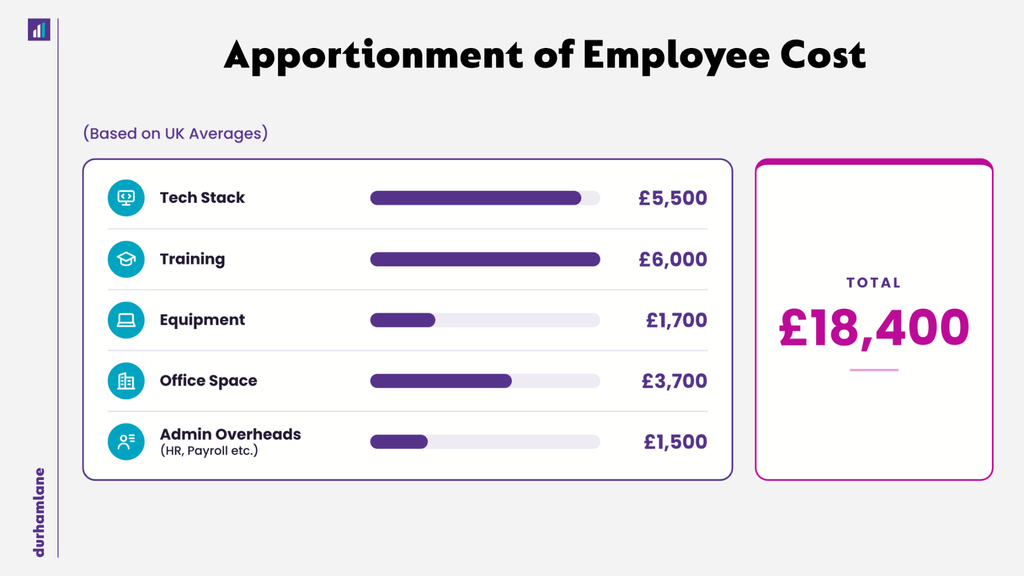
Put your own technology, training, equipment, office and admin figures into our SDR Cost Calculator. For this budget, those five items add up to £18,400. Office and admin account for £5,200 of that, using space and help the company already pays for. Alongside salary, employer charges, recruitment and management, these are the pieces of the full budget.
That gives you a clearer way to weigh up an SDR partner, too. At durhamlane, we work with your sales team to agree what makes an opportunity ready for handover. Magic35 gives us seven qualification criteria to work through, including the buyer’s need, decision criteria and reason to act.
Take competition. The buyer might be weighing up another supplier, or they might be happy sticking with what they’ve got. Each answer gives the SDR a different next question and gives your seller different context for the meeting. Our manager-led, phone-led teams carry those details into a structured handover, with a verbal briefing and feedback after the meeting.
Our SDRs have the conversations and make the qualification judgements. Your team stays involved through the handover and feedback, so the next round of prospect conversations can build on what sales has learned.
Make the whole package add up
Before you hire, put the offer next to the manager’s diary. Agree who’ll coach the rep, what sales needs at handover and which bills you need to budget for. Work those details out while you’re agreeing the package.
Tell us what you’ve already got covered and where you need a hand. Get in touch and let’s talk through the prospecting, qualification and day-to-day support your enterprise sales team needs.
What a Sales Mis-Hire Actually Costs You
Discover the true cost of a sales mis-hire and how to avoid it.
What a Sales Mis-Hire Actually Costs You
Discover the true cost of a sales mis-hire and how to avoid it.