


Summary
Traditional sales metrics often miss the complex, multi-touch reality of modern enterprise deals. With buyers juggling numerous interactions across multiple stakeholders and departments before signing, relying solely on calendar meetings underestimates the true effort required to close. Success in enterprise sales means tracking the real breadth of buyer engagement, understanding their specific buying purpose, and orchestrating the right expertise at every step.
Key takeaways
- Leave room for what happens between meetings. In 2025, the average is 16 interactions per buyer with the supplier they select, across conversations and supplier content.
- A new capability needs more back-and-forth. In 2024, buyers average 21.4 interactions with each supplier for a new capability and 16.4 for an improvement.
- High-value wins involve a wider set of buyer contacts. For $250,000+ new-business opportunities, the 2024 figures put won deals at 17 buyer contacts and lost deals at five.
- Include the meeting time spent on deals you lose when you plan capacity. Divide seller time across won and lost deals by the wins to see the meeting load behind each win.
- Find out when the buyer will review suppliers and who will lead it. That gives the next seller a reason to call, the right person to involve and the right time to pick the conversation up.
Your team has just had a promising meeting with a large organisation. Your contact likes the idea, their IT lead wants a closer look, and finance needs a clearer business case. Then the procurement team joins the conversation. Each has a decision to make before anyone signs.
Now the work spreads out. One person joins the next call, another reads the follow-up, and a technical question comes back through your main contact. If you’re planning an enterprise pipeline, the diary alone won’t tell you how much time the deal will take.
How many touchpoints does an enterprise B2B deal take?
An average B2B deal involved seven meetings in 2024. In 2025, buyers had an average of 16 interactions each with the supplier they selected, while the wider buying journey averaged 88 touchpoints across the organisation. The units are different. Seven counts meetings per deal, 16 counts interactions per buyer, and 88 covers activity across the whole buying organisation.
How much contact is involved?
| What are we counting? | Reported figure | Where it comes from |
| Meetings on a deal | 7 meetings per deal | mindtickle 2024 State of Revenue Productivity report |
| One buyer’s interactions with the selected supplier | 16 interactions per buyer | 6sense 2025 B2B buyer research |
| $250,000+ won new-business deals | 17 buyer contacts | Gong Labs analysis of 2024 closed new-business opportunities |
| People influencing the purchase | 13 inside the business and 9 outside | Forrester 2026 buying-network research, based on 2025 buyer research |
| Touchpoints across the buying organisation | 88 touches across 4 channels, with 10 buyer stakeholders across the journey | Dreamdata 2026 benchmark report, based on 2025 B2B journeys |
The wider journey goes well beyond the meeting diary. The benchmark moves from 76 touchpoints across 6.8 buyer stakeholders in 2024 to 88 across 10 in 2025. Think about a buyer who misses your demo, reads the follow-up and sends a technical question through a colleague. The meeting count stays the same. The buying conversation keeps moving.
Your account executive still needs to get that question to the right person and make sure the answer finds its way back to the buyer.
What counts as a sales touchpoint?
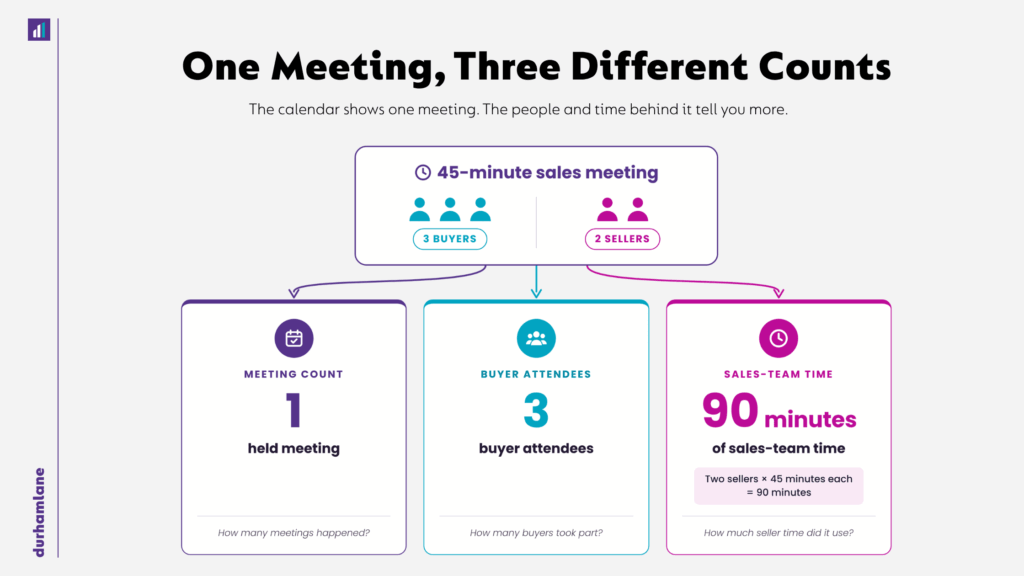
A sales touchpoint happens whenever a prospective buyer speaks with the supplier or engages with something the supplier sends or publishes. Calls, demos, webinars, email exchanges and buyer engagement with supplier content all count. Several buyers can share one meeting, so one event can still involve several people.
A slot in the diary is still only booked until the meeting happens. Keep unanswered dials and cancelled appointments in their own activity records, so you can see how much outreach turned into an actual conversation.
Why do some enterprise deals need more back-and-forth?
Some enterprise deals need more back-and-forth because the buyer is doing something new, more people have a say, or the decision takes longer to work through. Each creates a different kind of interaction load.
New capability, more to work through
A new capability lets a business do something it couldn’t do before. In 2024, buyers introducing one average 21.4 interactions with each supplier. Buyers improving an existing capability average 16.4. The count includes conversations and supplier content.
Picture a business adding remote equipment monitoring for the first time. It has to decide what to detect, who will respond and how alerts will change day-to-day operations. A team improving a monitoring service already knows how it works today, so it has something concrete to compare the proposed change with.
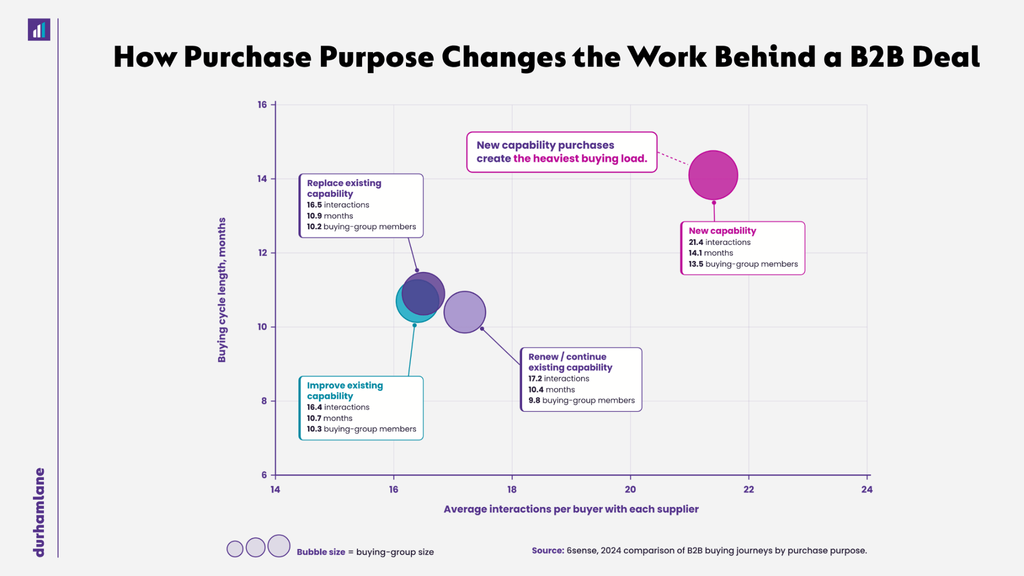
That distinction matters even with an existing customer. They may know your company well and still be buying a capability they’ve never used. Keep purchase purpose beside account status when you compare deals.
More people with a say in the deal
Enterprise purchases pull in people responsible for budgets, technology and day-to-day operations, plus advisers and peers outside the business. Some speak to the seller directly. Others shape the recommendation through your main contact, so the meeting invite won’t show everyone who has a say.
That wider circle shows up in the deal record too. Gong Labs’ current analysis of 2024 new-business opportunities shows an average of 17 buyer contacts on won $250,000+ deals and five on lost deals.
The network reaches further than the contacts your sellers have met. Forrester’s 2026 buying-network research found an average of 13 people inside the organisation and nine outside involved in a purchase, with 73% of purchases spanning at least three departments. A peer or adviser can shape the questions your seller hears without ever appearing on a meeting invite.
Your main contact has to deal with those different concerns. Operations may want to know what changes for their team, while finance is weighing the spend. Sending both the same deck leaves them to dig out their own answers.
Find out what each person needs to decide, then bring in the colleague who can help. If a technical question is holding things up, brief someone from your technical team on the buyer’s setup before they join the call. The buyer can pick up where they left off.
How long do B2B buying journeys take by company size?
In 2025, the journey from first recorded contact to a new sale takes 326 days for companies with more than 250 employees, 245 days for companies with 50–250, and 222 days for companies with fewer than 50.
Inside the 250+ employee group, the benchmark puts 220 days between marketing-qualified lead and sales-qualified lead and another 78 days between sales-qualified lead and a new sale. If your forecast starts at sales qualification, you’re starting the clock far later than the buyer’s first recorded contact. By then, months of research and internal discussion may already have happened.
A buyer who arrives after months of research may already have requirements and internal opinions in place. Find out what they’ve settled and what still needs checking, so your team doesn’t drag them back through decisions they’ve already made.
What buyers need to sort out before they sign
Before signing, buyers need to settle what success looks like, prove the solution fits, get colleagues on board and work through procurement. Those jobs create different conversations and pull different people into the deal.
Agree what success looks like:
Pin down the problem the buyer wants to solve and what a worthwhile result would look like. Use that to shape the demo and business case.
Put the solution to the test:
More than 60% of business buyers use a trial, rising to 78% for purchases worth $10 million or more. Agree what the trial needs to establish and who will judge the result. If integration is the concern, bring in the person who will test it and ask what would convince them it works.
Help your contact get colleagues on board:
Buyers rate sales reps as their most important information source when securing internal support. Ask which colleagues still need convincing and what they need to know. Give your contact an answer they can use in that discussion.
Bring procurement into the evaluation:
Forrester’s 2026 State of Business Buying reports procurement as a decision-maker in 53% of buying cycles, with procurement involved from the start and looking at functionality and performance as well as price. Bring those questions into the evaluation early enough to act on them.
A good demo can settle the product question while budget is still open. Agree what the buyer still needs to confirm before the deal moves forward, then bring in the person who owns that decision.
How to benchmark the meetings and seller time behind your enterprise deals
Build your own benchmark in five steps. Start with comparable completed deals, keep wins and losses separate, count held meetings from one consistent starting point and add up the seller time spent across those deals. Then listen back to a sample of the calls to see what the counts miss.
Pull together deals you’d genuinely compare:
Start with finished opportunities from a defined period. Count each deal from the same point, either opportunity creation or the first held meeting. Keep deal value, buying purpose and new-customer or existing-customer status to hand, and include earlier meetings that belong to deals closed in the period.
Check the diary against the CRM:
Remove duplicates and check the basics. Did the meeting happen? Who joined? How long did they stay? Ask the seller about gaps. Keep open opportunities out of the completed-deal comparison until you know the outcome and have the full meeting history.
See what a typical deal looks like:
For won and lost groups, keep the number of deals, the mean and the median meeting count. The median shows the middle of the ordered list and is less affected by a few meeting-heavy deals. Quartiles show how the middle half spreads out. Split by value or buying purpose only when the groups still contain enough comparable deals to teach you something.
Add up the seller time:
Sum the minutes each seller actually attended. For meeting time per win, divide the combined seller minutes on won and lost deals by the number of wins. If the group has no wins, report the total time without a per-win figure. Keep preparation and prospecting separate when you need the wider staffing picture.
Listen for what changed:
Sample calls from won and lost deals. Look for the people the team reached, what the buyer clarified, how the forecast changed and what follow-up was agreed. An early obstacle is useful information even when the call ends without another meeting in the diary.
Once you have the counts, listen back to a few calls. Luke Richards told me his Salesloft team used to celebrate dial volume. He shifted weekly recognition towards reps who actually got through to people. One rep had led the team on connected calls for six months and treated calls as a chance to learn something or get an introduction elsewhere in the business, taking some of the pressure off booking a meeting every time.
I look at the objective of the call alongside the connection rate. Luke also described how a live conversation can uncover a risk the seller hasn’t spotted or change their view of how promising the deal is. That gives the manager something concrete to coach. What did the buyer say? What changed in the forecast? What should the rep check next?
Give the next sales conversation a head start
Give the next seller what the buyer has already decided, what is still open and who needs to make the next decision. That gives the follow-up a useful starting point.
Research and CRM data give the seller a starting picture. Joey Gilkey of TitanX explained that the live conversation adds immediate feedback and information you can’t get online. When the buyer changes that picture, the next question should change with it.
Some of the most useful information only comes out when you ask. When G4S came to durhamlane, they wanted to expand their London business and needed fresh market intelligence. During onboarding, we agreed what our calls should establish about prospects’ existing security suppliers, the services they provided and when their contracts ended. We supplied qualification reports to G4S’s senior business-development managers for immediate opportunities and prospects returning to market later.
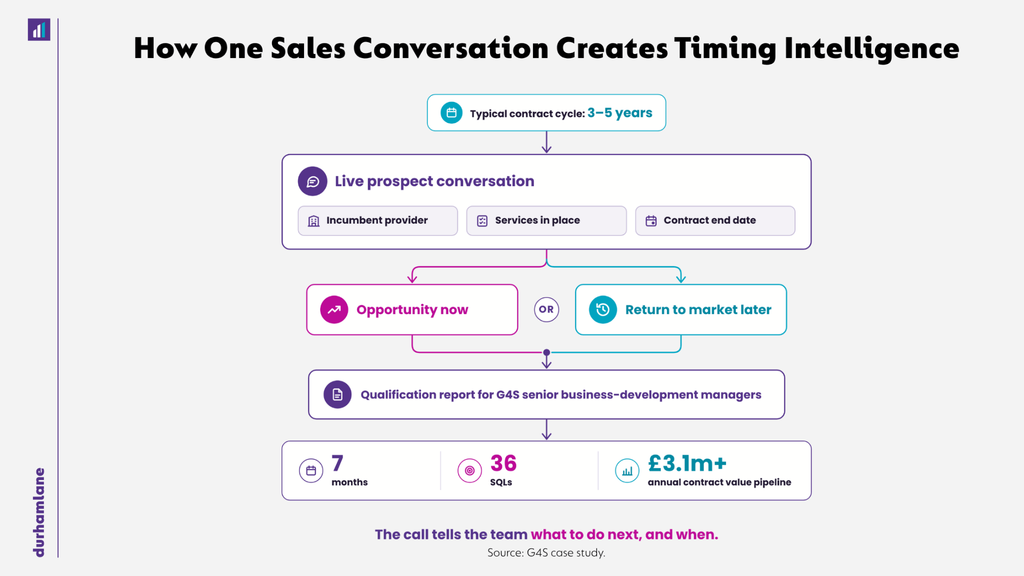
Knowing the contract end date gives the team a fact. The live conversation tells you what to do with it. Your seller can ask, “When will you start looking at alternatives, and who’ll lead that review?” A contract may run for some time while the buyer’s review starts much earlier. Agree when the team should come back, then record the date, the contact and the answer in the buyer’s own words. If the conversation uncovers a need the current supplier can’t meet, capture that too.
Before the client’s seller takes the meeting, we send the qualification information and talk it through. Our rep joins the first conversation, so the seller has someone to ask about anything still unclear. We ask for feedback afterwards to learn what the seller needed and what was missing.
Before we start calling, we agree with the client team what makes a prospect worth a sales meeting. That covers the type of company, the people involved, the business need and its timing. Our delivery managers coach the SDRs day to day. If a buyer mentions a contract ending and the rep never asks when the review starts, that’s the moment to replay and practise the follow-up.
So, where does that leave you?
Use external benchmarks to judge the scale, then your own won and lost deals to see how much meeting time your team really spends. Carry the buyer’s timing, open questions and decision owners into the next conversation so the seller can pick up the thread.
Get in touch – let’s talk about how we’d prepare, qualify and hand over opportunities with the context your enterprise sales team needs.