


Summary
Choosing between a full-cycle sales model and an SDR/AE split comes down to diary capacity and workload management. While full-cycle reps own the entire journey, live deals often squeeze out prospecting when pipelines get busy. Splitting the roles protects prospecting time, but success depends entirely on strong handovers, matched pacing, and clear qualification.
Key takeaways
- A full-cycle rep has to prospect and close. When live deals pile up, prospecting needs protected time or it gets squeezed out.
- An SDR/AE split protects prospecting time. It only works if the handover is solid and AEs can keep up with the opportunities SDRs create.
- SDR support doesn’t take prospecting off the AE completely. In a 2026 survey, AEs sourced 33% of pipeline in the $50k-$100k average-sales-price group and 39% in the $250k-plus group.
- The cheaper option can change as workload grows. One extra hire can change the maths very quickly.
- Full-cycle, split and hybrid setups solve the job differently. The right choice depends on who can prospect, who can close, how much of each job there is and how well buyer context survives a handover.
There’s a familiar moment in a sales team when today’s deals start eating tomorrow’s pipeline. Discovery calls multiply, proposals need work, procurement wakes up, and prospecting slips to Friday afternoon. Then Friday disappears too.
That’s the practical question behind the full-cycle model. Do you ask the same seller to find the opportunity and close it, or split the job between SDRs and Account Executives? Labels matter less than the diary. Someone still has to find the right accounts, start conversations, qualify what’s real, move live deals forward and make sure next month doesn’t arrive with an empty calendar.
That leaves three practical questions. (1) Who keeps prospecting moving? (2) Who has enough time for live deals? (3) Which setup needs another person first as the workload grows?
What does a full-cycle sales rep actually own?
A full-cycle sales rep owns the sales journey from prospecting through a won or lost decision. They find accounts, start conversations, qualify what they hear, run discovery, bring in demos or technical support, shape proposals, negotiate and work the deal to a close. Marketing, sales engineering, managers and RevOps can step in around them. They own the job from prospecting to close without having to do every piece of it alone with a laptop and a heroic to-do list.
An SDR or BDR focuses on early prospecting and qualification. The AE takes over and carries the later sales process. In practice, the line moves. Salesforce’s own guidance has AEs prospecting alongside SDR and BDR teams, so an AE can have SDR support and still self-source.
Full-cycle doesn’t have to carry on after the sale. Account management or customer success can take over after close, with renewals and expansion handled separately.
One seller has to switch gears a lot. Prospecting calls for account research and cold openings. Qualification needs listening and follow-up questions. Proposals and negotiation need commercial judgement. Keeping prospecting alive while live deals move needs diary discipline and decent CRM hygiene. You’re asking one person to open doors and then walk opportunities through them.
Prospecting and closing in one role or two?
With a full-cycle rep, the buyer stays with the same seller. That seller has to protect time for two different jobs. An SDR/AE split gives prospecting its own person and creates a handover into the closer. The practical differences show up in the diary, the handover and the next hire.
| What changes | Full-cycle rep | SDR/AE split |
| Buyer context | The same seller stays with the buyer from first conversation to close. | The SDR starts the conversation. The AE takes over with what the SDR has learned. |
| Calendar | Prospecting and live deals compete for the same diary. | Prospecting gets protected time. An overloaded SDR or AE can throw the balance off. |
| Skills and feedback | The same seller sees which early conversations turn into good deals. | Each role gets more focused practice and coaching. Deal feedback has to travel back to the SDR. |
| Cost and staffing | Lighter demand may fit one rep doing both jobs. | Different jobs can sit on different pay bands. The team needs enough demand to keep both roles busy. |
| Cover | One absence can hit prospecting and live deals at the same time. | Cover is easier to arrange by role. A vacancy at either stage can slow the team down. |
Keeping both jobs with one seller
The appeal is obvious. The person who heard the first objection also hears what finally gets the deal over the line. There’s less routine context to hand over, and the seller sees quickly which opening conversations turn into good deals. If a message keeps bringing in the wrong sort of opportunity, they feel it downstream.
Then the calendar takes over. Live opportunities shout louder than prospecting. A proposal due today will usually beat an account list for next month. A procurement call will beat a cold call. Without protected prospecting time, the role can drift into closing with occasional bursts of panic-sourcing.
If that rep is off, leaves or gets buried in late-stage deals, prospecting and live opportunities both take the hit. Cover, coaching and a clear view of the diary matter.
Splitting prospecting and closing
An SDR/AE split gives each job more room to breathe. SDRs can stay focused on prospecting, managers can coach a narrower set of skills, and AEs can spend more of the week on discovery, solution work, negotiation and close. Different jobs can also sit on different pay bands.
A calendar invite and a note saying “Good call. Seems interested.” won’t give the AE much to go on. Give them the buyer’s problem, who’s involved, what’s already been said, what could get in the way and what happens next.
The two roles also need the same idea of what counts as a qualified opportunity. Later-stage feedback has to make its way back to the SDR. If it doesn’t, the team can end up optimising for meetings the AE never really wanted.
If SDRs create more qualified opportunities than AEs can take on, meetings stack up or quality slips. If AEs have space and prospecting is thin, expensive closing time sits idle. The two sides need to keep pace with each other.
How much prospecting are AEs still doing?
More than an org chart might suggest. An AE with SDR support can be expected to create part of their own pipeline, and the share varies with the kind of sale.
In a 2026 survey of 158 B2B companies, AEs sourced 33% of pipeline in the $50k-$100k average-sales-price group and 39% in the $250k-plus group. The percentages move around across the other deal-size groups as well. SDR support and AE self-sourcing often sit side by side.
Team design varies as well. A 2025 SDR benchmark found one SDR supporting 2.4 AEs on average. The most common setup was one SDR to two AEs at 31%, while one-to-one appeared in 20%. For the two-person comparison, one side has two full-cycle reps. The other has one SDR and one AE.
So ask the question inside your own team. How much pipeline are AEs still expected to create, and what happens to that time when live deals get busy?
Same 13 weeks. Two ways to use the time
Before the maths, one bit of pay context helps. The 2025 SDR benchmark puts median SDR OTE at $80,000. The 2026 AE benchmark puts median AE OTE at $200,000. OTE means base salary plus target variable pay. AE pay also moves sharply by deal size, from $120,000 below $5,000 ASP to $240,000 at $250,000-plus.
For this scenario, I use the $200,000 AE median for the full-cycle seller, then assume 25% on top of pay for employer costs, $6,000 a year for technology and data, and $20,000 for management and support on both sides.
Ten hours of each 40-hour week go to other responsibilities and an allowance for leave. Each opportunity that makes it through qualification carries eight hours of prospecting and twelve hours of discovery, follow-up, proposal work and negotiation. The prospecting allowance includes research, unsuccessful attempts, no-shows and disqualification. The downstream allowance covers the deal whether it is eventually won or lost.
Two people in each setup. Who gets stretched first?
Two full-cycle sellers can move their own time between prospecting and active deals. In the split pair, the SDR has more room for sourcing than the AE has for downstream deals, so the AE fills up first.
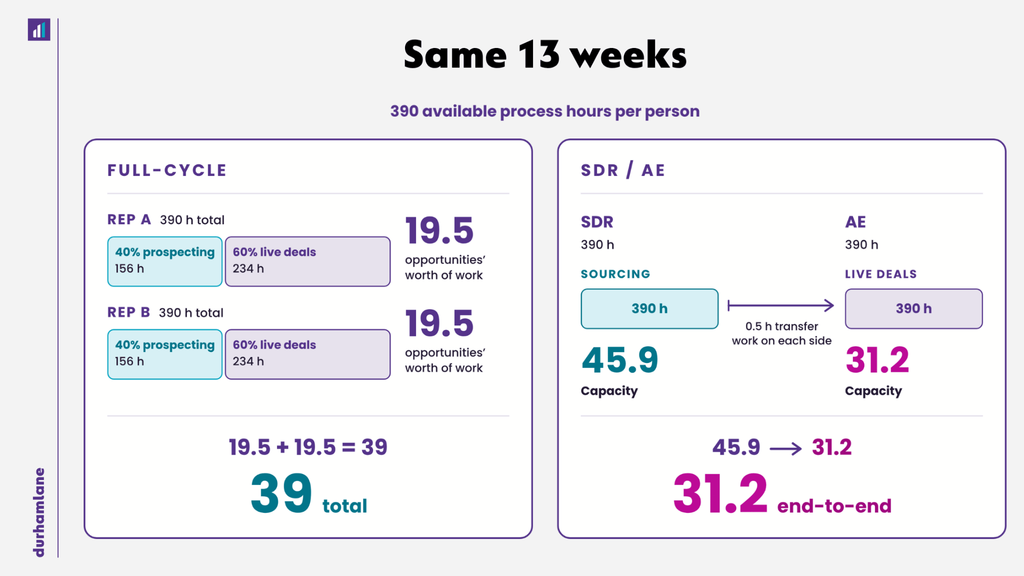
Two full-cycle sellers can keep the whole journey moving in parallel. In the split pair, extra SDR room stops helping once the AE is full.
How much busier can each team get before you need another hire?
The next hire changes the maths. A lighter workload may fit one full-cycle rep while an SDR/AE setup needs both jobs covered. Add more work and the full-cycle side can need its second person before the split team needs another closer.
| 13-week workload | Full-cycle team | SDR/AE team |
| 15 opportunities’ worth of work | 1 rep $69,000 | 1 SDR + 1 AE $100,500 |
| 30 opportunities’ worth of work | 2 reps $138,000 | 1 SDR + 1 AE $100,500 |
| 40 opportunities’ worth of work | 3 reps $207,000 | 1 SDR + 2 AEs $169,500 |
A spreadsheet is perfectly happy with 0.37 of a person on a Tuesday afternoon. The company still has to hire the whole person.
That’s why the cost comparison can flip even though the pay assumptions haven’t changed.
How far does the same budget go?
At $138,000 for the 13 weeks, a small self-contained team can afford two full-cycle reps or one SDR and one AE.
A larger organisation can spread SDR and AE time across a wider team. If that time can be divided perfectly, the same $138,000 supports 47.62 workloads in the model. A small team has to add the next SDR or AE when one role fills up.
So there are two different planning questions:
- One asks which complete team you can put on the payroll.
- The other asks how far a shared pool of SDR and AE time can stretch.
Mixing them creates clever-looking maths and odd-looking org charts.
Why is the SDR/AE split harder to run now?
When I was selling in 1996, the kit was fairly basic. A phone, a computer that was only just becoming useful, the early internet and plenty of brochures. I spent a lot of time speaking to people. Roll forward three decades and we have an extraordinary stack of technology designed to help us reach buyers, yet getting a real conversation can feel harder.
When I discussed that change with Joey Gilkey, founder and CEO of TitanX, he traced the split back to scale. Full-cycle sellers once carried much more of the journey themselves. Teams then carved the job into specialist roles so each part could be repeated and expanded. His argument was that specialisation brought extra roles, tooling and data costs while automated outreach made already-crowded channels even noisier.
The numbers tell a mixed story. The 2025 SDR research reports 60% of reps reaching quota on average and 4.1 quality conversations per rep per day. Raw pipeline dollars also rose as the deal-size mix changed. Some measures were under pressure while others improved.
AEs also source their own pipeline, including in larger-deal groups. The modern split already has more overlap than the clean SDR-then-AE boxes on an org chart suggest.
The split gets harder when SDR output, AE workload and handover quality stop lining up. The tooling has to earn its keep. Extra volume can make crowded channels even noisier. The phone still works. Brute-force volume is a poor substitute for a relevant reason to call.
Which setup fits your team?
- Full-cycle sellers prospect and close:
It suits sellers who are good at both and can keep prospecting in the diary even when live deals pile up. - SDR/AE teams protect prospecting time:
AEs need room for what comes through, and the handover has to be strong enough for them to pick up the conversation properly. - Hybrid teams keep some prospecting with AEs:
Shared SDRs cover another part of the market, so closers create some of their own pipeline without carrying all of it.
If you’re moving from one setup to another, start with one segment of the market. Leave live deals with the people already running them. Decide which new conversations move between roles, then compare prospecting time, held meetings, accepted opportunities, rework, how many live deals AEs are carrying and cost over the same period.
Changing the split among people you already have is one thing. Hiring is slower. The 2026 AE benchmark puts average ramp to full productivity at 6.2 months. Early progress shows up first in prospecting, meetings and accepted opportunities. Revenue waits on the buyer’s remaining sales cycle.
Keep prospecting moving while closers close
Your AEs can be perfectly capable of prospecting and still lose the time for it. Live deals take over the diary. At durhamlane, our SDR teams take on the prospecting and first qualification so your salespeople can stay focused on the opportunities already in motion.
That only helps if the handover is worth having. A meeting on its own is not the point. Our SDRs use Magic35 to test what the conversation has actually opened up, whether there is a real problem behind the interest, who is involved, what might block progress and what should happen next. That gives the closer enough substance to move the deal forward without dragging the buyer back through the same ground.
Managers listen to calls and coach the questions behind that judgement. What closes, stalls or falls apart later in the deal can feed back into prospecting too, so the team gets sharper about which conversations deserve a closer’s time.
For teams where prospecting keeps losing the diary battle, that gives you another option. Prospecting keeps moving, qualification gets tighter and closers get more room to close.
Choose a setup your team can keep running
Don’t choose the model because it’s fashionable. Look at the job in front of you.
- Start with prospecting:
How much prospecting needs to happen every week? - Look at the closers:
How much live-deal work are they already carrying? - Check the role fit:
Can the same sellers keep both moving? - Find the next hire:
Which setup reaches that point first?
Pick the setup your team can still run when deals bunch up, diaries get messy and somebody goes on holiday.
If sourcing keeps getting squeezed or your AEs aren’t getting enough useful context from the handover, get in touch. We can look at where the pressure is building and whether a dedicated SDR team would give the rest of your sales team more room to sell.
The True Cost of Building an SDR Team
An in-depth look at the hidden costs, risks, and challenges of building an in-house SDR function versus outsourcing.
The True Cost of Building an SDR Team
An in-depth look at the hidden costs, risks, and challenges of building an in-house SDR function versus outsourcing.