



Summary
Enterprise sales strategy development isn’t governed by a single deadline, but by four distinct milestones: settling the strategy charter, reaching launch readiness in around 30 days, using month one for operational learning, and conducting a formal proof-of-concept review at six months.
Key takeaways
- Define what the date is meant to unlock. Agreeing the direction, launching the programme, learning from buyers and deciding what happens next are separate commitments.
- For a launch-ready programme, we plan around 30 days to go live. That clock starts when scope, inputs, owners and launch dependencies are in place.
- Use month one to adjust execution. Buyer response shows which messages, proof points and qualification assumptions need work.
- Plan around six months for a formal proof-of-concept review. Use that point to decide whether to scale, repair, narrow or stop.
- A broader, well-coordinated programme can reach a decision before a narrower blocked one. Remove decision delays, protect specialist capacity and run independent preparation in parallel.
Sales leaders need dates before they commit budget, specialist time and executive attention. One requested date often covers several different commitments, from agreement on the commercial direction to programme launch, early buyer response and the point at which a larger resource decision becomes defensible.
Those commitments mature at different speeds. A team can be ready to test a proposition long before leadership knows whether the programme deserves more capacity. Early conversations expose weak messages, inaccessible accounts and missing proof while the wider commercial case is still taking shape. A single deadline hides those differences and encourages the wrong trade-offs.
A useful enterprise sales strategy timeline starts with the decision the date is meant to enable. Leaders can then map the longest dependency path, separate preparation from waiting, assign authority and protect enough live-market learning to support the next move. The result is a planning range with a clear start, finish and management purpose.
There are four different answers to “how long?”
Enterprise sales strategy development has four practical milestones. At durhamlane, we plan around 30 days to reach launch readiness when the prerequisites are present. We use month one for operational learning and schedule a formal proof-of-concept review at about six months in a well-defined programme. The strategy-charter milestone has no fixed duration because it depends on how much commercial direction is already settled.
Before programme planning begins, the wider B2B sales strategy and the chosen enterprise sales motion need enough definition to guide account scope, proof and resource decisions. Market choice, product direction and the basic commercial proposition belong upstream of the launch commitment.
Programme-development timing answers a different question from B2B sales-cycle length. Programme development follows the organisation from an agreed direction through launch, learning and a resource decision. Sales-cycle timing follows the buyer through a purchase.
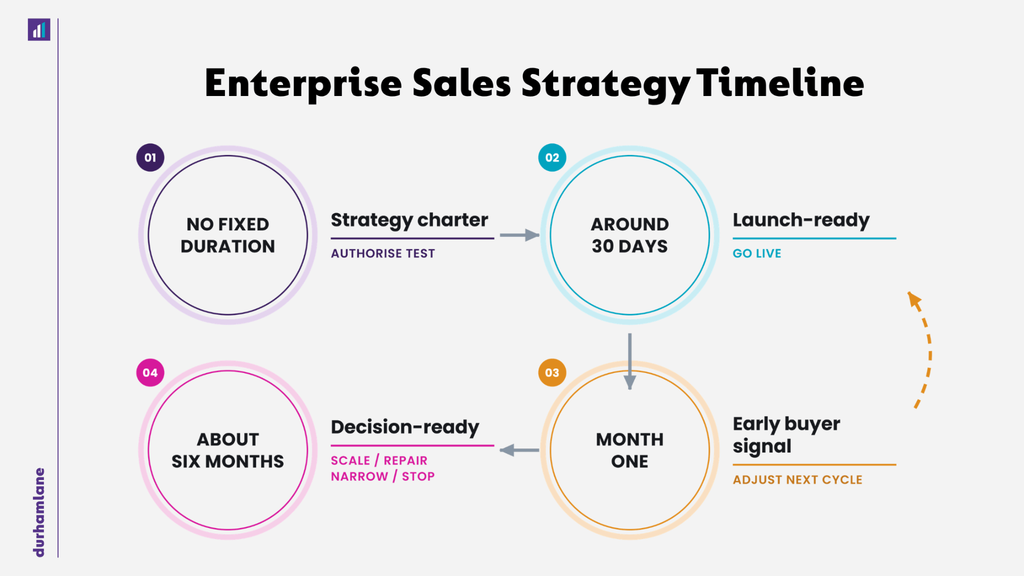
Each clock starts when its minimum starting condition exists, so counting from the first internal discussion hides the real source of delay.
Who owns the decisions behind the timeline?
Completed preparation often sits idle because each function assumes another owns the approval. A governable timeline gives each milestone one named decision owner, the information that person needs, the latest useful decision date and the action available once the decision is made.
| Decision | Typical decision authority | Evidence required | Decision available |
| Portfolio commitment | CRO, VP Sales or executive sponsor | Account fit, opportunity economics and protected capacity | Commit, narrow or stop pursuit |
| Proof and risk architecture | Sales leader with product, delivery, security and commercial owners | Buyer proof needs, plus delivery, security and commercial readiness | Build, repair or hold |
| Resource ceiling | Sales leadership, RevOps and relevant specialist leads | Seller and specialist availability against protected workload | Allocate, defer or rebalance |
| Local exception | Regional or country sales leader | Evidence that local conditions justify the exception, plus its boundary and named owner | Approve exception, standardise or repair |
| Pilot evidence review | Named pilot owner, with a cross-functional review forum | Decision-grade pilot evidence. Early signals alone don’t settle the decision | Continue, repair or stop |
| Scale decision | Executive sponsor, with a commercial decision forum | Tested assumptions, unresolved risks and scalable capacity | Scale, repair, narrow or stop |
Titles vary by organisation. Each decision still needs one named accountable owner.
The final column turns the register into an operating tool. A review can release capacity, approve a proof route, change the pilot, authorise a local exception or end the programme.
The schedule also needs a latest useful date. Product approval creates rework if it arrives after the pilot message is finalised. Security guidance creates delay and weakens credibility when it appears only after a buyer asks for proof. A local exception approved after the market window has closed has no operational value.
Book the decision forums before the programme needs them. If a proof question requires product and security judgement in week three, those owners need the question, the required format and the review date in advance. The same applies to the formal proof-of-concept review. The criteria and the people authorised to use them should exist before live activity begins.
What actually changes the timeline?
Elapsed time comes from two sources: work that must happen in sequence and waiting attached to decisions, buyer access, proof and scarce specialist input. Scope affects the amount of work. Dependencies and waits determine how quickly that work reaches a usable milestone.
Work that has to happen in sequence
Some choices create the inputs for everything that follows:
- Leaders need a credible pursuit decision before they commit specialist capacity.
- The team needs a proof route before it tests a message that depends on that proof.
- Qualification and handoff criteria need to exist before managers can judge whether live conversations are progressing towards a sales-ready outcome.
Other preparation can overlap once the shared assumptions are clear enough. Account research, data preparation, message development, proof design, CRM setup and manager preparation can move together when each team knows which decisions are fixed and which assumptions remain open.
A plan becomes useful when it shows more than activity. Forrester’s 2025 planning guidance connects priorities, owners, resources, milestones, governance and feedback as inspectable parts of the plan. In an enterprise sales programme, every workstream should show the decision it depends on, the date that decision is needed and the work that can continue without it. That makes a two-day approval visible as the controlling constraint even while a longer analysis progresses outside the critical path.
In my experience, an extra day of analysis rarely makes a programme slow. The larger delays usually come from decisions with no date, buyer access that depends on one sponsor, or proof questions that surface after the team has committed to a route. Those waits need the same management attention as the preparation itself.
The path changes when a new buyer requirement moves proof ahead of messaging, or when a delivery constraint turns parallel work into a launch blocker. Update the route when the controlling dependency changes, and keep the reason visible.
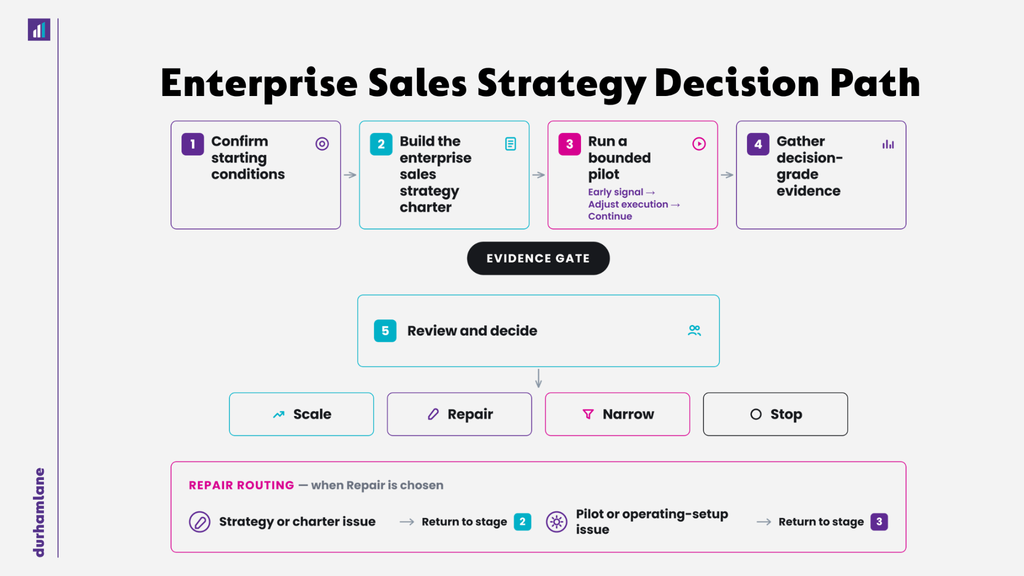
Waiting that has to be managed
Enterprise programmes lose time when the underlying task is complete but the next decision isn’t available.
- An executive decision moves to the next leadership meeting.
- Buyer access depends on a sponsor introducing another function.
- Product specialists are committed elsewhere.
- Security asks for a different proof format.
- Procurement hasn’t clarified the evaluation route.
- A regional team sees a local problem and lacks authority to act.
A vague wait gives leaders little control. “Waiting for security” says nothing about what is missing or when the delay becomes critical. “Security lead to confirm the required data-flow proof by Friday, with escalation to the executive sponsor on Monday” becomes a schedulable dependency.
One source of waiting sits inside the buying group. Gartner’s 2025 buyer-team research shows why support from one stakeholder can coexist with unresolved conflict elsewhere. For the programme, access becomes a planning dependency. Which functions are still missing, what remains untested and who can open the next conversation?
Even consensus doesn’t finish the buyer-side path. Forrester’s 2026 business-buying research places procurement, trials and proof inside the wider information network around a decision. Those steps need owners, material and access before they become late-stage blockers.
The programme can still stall after the buyer path is open. A 2026 qualitative case study in the Journal of Marketing Management draws on one knowledge-intensive business services setting and identifies constraints inside the selling organisation, including incentives, credit, authority, knowledge access and proposal governance. Each constraint calls for a different intervention. A general call for alignment doesn’t identify what is holding the programme in place.
Across the buying group, the buying process and the selling organisation, the management job is the same → name the owner, the missing input, the escalation route and the latest useful date.
Global programmes add another coordination problem. Local teams need enough room to respond to what buyers say, while the central strategy needs a clear route for approving material changes. Without that route, local evidence either goes unused or fragments the programme across markets.
Recommended listen
On our podcast episode, Simon Hazeldine and I spoke with Neil Ritchie, then Head of Global Marketing and Sales for Motion Services at ABB. We discussed how a global organisation can stay close enough to local customers to listen and adapt without losing a common direction. Neil’s argument went beyond giving local teams more flexibility. A generic account label can conceal different persona needs, while the operating process still has to remain simple enough to travel across languages and cultures.
For an enterprise sales programme, that creates a concrete governance test. Decide in advance which local adjustments the team can make, which need central approval, and how buyer evidence reaches the person authorised to change the plan.
Why a broader programme can move faster
Scope alone doesn’t determine elapsed time. A broader programme can reach a decision sooner when ownership is clear, specialist capacity is available and independent preparation runs in parallel. A narrow programme can take longer when slow decisions and readiness gaps force each step into sequence.
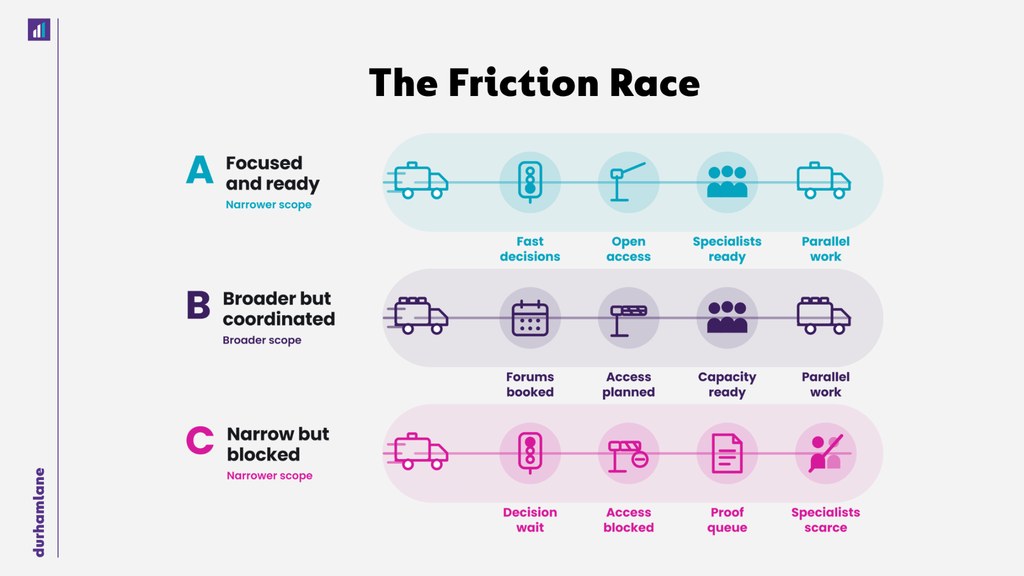
The same model translates those starting conditions into sequencing, safe overlap and waiting time. The chart below shows the resulting pilot-ready and decision-ready planning windows.
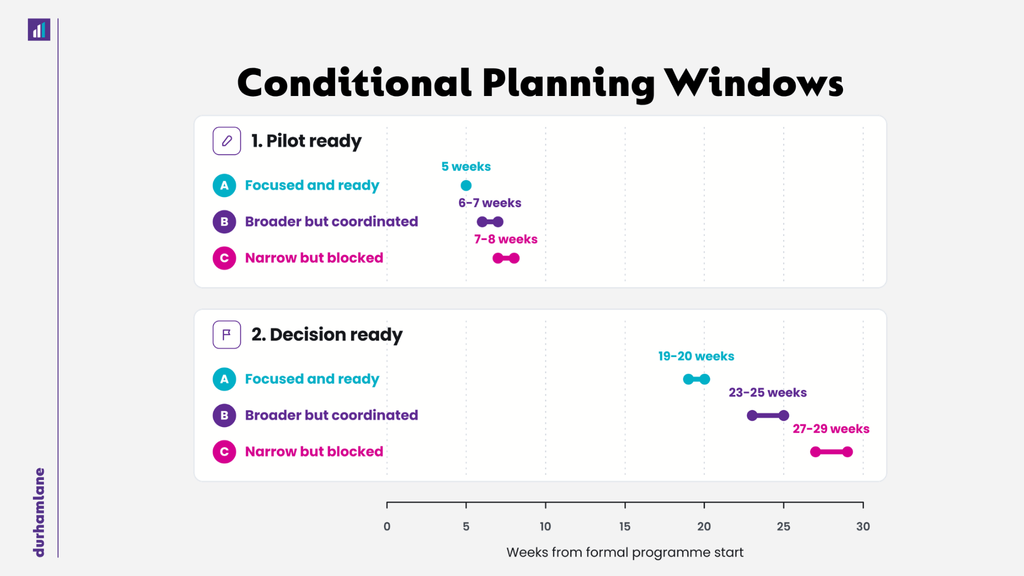
Scenario B reaches both milestones before Scenario C. The management question therefore shifts from scope alone to the dependency or wait controlling the date.
Additional scope creates risk when it brings unowned complexity. A narrower programme can still take longer when decisions, buyer access, proof and specialist capacity arrive too late.
Build the programme in three phases
The four milestones become easier to manage through three operating phases. Launch, learn and decide! Each phase ends with a different management action and uses a different basis for judgement.
1. Launch
Launch means the programme is ready to test a defined set of assumptions through live commercial activity. It needs agreed scope, named owners, client inputs, target-account boundaries, messaging, data and systems readiness, qualification expectations, specialist dependencies and a sales-ready handoff route.
For a launch-ready programme, we work to get into market in around 30 days when those prerequisites are already available. The clock starts at that clean onboarding point. Product, scope or data decisions that remain open belong to launch-readiness work before the commitment.
Keep the launch record short enough to use. It should name the scope being tested, the commercial assumptions, the accountable owner, the first review date and the conditions that pause execution. Going live authorises the test and opens the first opportunity to learn from buyers.
2. Learn
Month one is where planning meets buyer reality. Managers examine which messages create substantive conversations, which accounts are accessible, where qualification assumptions survive scrutiny and which objections expose missing proof, risk or delivery detail.
The learning record connects the original assumption, the observed signal and the change made. A channel adjustment, message change or narrower target is justified when the team can show what it heard and why the response matters. The learning then accumulates across calls and accounts instead of disappearing into isolated anecdotes.
Use month-one signals to adjust messaging, targeting, proof preparation and coaching. The next review question is practical. What did buyers tell us, which assumption changed and what should the programme test next?
3. Decide
The formal review compares accumulated buyer response and operating performance with the criteria agreed before launch. For a programme with clear scope, defined review criteria and named owners, we generally schedule the first proof-of-concept review at about six months.
Each outcome has a distinct resource consequence.
- Scale adds capacity under defined conditions.
- Repair changes a defective part of the programme and sets a new test.
- Narrow concentrates effort where buyer response is strongest.
- Stop releases capacity when the value, access, risk or implementation conditions no longer justify further commitment.
When Omron Healthcare turned to us to build a proactive route to market for Hypertension Plus, we began with a three-month proof of concept and one full-time resource. Month one produced the first useful market signal. By month two, impromptu phone conversations had proved difficult, so the team shifted more heavily towards email and pre-booked discovery. The formal month-three review led to a 12-month extension and an increase to two full-time resources.
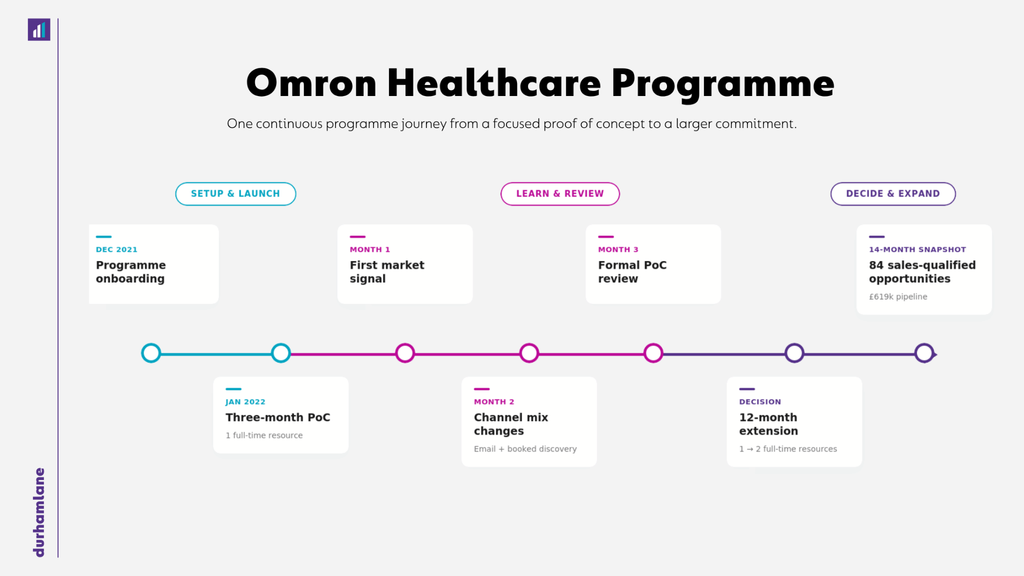
Launch, early signal, operating adjustment, formal review, extension and later commercial outcomes didn’t arrive at the same point. Each decision used a different body of information.
Record the information considered, the action chosen, the owner and the next review condition in a decision log. The log preserves the reasoning when people, markets or specialists change and keeps the same unresolved question from returning at every meeting.
How to shorten the timeline without weakening the basis for the decision
A sound resource decision needs more than a date. It draws on buyer response, access to the relevant functions, proof requirements, qualification quality, operational readiness, handoff information and unresolved risk or implementation conditions. To shorten the programme safely, remove waiting and rework while protecting those inputs:
Repair readiness before the clock starts
Resolve missing direction, client inputs, data access, ownership and launch dependencies before the target date becomes a public commitment. Visible readiness gaps then stay outside the delivery schedule.
Pre-book the decisions
Put launch, proof, exception and scale forums in the calendar. Name the accountable owner and define the information format. Completed preparation needs a decision while it is still useful, before the programme is forced to wait for an executive diary to open.
Define where overlap is safe
Account research, data preparation, manager preparation and proof design can run in parallel when their minimum inputs are known. Each workstream also needs a rule for handling a changed assumption without rebuilding everything downstream.
Protect scarce specialist capacity
A 2025 modelling study in Production and Operations Management analysed 4,574 opportunities across 23 countries at one global services firm. It separated opportunity attractiveness from the portfolio that could be pursued under limited bidding capacity. For an enterprise sales programme, the implication is direct. An attractive new pursuit can still slow higher-priority work when it draws on the same solution experts, commercial reviewers or seller time. Capacity belongs in the pursue-or-defer decision.
Create early buyer access and escalation
Seek sponsor access, technical validation and procurement answers early enough to act before delays compromise the review date. Internal confidence can’t supply the proof that only real buyer questions and decisions reveal.
Track waiting separately from preparation
A message-development task that takes four days needs a different response from a four-day approval wait. The first needs better craft or resourcing. The second calls for a named owner, an earlier forum or a clear escalation route.
How durhamlane turns strategy into a testable commercial programme
Your leadership team sets the commercial direction and retains control of product, pricing, risk, closing and delivery commitments. durhamlane turns that direction into a manager-led sales-development programme using account research, phone-led outreach, qualification and sales-ready handoff.
Account intelligence sharpens the opening hypothesis. Phone-led human conversations then test relevance in real time. Our qualification and handoff discipline gives managers and sales teams a shared standard for deciding which conversations deserve further investment.
Managers compare recurring buyer questions with the original account priorities, qualification rules and proof assumptions. That feedback gives your team a clear basis for changing targeting, messaging or the material prepared for the next conversation. Within our manager-led operating model, AI supports research, role-play, data quality and workflow. Managers and SDRs retain the buyer conversation, qualification and commercial judgement.
Conclusion
An enterprise sales strategy timeline has value only if the date is tied to a named milestone and to the dependency that controls it. Agreement, launch, early learning and a formal resource decision need different starting conditions, owners and information. One deadline creates false certainty and hides where the programme is actually waiting.
Write each commitment with its start condition, accountable owner, required input and available action. That makes the active constraint visible, protects the learning period and gives leadership a disciplined route from commercial direction to launch, adaptation and a justified next move.
Planning an enterprise sales programme? Get in touch to work through the milestones, dependencies and operating model.
Winning Strategies for Go-To-Market Challenges
Actionable solutions to elevate your go-to-market strategy.
Winning Strategies for Go-To-Market Challenges
Actionable solutions to elevate your go-to-market strategy.