

Summary
Enterprise sales deals become complex when multiple stakeholders, budget owners, and technical checks enter the picture. Instead of relying on raw volume, success depends on mapping the buying group, following where the money and benefits lie, and clarifying what every review or trial needs to prove before moving forward.
Key takeaways
- Enterprise deals get heavier when new teams, budget owners and extra checks appear. Keep the map current as the purchase takes shape.
- Your contact is keen. Someone else owns the budget. Find the person who pays and the person who signs it off.
- A demo, security review or supplier check should settle something. Before you set it up, get clear on the question, who needs to accept the answer and what happens if it goes well.
- If a deal drags on, find out where the time is going before pulling more people in. Is the buyer evaluating, waiting for someone else or revisiting something that should already be settled?
- A bigger buying group gives you the outline. The useful detail is who’s in it, what each person brings and how much of that network your team actually reaches.
Say the demo goes well. Then your contact mentions another budget owner, IT wants to check an integration and procurement has a few questions of its own. The opportunity may still be a good one. Your “next step” has simply acquired a supporting cast. Before you promise a date, work out what each person needs to settle and how much work that adds.
What makes an enterprise sales opportunity complex?
Enterprise sales complexity starts to show itself when a deal depends on several people, checks, approvals or technical pieces lining up. Each clue tells you where the buyer or seller will need more coordination, evidence or specialist input.
Headcount, deal value and time give you the rough shape. Then get under the bonnet.
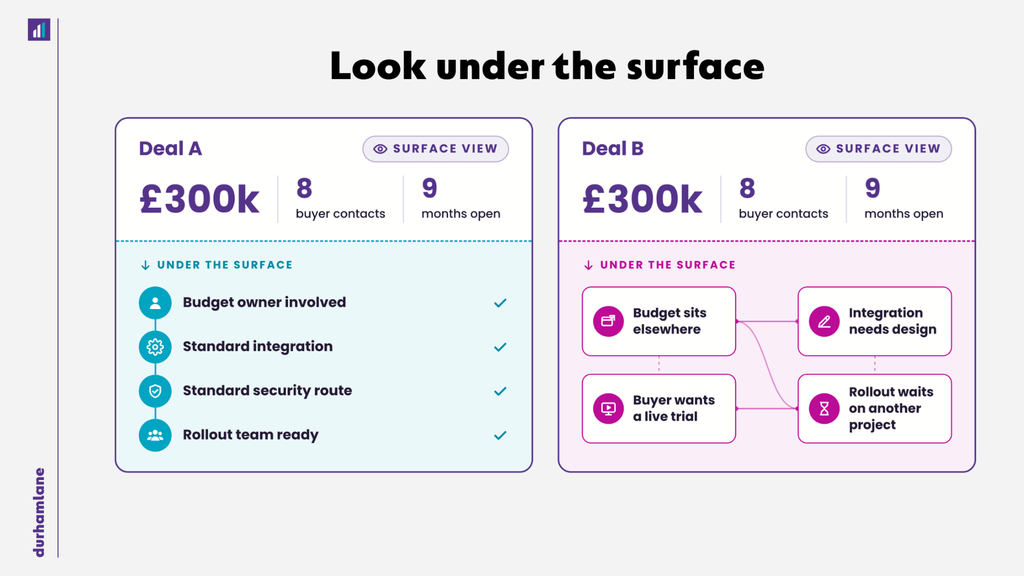
Take a renewal and a rollout to a new site. The supplier and solution are familiar, although a different site brings fresh interfaces, new users and another round of checks. Familiar territory can get complicated surprisingly quickly.
That picture also helps you choose the sales approach that fits the opportunity. Build the team around the deal that’s actually in front of you.
10 enterprise sales complexity indicators to look for
Some clues are visible early. Account research and discovery reveal existing systems, buying roles, budget ownership and standing supplier requirements. Others appear later, when a new reviewer joins, a test changes the requirement or a settled point opens up again. If you don’t know yet, treat it as a discovery gap. Get the answer before you label the deal complex.
What’s making this deal more complex?
| Indicator | Signal | Ask |
| 1. Buying group | More teams join | Who’s missing? |
| 2. Competing priorities | Teams want different outcomes | Who settles it? |
| 3. Budget and sign-off | Your contact is keen. Someone else owns the budget. | Who owns the budget? Who signs off the spend? |
| 4. Deal value | Senior approval or a costed case appears | What needs justifying? |
| 5. Familiar vs new | Known supplier, new use or site | What needs checking again? |
| 6. Integration | Systems, equipment or processes have to line up | Standard setup or joint design? |
| 7. Trials and proof | Buyer wants evidence in a real setting | What should the test show? |
| 8. Supplier checks | Risk, legal or security adds review | What’s still open? |
| 9. Switching and rollout | Migration, training or access must line up | What has to happen first? |
| 10. Delay and rework | Dates move or settled points reopen | Doing, waiting or redoing? |
1. A bigger buying group, and more plates to spin
A bigger buying group brings more expertise into the decision and more conversations for your team to keep straight. Start with the map. Which functions are involved? What’s each one trying to get right? Whose view is missing?
Recent buying research puts the average business decision at 13 internal stakeholders and nine external influencers. Larger groups in the same research also reported broader perspectives, shared validation effort and more help securing budget. Size tells you how wide the network is. The harder question is what those people actually do.
Larger buying groups were also linked with longer buying journeys in the 2025 buyer study. Treat that as a coordination clue. How many separate issues does this group have to settle, check or prove?
Then look at coverage. In a 1.8-million-opportunity dataset, won deals in the $250,000-plus band had 17 buyer contacts while lost deals had five. If finance, procurement and technical questions all funnel through one champion, your route through the account is thin.
In plain English, multi-threading means keeping useful conversations open with more than one buyer and bringing in the right seller or specialist for each issue. A technical question goes to the specialist who knows the answer. Leaving everything with one contact gives that person a fair bit of homework.
2. Conflicting priorities and moving goalposts
A deal gets harder to steer when finance, operations, IT or another function wants a different outcome. The real issue is the trade-off and who has authority to settle it.
Say finance wants predictable spend while operations wants room to change capacity. A fixed-cost proposal keeps the numbers tidy and leaves operations asking what happens when demand shifts. Put both requirements into the same conversation. Find the person who settles the trade-off.
Criteria also move for legitimate reasons. A trial sometimes exposes an operating requirement nobody saw at the start. Trouble starts when a settled point keeps returning and nobody decides what the change means for scope, cost or timing. Ask what changed, who owns it and which decision is now open.
3. Who checks, who pays and who signs it off?
Interest, technical approval, budget and final sign-off often sit with different people. Put a name against each role. Who wants the solution? Who tests it? Who owns the money? Who signs?
On the Inside the Funnel episode “The Birth of An Industrial Data Solution”, Richard Jeffers gave me a great example of what happens when one person pays for a solution and another gets the saving.
A broken machine gives you an obvious budget conversation. Energy saving is trickier here because one team picks up the bill while another gets the saving. Follow the money, then follow the benefit.
4. Deal value and the internal sell
Once the number gets big enough, the proposal starts picking up company. Finance wants to know what it costs. Leadership wants to know why it’s worth doing. Whoever signs it wants to know what happens if the bet goes wrong.
Marcus Curtis, IT Manager at Aprolis UK, was looking at around 90 ageing servers spread across UK locations. Public cloud looked like an obvious route, although the pricing was too hard to pin down for the board case he needed to build. A fixed monthly model gave him a number he could cost properly and take to the board. The technology had to work. The financial story had to survive the boardroom too.
Before you talk about deal size, get clear on the number the buyer actually has to approve. Is it this year’s spend, the full contract value or a one-off capital request? Each lands in a different budget conversation.
5. A familiar supplier, a fresh buying job
A familiar logo gets you through the door with some history behind you. The new purchase still brings its own questions.
Even when buyers were adding a new capability, they chose a supplier they had evaluated before in 81% of purchases. Find out what the buyer already knows about you, then ask what they still need to check for this particular purchase.
Go back to the renewal and new-site example. The renewal reuses part of the old evaluation. The new site brings fresh checks around local processes, users and interfaces. Ask what carries over and what the buyer has to check again.
6. Will the customisation and integration play nicely?
Integration gets serious when the solution touches several systems, pieces of equipment, facilities or operating processes at once. Standard setup stays relatively contained. Joint design across several interfaces pulls more specialists, testing and coordination into the deal.
Warehouse automation at Agratas had to fit into a much bigger picture. Logistics flows, digital systems, the building, manufacturing equipment and the warehouse setup all had to line up.
“How will this work with what we already have?” is where the conversation starts. Then you get into the joins. Which connections are straightforward? Where does the buyer need joint design? Who has to test the setup before the project moves?
Get those answers before anybody promises a date or a bespoke build.
7. What must the trial prove?
Trials get serious when the buyer wants to see the solution behave in its own world.
Among purchases worth $10 million or more, 78% of buyers used some form of trial.
In Deloitte’s cleantech research, buyers put real weight on results from their own sites and performance data from facilities already in operation. Before you set up another demo, ask what the buyer wants to see happen in the real environment and who needs to trust the result.
Before you book the test, agree what it has to prove, who needs to accept the result and what happens if it goes well. A paid pilot is already a commercial commitment, so tie the result to a clear next decision.
8. What procurement and supplier checks are still open?
At John Lewis Partnership, reaching the shortlist opens the due-diligence stage. Suppliers then move through risk questions, evidence requests and follow-up review.
Shortlisted suppliers are told to expect around five or six sets of risk questions, sometimes as many as ten. Some answers trigger supporting documents, follow-up questions or resubmission.
Those checks reach the contract too. A Business Contract Manager sets the initial risk level, and due-diligence findings sometimes trigger extra contract clauses. That puts the paperwork inside the commercial discussion.
On your deal, ask which checks are open, who owns them, what evidence is missing and what happens if the answer changes the contract. Keep buyer policy, negotiated terms and legal requirements separate. Each gives you a different route to resolution.
9. What has to change before rollout?
Rollout often has a second life after the commercial decision. The solution gets approved while the buyer is still lining up migration, training, site access and internal projects that need to land first.
Cleantech buyers in Deloitte’s research linked successful scaling with cross-functional alignment, while site integration and engineering complexity kept showing up as obstacles. When go-live comes up, keep going until you know who owns the change, what else is competing for the same people or site, and what has to be ready before your part moves.
Get those answers early enough to bring in delivery expertise and avoid promising a date the buyer can’t support.
10. What’s really stretching the sales cycle?
Ten months in the CRM can mean very different things. One deal is packed with technical evaluation, one spends weeks waiting for an approval, and a third keeps looping back over the same requirement. Pull the timeline apart before you decide what happens next.
Average buying journeys ran to 10.1 months globally and 8.1 months across the UK and Ireland in the 2025 buyer study. That clock covers the buyer’s full selection and validation journey. If your CRM clock starts when the opportunity is created, it begins later. Compare like with like.
- Active evaluation:
A solution engineer is preparing integration proof, legal is reviewing terms or procurement is checking supplier evidence. - Waiting:
The next task is sitting behind reviewer availability, another result or a decision date. - Rework:
A requirement changed, an answer was rejected or a point that looked settled has to be examined again.
Ask what’s holding up the deal. Is someone working on it, is the next step stuck behind another review, has something reopened, or is everyone waiting for a decision? If the date moves, find out what actually moved it.
Pipeline reviews get better when they record what changed in the opportunity. Treat a completed meeting as activity and an accepted test result as evidence that a buying question has been settled. Carry that distinction into the next review.
Before everyone’s diary fills up
Start by figuring out what changed. Sometimes the buyer has raised a genuinely new requirement. Sometimes your team is repairing something it should have caught earlier.
Say two buyers ask for an extra demo. In one deal, a new integration requirement has appeared. In the other, the seller missed a requirement the customer had already supplied. One sends you into technical investigation. The other sends you back to your own preparation. Both sometimes show up in the same opportunity.
Before you blame buyer complexity, check your own side. In a 3,664-person B2B survey across 13 countries, buyers said they were more likely to stop working with a supplier when different supplier teams gave inconsistent information or when they struggled to reach someone with the knowledge or authority to help. If your sales rep, solution engineer and lawyer are giving the buyer three different answers, some of that friction is coming from your side. Fix the contradiction before you book another meeting.
Then put a realistic cost on the extra sales effort before you decide how hard to pursue the opportunity. Name the unresolved decision, who has authority to settle it and which people or hours the opportunity will take on your side.
Another test? Put some hours and pounds against it
Say one extra integration test pulls in a sales lead for two hours, a solution engineer for six, plus an hour each from security and legal. Put a value against that staff time before you book everyone in.
One extra round of integration evidence
| Who gets pulled in | Example hours | Example £/hour | Staff-time value |
| Sales lead | 2 | £60 | £120 |
| Solution engineer | 6 | £90 | £540 |
| Security specialist | 1 | £100 | £100 |
| Legal reviewer | 1 | £100 | £100 |
| Total | 10 | £860 |
At those example hours and rates, the test uses ten person-hours and £860 of staff time. The solution engineer accounts for £540. Swap in your own hours and internal cost rates for a live deal. Add external fees, travel or overtime separately.
Before you book four people into the test, pin down what the buyer wants to learn and who needs to accept the result.
Which reviews run side by side?
Effort and elapsed time are different planning questions.
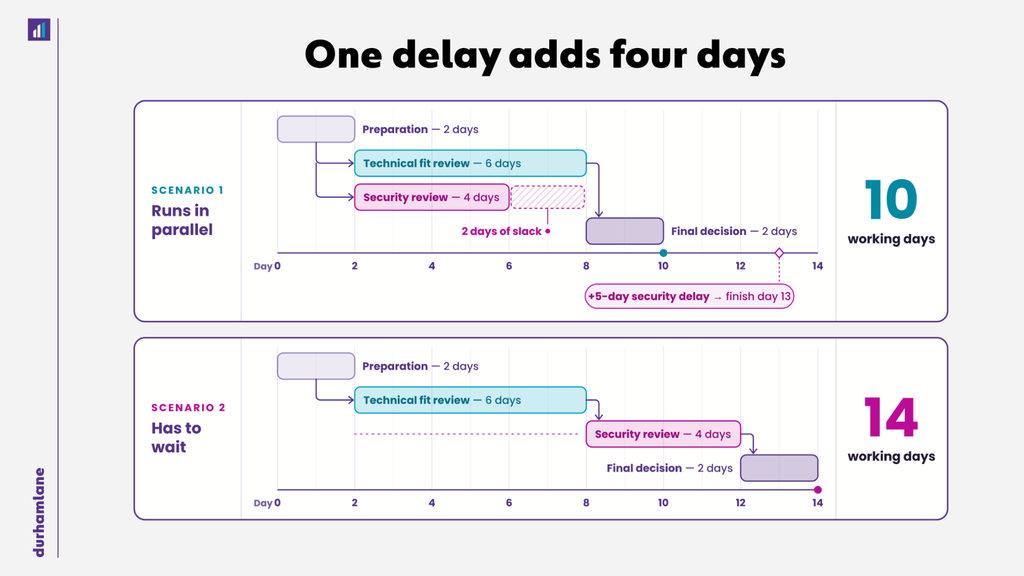
Check the dependency before you book the sequence. Does security need the technical result before it starts? If the answer is yes, run them in sequence. When security starts independently, let the reviews overlap.
Give the next sales conversation a head start
If the handover says only “interested in a demo”, your seller starts the next conversation playing detective. Give them the buyer’s problem, the buying roles already involved, what has been agreed and which questions are still open.
durhamlane’s manager-led outsourced SDR teams are built around that handover problem. We research the account, speak with buyers by phone, qualify what we learn and pass a clearer picture to the client’s seller. The handover carries the buyer’s problem, the roles already involved, the budget position, the agreed next step and the questions that remain open.
Magic 35 helps us and the client look at the opportunity in the same way. Its seven core criteria capture the buyer’s situation, commercial fit and next-step readiness. If a technical, legal or commercial point is still open, the client sees it before the next conversation starts.
Know what the deal will demand
A useful deal review should leave you able to point at the heavy bits, from an approval still pending to a test with a real question, an unresolved interface or rollout preparation on the buyer’s side. Keep that picture current, then bring in the people who own the next piece of work.
Need clearer qualification and a handover your sales team can pick up with confidence? Get in touch and let’s talk through where we could help.
Winning Strategies for Go-To-Market Challenges
Actionable solutions to elevate your go-to-market strategy.
Winning Strategies for Go-To-Market Challenges
Actionable solutions to elevate your go-to-market strategy.