

Key Takeaways
- Enterprise sales is a specialised B2B motion. B2B remains the umbrella for sales to companies of every size and level of complexity.
- Account size can signal complexity. Opportunity burden and pursuit economics should determine the sales motion.
- Enterprise conditions raise the standard for account intelligence, stakeholder qualification, proof, risk management and handoff continuity.
- The core capabilities are shared across B2B. Enterprise work applies them with more coordination, continuity and commercial judgement.
- A lighter or hybrid motion often fits better when the offer, risk, onboarding and decision path are still repeatable.
Sales teams can misclassify an opportunity in two costly directions.
A repeatable motion risks under-serving a demanding buying decision with shallow research, one-threaded qualification and a weak handoff. An enterprise motion risks over-engineering a straightforward purchase with unnecessary meetings, specialists and approval steps.
B2B sales is the broad category. Enterprise sales sits inside it as the motion for opportunities whose organisational burden changes how the account must be researched, qualified, developed and handed over.
The purchase itself matters more than the logo. A large organisation can buy a standard service on familiar terms, while a smaller business can make a high-consequence decision involving several functions, technical validation and material change.
I use a simple management test → match the sales system to the buying work, then decide whether the potential return justifies the human and specialist capacity it will consume.
The Core Difference Between Enterprise Sales and B2B Sales
Salesforce’s 2025 guide to B2B sales shows why the usual contrast is misleading. B2B can already include approval chains, demonstrations, negotiations and multi-stakeholder decisions. Its previous enterprise sales guide narrows the term to large-company purchases whose business impact, implementation, contractual commitment or risk can spread across the organisation.
Enterprise sales therefore describes the operating demands of the sale. Company size or account prestige can’t define it alone.
| Dimension | More repeatable B2B motion | Enterprise-style B2B motion | Decision implication |
| Category relationship | One possible motion inside B2B | A specialised motion inside B2B | B2B is the umbrella; enterprise is one motion |
| Opportunity burden | Lower organisational downside and fewer dependencies | Higher consequence, dependency or change burden | Match effort to the opportunity |
| Sales-cycle shape | Fewer interdependent steps make timing more predictable | Coordination, validation, contracting and adoption add elapsed work | Manage the dependencies that create elapsed work |
| Decision network | Narrower network or lower coordination burden | More interdependent roles and internal consensus work | Organisational readiness needs broader evidence |
| Qualification and proof | Fit, problem and next step may need a narrower evidence set | Role, risk, validation and decision-path evidence must travel together | Raise the evidence threshold before handoff |
| Procurement, contracting and adoption | Standard terms and repeatable onboarding may be sufficient | Additional review or adoption work may become material | Surface the real work early |
| Resource intensity | Generalist coverage may be commercially efficient | Specialist support helps when the work exceeds the seller’s remit | Resource the work the opportunity requires |
| Handoff continuity | Fewer context dependencies may survive a simpler handoff | Context loss can force sales to rediscover the opportunity | Preserve commercial reasoning across owners |
The table describes a spectrum. A purchase can carry enterprise-style risk in one area while staying highly repeatable in another. A standard product might need security review. A complex service might still handle routine information and administration through digital self-service. Good sales design identifies where human judgement and coordination add value and keeps the rest of the motion as light as the buying reality allows.
How Opportunity Burden Shapes The Sales Motion
Enterprise-style selling consumes more attention before a deal is won. Research goes deeper, more people need confidence, proof has to survive scrutiny and context has to travel across a longer chain of seller and buyer interactions. That extra work makes sense when the opportunity genuinely requires it.
Buying-group interdependence changes qualification
A supportive contact can open a door without representing the full decision.
Once different functions carry different forms of downside, the seller is no longer trying to persuade one person. The work becomes organisational. Finance may care about commercial exposure, an operational leader about disruption, a technical team about feasibility, and procurement about how the organisation can buy. Those concerns may be individually reasonable and still pull the decision in different directions.
Gartner’s 2025 report makes the coordination problem visible. In its survey of 632 B2B buyers, 74% of the buyer teams studied showed unhealthy conflict.
Qualification carries a higher standard in that setting. Before the opportunity progresses, the team needs a credible view of the problem, the roles involved, the people still missing and the material risks. The qualification record must also capture the decision route and the next step the buyer has actually agreed. A positive conversation with one stakeholder shows interest. Organisational readiness requires broader evidence.
A reliable decision map matters more than a large contact count. It shows how the decision moves, where priorities conflict and which dependencies the closing team must carry forward.
Proof, risk and contracting have to surface at the right time
A more demanding purchase needs more than a persuasive value proposition. The buying organisation must also believe it can approve, adopt and defend the decision.
The relevant risk route depends on what is being bought. A software purchase touching sensitive data creates different questions from a regulated service or a non-standard commercial model. Security, architecture, governance, procurement and contracting can all shape solution fit and buyer confidence before formal negotiation begins.
Forrester’s 2026 Buyer Insights research shows why approval work can’t always wait until negotiation. Procurement acted as a decision-maker in 53% of the business buying cycles studied, often from the start. CISA’s 2025 software-acquisition guidance applies the same timing logic to security by integrating software assurance and supplier-risk questions throughout the procurement lifecycle.
The seller needs to identify the approval and risk questions that are real for this buyer, then secure the evidence needed to address them. Legal, security or technical specialists enter when their judgement is required. Standard terms and limited review are sufficient for lower-risk purchases. Resource the risk that is actually present.
Implementation and cost of change raise the pre-sale evidence burden
Contract negotiation is only one source of complexity. The work after signature can create another.
If successful adoption depends on integration, configuration, testing, onboarding or a change in how teams work, the buyer needs confidence that the organisation can absorb that change. Readiness, dependency and scope questions move into the pre-sale conversation. The seller tests readiness, clarifies dependencies, involves delivery expertise or narrows the proposed scope according to the adoption work.
A 2025 Journal of the Academy of Marketing Science study shows how downstream complexity can reshape the sale before signature. In its B2B SaaS setting, larger add-on bundles increased perceived onboarding complexity, while leaner communication aggravated it. The buyer’s adoption burden therefore changed what the seller needed to understand and prove before commitment.
Adoption risk determines the response. Some buyers need a pilot, custom integration or training. Others need only a clear readiness check. In both cases, the handoff must carry the assumptions made during the sale.
What enterprise conditions demand from sellers
Enterprise conditions intensify capabilities that already matter in B2B sales. The difference is the breadth of the work, the time over which it must be sustained and the cost of losing context.
Account preparation should produce a commercial hypothesis. That means a reason to believe the account has a relevant problem, an idea of which roles may care and a plausible route into the decision. Weak preparation produces generic outreach and burns valuable accounts before the team learns anything useful.
Recommended Watch
Enterprise Sales Prospecting Techniques
In my conversation with George Hackett, then at Freshworks, he described how enterprise prospecting began with account selection and access planning before the outreach sequence was built.
At Freshworks, substantial territory and ICP planning came before outreach. The team used that work to build an A-list of priority accounts and identify recurring patterns in who the decision-makers were and how to reach them.
Marketing then supported those accounts with content, invitations and case studies, while sales tested access through InMail, phone and email. What the team learned shaped more relevant follow-up.
That preparation concentrates human effort on accounts with a defensible commercial hypothesis and a plausible route in.
Buyer evidence should keep changing the account plan once outreach begins. Role-aware relevance earns the first conversation. Listening and questioning then update the account view when the initial hypothesis is wrong or incomplete. Stakeholder navigation shows how different concerns connect, and commercial judgement turns those signals into a decision to progress, nurture or stop.
The same standard applies to handoff. A meeting alone can’t carry the opportunity into sales. The next seller needs to know what problem appears real, who is involved, which risks remain unresolved, what the buyer agreed and why the opportunity deserves more attention. When technical or contractual work exceeds the seller’s remit, good judgement brings in the right specialist for the task and releases that support when the task is complete.
The skills themselves are familiar. Enterprise conditions demand more coordination, more continuity and stronger judgement across the opportunity.
When a Lighter Or Hybrid B2B Motion is The Better Fit
Enterprise-style selling consumes material capacity, so target-company size or attractive contract value can’t justify it alone.
A more repeatable motion can be the better commercial choice when the offer is standardised, onboarding is familiar, organisational downside is bounded and the buyer can decide with a narrower evidence set. Human support remains available at the points where judgement changes the decision, while the rest of the purchase follows a repeatable path.
Hybrid motions split repeatable work from work that still needs seller judgement. A 2026 Journal of Marketing study using data from a large B2B firm (that the authors didn’t name) found that customers moved substantial transaction volume online without an equivalent fall in face-to-face sales activity. Routine transactions changed channel, while sellers remained active where the relationship still required interaction and context.
Use human attention where it changes confidence, risk or decision quality. Standardise routine work that requires less judgement. That means a large account can buy through a lighter motion, while a smaller account can still require enterprise-style treatment when the purchase creates significant organisational consequences.
How to decide which sales motion the opportunity needs
The right motion manages the opportunity with the least capacity consistent with buyer confidence and sales quality.
A 2025 Production and Operations Management study moves the question to portfolio level. Authors analysed 4,574 opportunities across 23 countries at an anonymised global on-site services provider. Opportunity size, relationship strength and bid context were associated with pursuit and win decisions in that setting. Every pursuit competed for limited capacity, so complexity alone couldn’t justify the work. Expected value and realistic win likelihood also had to support it.
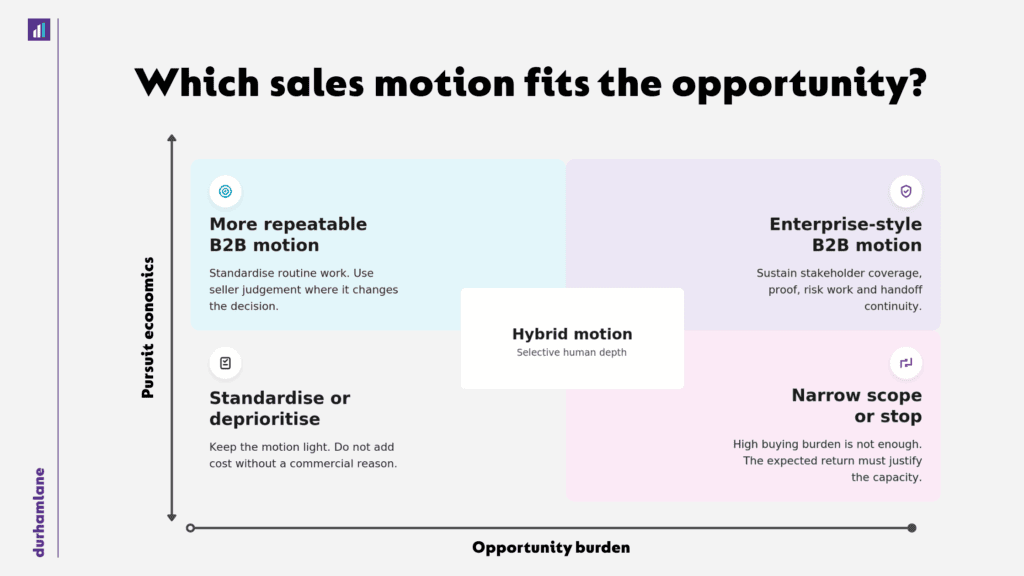
Sales-motion fit matrix shows how opportunity burden defines the work and pursuit economics decides whether that work is worth funding.
Use these six questions before committing the account to an enterprise-style motion:
- What’s the organisational downside if the purchase fails or the change doesn’t land?
- Which functions and roles must align, and how interdependent are their decisions?
- What proof or validation must exist before the buyer can commit with confidence?
- Which technical, data, security, contractual or procurement risks are actually present?
- How much integration, onboarding or organisational change must the buyer absorb?
- Can the team sustain the account intelligence, stakeholder coverage, specialist input and handoff continuity required, and do the expected value and win likelihood justify that capacity?
- Lighter motion fits when the offer is repeatable, the risk is bounded and the buyer can progress with limited coordination.
- Hybrid motion fits when routine activity can stay standardised or digital, while selected moments require deeper human judgement.
- Enterprise-style motion fits when the decision depends on sustained stakeholder coverage, stronger evidence, coordinated risk work and continuity across several owners.
Use the six questions as a management test. Their answers should change account priority, qualification thresholds, resource allocation and the point where the team stops investing.
Where durhamlane Fits in a Complex B2B Motion
Before a business adds more execution capacity, its B2B sales strategy should settle the segment, account focus and route to market. The operational question is whether the current team can create enough relevant conversations, qualify them properly and preserve the context sales needs.
At durhamlane, we support that front end through manager-led outsourced SDR teams. Account intelligence sharpens the opening hypothesis. Phone-led human conversations test relevance and uncover buyer context in real time. Selective multichannel follow-up widens account coverage, while qualification discipline and sales-ready handoff protect the closing team from thin opportunities.
Procurement decisions, legal review, technical architecture and implementation stay with the client’s closing and delivery teams. Our work is upstream. We create credible commercial conversations, widen stakeholder access where needed and carry enough commercial reasoning into the handoff for sales to continue.
Conclusion: Match the Sales Motion to The Buying Work
Enterprise sales is a specialised motion within B2B. Stakeholder interdependence, proof, risk, implementation and handoff demands make that motion necessary by changing the work required to progress the opportunity.
The commercial discipline is to use the lightest motion that can manage that burden, then stop investing when expected value and win likelihood no longer justify the capacity. Opportunity requirements and pursuit economics take precedence over logo size.
If attractive accounts are still producing thin opportunities, diagnose where the front-end motion is losing focus, buyer context or qualification quality. Book a call for a sales audit and diagnostic to find out where focus, buyer context or qualification quality is breaking down.
Get in touch
FAQ
Is enterprise sales a type of B2B sales?
Yes. B2B sales is the broad category for selling from one business to another. Enterprise sales is a specialised B2B motion used when the opportunity involves greater organisational consequence, stakeholder interdependence, proof, risk or adoption work. B2B is the umbrella category. Enterprise is one motion within it.
Does selling to a large company always require an enterprise sales motion?
No. Company size can indicate likely complexity, but the purchase itself should determine the motion. A large organisation might buy a standardised offer with familiar terms and repeatable onboarding, while a smaller company might need enterprise-style treatment when the decision affects several functions or creates significant technical, commercial or operational risk.
What makes an opportunity enterprise-style?
An enterprise-style opportunity carries enough buying burden to change the work required to progress it. Typical signals include interdependent stakeholders, a higher qualification threshold, role-specific proof, material risk review, meaningful implementation or adoption consequences, and a need to preserve context across several people. The potential return must also justify the capacity required.
Does enterprise sales always take longer than other B2B sales?
No fixed duration defines enterprise sales. These opportunities often take longer because coordination, validation, contracting and adoption questions add work to the decision. A well-prepared enterprise opportunity can still move efficiently, while a poorly qualified smaller deal can drift. Cycle length is an outcome of the buying work behind the opportunity. The motion itself is defined by the coordination, validation, contracting, adoption, risk and handoff demands the buying work creates.