

Key Takeaways
- Strong SDRs combine prospecting discipline with commercial judgement.
- Listening, questioning and qualification determine whether activity turns into a credible opportunity.
- Phone competence sits inside a coordinated multichannel approach.
- CRM discipline, follow-up and AE collaboration preserve context after the first conversation.
- AI strengthens research, preparation and practice, while the SDR still owns relevance, qualification and buyer interaction.
From the outside, the narrow meeting-setter version of the SDR role can look toxic. Relentless activity and meeting targets dominate, while the SDR owns little of what happens next. I understand why that impression has taken hold.
The specialist model was designed to create focus. One group concentrated on prospecting and early qualification, and account executives worked the active opportunity. Judging the SDR mainly by activity, meeting count and cost distorts that model. At that point, the role loses contact with the commercial substance it was meant to create.
A capable SDR protects origination, understands the buyer, qualifies purposefully and passes useful context to the closing team. Those responsibilities rely on practical skills built through coaching and repetition, while judgement determines how the SDR uses them.
AI raises the standard. Research, drafting and administration are becoming faster, so the harder questions remain with the person. Is this account relevant? What does the buyer’s answer change? Is there enough commercial substance to progress? What does the AE need to know before the next conversation?
The practical skills question leads into a larger one about how much value a strong SDR can create across the opportunity without losing prospecting focus.
What Skills Does a Sales Development Representative Need?
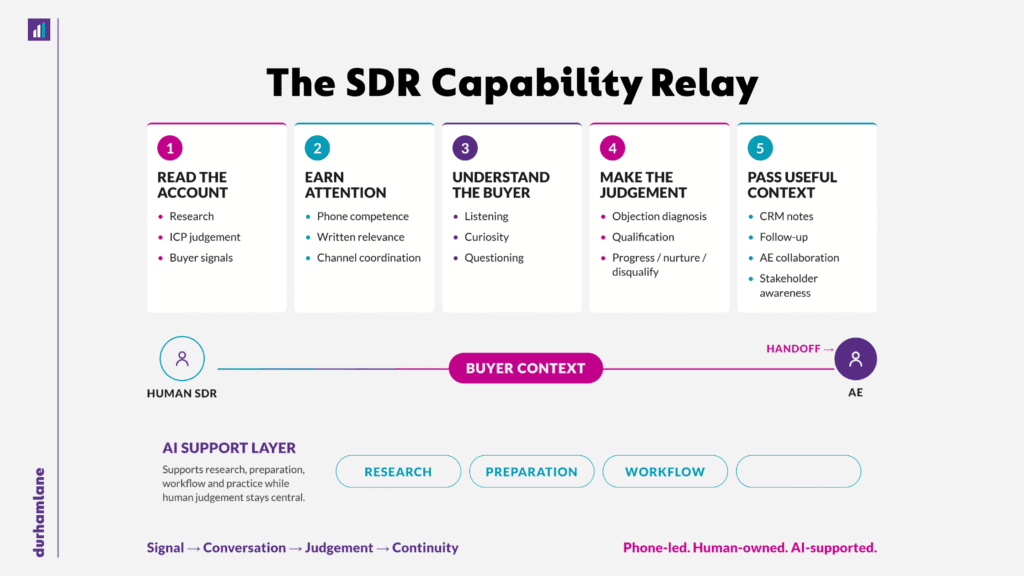
A strong SDR needs account research, phone and multichannel prospecting, clear written communication, active listening, questioning, objection handling and qualification. CRM discipline, organised follow-up and AE collaboration preserve what the SDR learns, while resilience and coachability support repeatable improvement. In complex B2B, these skills work together to create credible commercial conversations and sales-ready handoffs.
The specialist model concentrated research, prospecting and early qualification in one role. I still believe in that focus. A meeting count gives an incomplete picture of capability because the meeting might contain strong commercial potential, early interest or very little at all.
Skills England’s Sales Executive occupation map treats customer research, needs analysis, questioning, objection handling, digital-tool use, CRM accuracy, collaboration, resilience and continuous development as parts of one broader sales capability. That framing fits the SDR role because the value lies in how the skills work together.
| Capability group | Core skills | What good execution produces |
| Account understanding | research, ICP judgement, buyer context | relevant outreach and a credible opening hypothesis |
| Conversation | phone competence, writing, listening, questioning | a useful commercial exchange shaped by the buyer’s context |
| Qualification | objection diagnosis, business judgement, fit and timing | a decision to progress, nurture or disqualify |
| Opportunity discipline | CRM, notes, follow-up, AE collaboration | context that survives the handoff |
| Personal development | resilience, coachability, self-awareness | repeatable improvement under pressure |
| Technology fluency | data, workflow and AI support | faster preparation and cleaner execution under human control |
Prospecting And Outreach Skills That Earn a Real Conversation
Account research and relevant personalisation
Research helps an SDR form a commercial hypothesis. It gives the SDR a reason to approach this account, this person and this issue at a specific moment.
That requires an understanding of the ideal customer profile, the account’s business context and the likely priorities of the buyer’s role. Trigger events and intent signals direct attention, although they don’t prove that a buyer is ready. The SDR still has to investigate the signal, judge its relevance and decide how it changes the outreach.
AI makes the collection and synthesis of information quicker. Human judgement turns that information into a useful point of view. Personalisation therefore connects the account context with a plausible business issue. A detailed message built around the wrong problem is still irrelevant.
Phone competence inside a multichannel motion
Phone skill develops through real calls. Practice builds confidence, pacing, professional persistence and the ability to listen under pressure. A software platform doesn’t create that muscle memory.
On the phone, the SDR can test the opening hypothesis immediately. Written channels often delay that feedback. Tone, hesitation, questions and objections provide information, and a strong caller adapts while the conversation is happening.
Phone-led sales development still coordinates email, LinkedIn and other relevant channels because buyers rarely stay in one place. McKinsey’s B2B Pulse, based on nearly 4,000 decision-makers, found preferences spread across in-person, remote and digital self-service interactions. Gartner’s 2026 survey of 645 B2B buyers adds the human-contact point, finding that 69% preferred to validate AI-generated insights with a sales rep. Buyers move across channels, but context, confidence and risk still call for a capable person. Phone competence earns its place at those moments.
Clear written communication and channel coordination
Written communication needs clarity, relevance and accurate claims. An SDR has to explain why a conversation would be useful without burying the point in background detail or generic enthusiasm.
Channel coordination matters as much as the quality of one email. Each follow-up should develop the conversation, add useful context or respond to something the buyer has done. Repeating the same message through email, LinkedIn and voicemail creates noise.
The goal of outreach is to earn attention and reach a conversation that helps the SDR learn. Once attention is earned, conversation quality determines what the SDR understands.
Conversation And Qualification Skills That Protect Opportunity Quality
Active listening, curiosity and questioning
One of our ten sales mantras at durhamlane is Be Interested to Be Interesting. Mantra #3 gives curiosity a practical role in the conversation.
Active listening means following the buyer’s answer far enough to understand its commercial consequence. The SDR has to resist the urge to return immediately to the prepared question list. A short pause, a connected follow-up question or a challenge to the initial assumption often reveals more than a polished script.
Good questions also create cleaner decisions. The conversation may reveal a genuine problem, a relevant stakeholder and a reason to progress. At other times, it shows that the timing is wrong or the fit is weak. Both outcomes are useful. An SDR who qualifies out with confidence protects the buyer’s time and the sales team’s capacity.
The tension between following a qualification structure and staying genuinely curious is easier to hear in a real conversation.
| RELATED LISTEN Reinventing Sales Conversations: Why Listening and Curiosity Win In our podcast series The Insiders, Ollie Whitfield from Slingshot Content puts me in the hot seat to discuss listening, cold calling, RevOps thinking and the future of the SDR role. We discuss why people remain poor listeners, how “Be Interested to Be Interesting” changes the next question and where cold calling fits a modern multichannel motion. Then we move to the commercial result of careful listening, whether that meant uncovering a real opportunity or qualifying out with confidence. |
Objection handling and commercial judgement
An objection carries information. It often reveals a weak fit, a competing priority, a missing stakeholder, an internal risk or a genuine misunderstanding.
The SDR’s job is to diagnose before responding. That takes composure and enough product, market and buyer knowledge to distinguish a question from a dismissal. Commercial judgement also means knowing which response will help and which pressure will damage the conversation.
That keeps objection handling close to qualification. The point is to understand the buyer’s position and decide what it means for the opportunity.
Qualification beyond the booked meeting
A booked meeting is an activity outcome. The commercial question is whether the conversation has enough substance to deserve sales time.
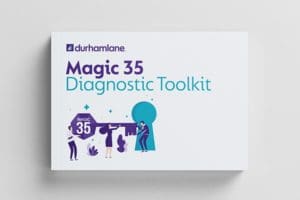
durhamlane’s Magic 35 diagnostic toolkit turns that judgement into a repeatable process. It applies seven core criteria to the evidence gathered in the conversation, giving the SDR a structured route through questions about business need, buying context, timing and commercial fit. The process puts another of our mantras into practice – Estimate then Validate; Never Assume. By the end of the conversation, the SDR must be able to explain why the account progresses, enters nurture or is disqualified. The AE receives the same reasoning in a sales-ready handoff. Closing outcomes still depend on the wider opportunity and buying process.
I would prefer a smaller pipeline built on stronger qualification to a larger one the sales team can’t trust. That changes the SDR’s success criteria because the quality of the decision and the clarity of the reasoning matter as much as the meeting.
Qualification loses value when the evidence disappears after the call.
CRM, Follow-Up And Collaboration Skills That Protect The Handoff
CRM discipline, commercial notes and follow-up
The CRM serves as commercial memory. Activity logging alone doesn’t.
Useful notes capture the buyer’s situation, what changed during the conversation, who is involved, the agreed next step and the evidence behind the qualification decision. Managers then have something specific to coach, and the AE can enter the next conversation without forcing the buyer to start again.
Follow-up needs the same discipline. Professional persistence moves the commercial exchange forward by clarifying a question, sharing relevant information or confirming an action. A string of reminders that adds no new value simply increases activity.
AI assists with summaries and administration. The SDR remains responsible for accuracy and context.
AE collaboration and stakeholder continuity
Collaboration begins before the handoff. SDRs and AEs need a shared view of the account, clear role ownership and feedback on what later happened to the opportunity. Without that feedback, the SDR keeps repeating the same qualification mistakes.
Wider buying groups make the shared account view more important. Forrester’s 2026 State of Business Buying describes decisions as networks of internal stakeholders, external influencers and procurement. Exact group sizes vary, and the first contact rarely represents the full decision. Useful SDR notes therefore identify who is involved, what each person appears to care about and where the AE needs to widen the conversation.
I see a stronger SDR becoming the AE’s right hand on account context, stakeholder access and follow-up. That idea extends beyond our current sales-ready handoff model, so the boundaries have to be clear. Full-cycle and shared-prospecting teams also work in the right environment. Dedicated origination earns its place in environments that need consistent ownership of prospecting capacity, early qualification and context transfer.
Resilience, Coachability And Deliberate Practice
Recovering after rejection without lowering conversation quality
Rejection is built into sales development. Resilience means recovering without allowing one buyer’s response to damage the next conversation.
Repeated rejection makes recovery difficult. Outreach can become mechanical. Frustration changes pace, tone and curiosity. Strong SDRs recognise the change and reset before the next interaction.
Resilience also includes honest reflection. Some rejection is normal. Other rejection points to poor account selection, weak relevance or a conversation that needs work. The skill lies in separating those causes and acting on the part the SDR controls.
Coachability, self-awareness and focused improvement
Coachability starts with the ability to receive specific feedback without turning it into a judgement about personal worth. Its value appears when the SDR turns that feedback into one behaviour for practice and review.
Call review, role-play and repetition are most useful when the improvement target is precise. Listen for the moment the SDR interrupted. Rework one weak opening. Practise a follow-up question until it sounds natural. Broad advice produces broad intentions.
I also believe development improves when an SDR learns alongside experienced sellers. Repetition builds confidence. Exposure to the wider opportunity shows why the early conversation matters.
Which SDR Skills Transfer Into an Account Executive Role?
Research, listening, questioning, qualification, objection diagnosis, CRM discipline and stakeholder awareness all transfer into closing work. An SDR still needs exposure to deeper discovery, commercial shaping, negotiation and the wider deal journey before taking full AE responsibility.
My own progression began with creating meetings and grew into broader selling responsibility. That experience is why I see the SDR role as an apprenticeship. A capable person learns how to start a commercial conversation, handle rejection, test fit and build a disciplined view of an account.
A close working relationship with an experienced AE or senior mentor strengthens the apprenticeship. Sales can learn from the way law firms connect partners, associates and graduates to the same work at different levels of responsibility. Sales teams often separate people more sharply and lose some of the learning that shared exposure creates.
The SDR-to-AE path is one route among several, and it offers no guarantee. Some excellent AEs arrive through industry expertise, full-cycle selling or another commercial role. The greater strategic risk is losing both origination and a development route for future sellers. Simply expecting AEs to absorb prospecting weakens future pipeline.
How AI Changes The SDR Skill Set
As AI takes on more research, drafting and administration, the SDR’s judgement becomes more important. The SDR remains responsible for accuracy, relevance, qualification and the live buyer relationship.
Tasks AI accelerates
AI is already useful for account research, synthesis, message variation, enrichment, prioritisation prompts, CRM administration, coaching practice and follow-up preparation.
Two experiments show where AI can create usable capacity. In a 2023 Science experiment, 453 college-educated professionals completed occupation-specific writing tasks. ChatGPT users finished 40% faster and produced work rated 18% higher in quality. A 2025 NBER field experiment across 66 firms and 7,137 knowledge workers found that active users spent two fewer hours per week on email.
For an SDR team, the opportunity sits in the work around the conversation. Research synthesis, message preparation, CRM administration and follow-up planning produce outputs that can be checked before they shape the buyer experience. AI reduces the time these tasks consume. The commercial gain appears when that capacity is reinvested in sharper account judgement, better preparation and more live buyer conversations.
The SDR’s skill lies in directing the support layer, checking its output and deciding what the account needs next. More output has little value if account selection, claims or qualification judgement are wrong.
Judgement and buyer interaction the SDR still owns
AI output needs verification because account research goes stale, polished messages can contain inaccurate claims, prioritisation models can elevate weak signals and qualification tools can create false confidence.
A 2026 field experiment published in Organization Science shows why that reviewability boundary matters. The study involved 758 Boston Consulting Group consultants. Across 18 tasks inside the AI capability frontier, AI users completed 12.2% more work and finished 25.1% faster, with stronger quality. On a complex task outside that frontier, they were 19% less likely to reach the correct answer.
For SDR teams, reviewability is the dividing line. Research summaries can be checked against their sources, drafts edited before sending and CRM notes compared with the call. Buyer hesitation, conflicting stakeholder signals and the decision to commit AE time to an account do not offer the same clean answer key. As ambiguity and commercial consequence rise, the human has to stay closer to the judgement.
Gartner’s 2026 survey of 645 B2B buyers shows why that boundary matters commercially. Forty-five percent used GenAI during a recent purchase, 69% preferred to validate AI-generated insights with sales reps, and 51% said they were more likely to encounter misleading information through GenAI. Buyers use speed and self-service, then turn to sellers for context, confidence and risk reduction when the answer carries more weight.
The seller’s role begins once AI output is harder to verify and more costly to get wrong. Listening, qualification, objection diagnosis and stakeholder judgement therefore remain human-owned. Another tool or the removal of the SDR role won’t solve a sales-development problem without a redesigned operating model. Used well, AI improves preparation without separating the SDR from the buyer.
Is The SDR Role Becoming an Opportunity Co-Pilot?
The conventional model created focus by separating origination, qualification and closing, but the handoff also created a seam. Context often weakens there, especially when the opportunity involves several stakeholders and a long decision process.
AI-supported research and workflow give a capable SDR a wider view of the account. In some complex sales environments, I see the role extending beyond the initial meeting. The SDR would preserve context, track stakeholder developments, support follow-up and help the AE maintain continuity.
I use opportunity co-pilot as a working description for that possible model. The fit depends on role clarity, motion complexity and what the AE needs from the SDR.
My test is simple: 1 + 1 has to produce more than 2. A broader SDR role has to make the AE and the wider revenue system more effective. That means higher close rates, stronger opportunity quality or more AE time for work that needs their experience. Moving the same tasks between two job descriptions achieves nothing.
Calling the role “AE light” misses the point. Origination and purposeful qualification remain distinct responsibilities, and broader involvement needs its own accountability. The SDR mustn’t spend so much time supporting active deals that future prospecting disappears.
Full-cycle and no-SDR models remain viable in motions with little added value from specialist origination. In complex motions, sales development becomes essential to the revenue system by protecting origination, opportunity quality and future seller development
| Leadership check – Can the SDR form a credible account hypothesis before making contact? – Can they hold a useful phone conversation and listen well enough to change their view? – Can they distinguish interest, nurture and a sales-ready opportunity? – Can they preserve context through CRM discipline, follow-up and AE collaboration? – Can they use AI and technology while retaining commercial judgement? |
Capability also depends on the system around the person. In my experience, clear management, focused coaching and role clarity determine whether these skills become repeatable performance.
What Strong Sales Development Should Deliver
Strong sales development should keep origination healthy, move better-evidenced opportunities into the pipeline and give AEs more time for work that needs their experience.
Prospecting and live conversation create the opening. Research, qualification, CRM discipline and collaboration carry its value into the wider revenue system, while technology accelerates the supporting work under human judgement. A broader SDR role earns its place when it creates incremental value and keeps future prospecting healthy.
If the SDR layer disappears and no one owns origination, pipeline will dry up. A well-built sales development role creates current opportunities and develops future sellers.
durhamlane’s proactive outbound sales development teams are built around those outcomes. Account intelligence sharpens the opening hypothesis, and phone-led outreach tests it in a live conversation. Magic 35 turns what the SDR learns into a consistent qualification decision. The sales-ready handoff carries that reasoning into the next stage. Feedback from sales and marketing improves the next cycle.
Manager-led coaching holds the system together by giving each SDR clear account priorities, a qualification standard and visibility into what happened after the handoff.
If the market opportunity exists but your team lacks the capacity or operating discipline to turn it into qualified pipeline, talk to us about what is holding the motion back.
Get in touch
FAQ
What are the most important sales development representative skills?
The most important SDR skills are account research, phone and multichannel prospecting, clear communication, active listening, questioning, qualification, objection diagnosis, CRM discipline, follow-up, resilience and collaboration with AEs. These capabilities work as a system. Research improves relevance, conversation reveals the commercial situation, qualification protects sales time, and accurate handoff gives the closing team useful context for the next commercial step.
What hard skills does an SDR need?
An SDR needs practical competence in account research, CRM use, data hygiene, written outreach, phone conversations, qualification, note-taking and organised follow-up. Product, market and buyer knowledge also matter because the SDR must connect the offer with a credible business issue. AI and workflow tools support these tasks, while the SDR remains responsible for fact-checking, relevance and the qualification decision at every stage.
Which soft skills matter most for SDRs?
Active listening, curiosity, resilience, coachability, self-awareness and professional persistence are central soft skills for SDRs. Listening and curiosity help the seller understand what the buyer means. Resilience protects conversation quality after rejection. Through coachability, feedback becomes focused practice. Self-awareness helps the SDR recognise how tone, assumptions and habits affect the commercial exchange, then adjust with purpose during the next conversation.
How is AI changing the SDR role?
AI is making research, drafting, enrichment, CRM administration, prioritisation and role-play practice faster. That shifts more value towards human judgement. SDRs still need to verify facts, decide what is commercially relevant, listen carefully, qualify opportunities and manage trust-sensitive conversations. A well-designed operating model uses AI as a support layer while the human SDR owns buyer interaction and the next commercial decision.
Which SDR skills help someone become an account executive?
Research, discovery questioning, active listening, qualification, objection diagnosis, CRM discipline and stakeholder awareness all transfer into an AE role. SDR experience also builds comfort with rejection and commercial conversations. Broader AE responsibility requires further development in discovery depth, solution shaping, negotiation and closing. The SDR path is a useful apprenticeship route, although strong account executives also enter through other commercial and industry backgrounds.