


Summary
B2B sales training programs are not one-size-fits-all. Matching the right learning format, feedback mechanisms, and coaching depth to your team’s specific commercial challenges is the only way to turn taught skills into reliable sales judgment.
Key takeaways
- Start with the sales work that needs to improve and the learner who’ll do it. Then compare the practice, feedback and support around that task.
- The buying models vary as much as the subjects. HubSpot is free and self-paced, MySalesCoach combines group learning with individual coaching, and Force Management is sold as a tailored organisational engagement.
- Headline prices aren’t directly comparable. The list includes per-learner fees, team prices, subscriptions and quote-only engagements, with conditions such as team size, VAT, membership and regional availability.
- Time outside the taught session matters. Workplace assignments, call review and manager or coach feedback shape what happens when the learner tries the skill for real.
- Useful practice tests judgement as well as delivery. When a buyer changes the meaning of the opportunity, the seller should recognise it, adapt the next question and preserve the reasoning for handoff.
A sales-training shortlist looks tidy until you ask what the fee actually buys. One provider gives you a course you complete yourself. Another sells coached practice for a small team. A third starts with leadership and the company’s messaging before sellers enter the room.
If you’re developing your own selling skills, immediate access and a clear price may settle much of the choice. If you’re buying for employees, the tricky questions arrive quickly. Who gives feedback on practice? Will learners bring real calls or opportunities to coaching? What support continues between sessions?
Compare each programme’s fee, format and coaching against the sales work you want to improve. The options cover foundations, prospecting, qualification, consultative selling, negotiation and sales management, with both individual and company-wide ways to take part.
B2B sales training programs at a glance
Use the table for a first cut: what each programme is for, how you learn, what it costs and where you can access it. Each profile then adds duration, support detail, and buying conditions.
| Programme | Focus | How you learn | Price | Access |
| Classes + Coaching Factor 8 | Small SDR teams | Online learning, group coaching and call grading | Team quote for fewer than 10 learners | Global virtual delivery |
| Command of the Message® Force Management | Value messaging | Tailored team training and manager coaching | Custom engagement | North America, EMEA and APAC |
| SMDP Growth Matters International | Sales management | Group learning with personal coaching reported in 2025 | Quote on enquiry | International |
| Inbound Sales Certification HubSpot Academy | Sales foundations | Self-paced videos and quizzes | Free | Worldwide online |
| SPIN Selling Huthwaite International | Consultative questioning | Live practice and continued coach feedback | Tailored quote | International courses |
| Full MEDDPICC MEDDIC Academy | Complex-deal qualification | Self-paced videos and quizzes | $297 first year, then $97/year | Worldwide online |
| Prospecting (Foundations for Pipeline Creation) MySalesCoach | Coached prospecting | Group learning and individual coaching | £995 + VAT per learner | International virtual delivery |
| RAIN Selling (Foundations) RAIN Group | Consultative selling | Tailored delivery. Assignments and coaching at RS Americas | Custom team quote | UK/Ireland, EMEA and international teams |
| SNS for Sales RED BEAR Negotiation | Negotiation | Group simulations and personal feedback | Custom quote, typically 12–24 participants | Worldwide |
| Sales Geek Academy Sales Geek | Ongoing sales learning | Course library, live learning and expert Q&A | Up to 9 users. £20/user/month or £200/user/year. VAT extra where applicable | UK subscriptions |
| Professional Sales Training SalesSense | Instructor-led practice | Weekly live sessions and workplace tasks | £995 + VAT per learner | Worldwide remote. Face-to-face in UK/EU |
| Prospecting for Impact Winning by Design | Prospecting | Live online role-play and breakout work | Open course $1,500/person. Private training $30,000/team, for 8+ learners | EMEA and other global time zones |
*Prices and review ratings were recorded in September 2026.
How we compared B2B sales training programs
We selected 12 programmes from 152 B2B sales training offers. Four criteria shaped the shortlist:
- Fit for the learner
- Sales task → foundations, prospecting, qualification, consultative selling, negotiation or sales management.
- Experience level → from first exposure to a method through to applying it in complex opportunities.
- Role → individual seller, owner, sales manager or wider team.
- Learning and support
- Learning mode → self-paced, scheduled group, subscription or company programme.
- Practice and feedback → exercises, role-play, call grading, individual coaching or other review.
- Workplace application → what happens between sessions and what support the employer still needs to provide.
- The purchase
- Price and buying unit → per learner, team, subscription or quoted engagement.
- Time commitment → course length, session cadence and work between sessions.
- Access → geography, delivery format, enrolment route and any licence or membership conditions.
- What each programme adds to the shortlist
- Problem coverage → a materially different sales task or buyer need.
- Purchase model → individual place, open cohort, ongoing subscription or team rollout.
- Support mix → enough variation to compare self-study, live teaching, coaching and employer-led follow-through.
Programme information established the content and commercial terms. Available buyer feedback on G2 and Gartner Peer Insights helped us examine coaching, scheduling and application in practice. The programmes are listed alphabetically by provider.
Which type of B2B sales training fits your team?
Choose according to the sales work that needs to improve and the support the learner needs. Independent study suits someone learning a method at their own pace. A scheduled course adds live learning with other participants. Personal coaching provides time to work on individual application, while a team programme helps an organisation develop a shared approach.
For a course you’re taking yourself, consider how you want to learn and the work you want help with. You might need an introduction to qualification, practice in prospecting or a coach to discuss a difficult conversation. The course’s syllabus, exercises and support should address that task.
On an open group course, you book a place and learn alongside other participants, often from different organisations. MySalesCoach adds individual sessions to its Prospecting path. SalesSense teaches its scheduled course through weekly meetings. Huthwaite follows open-course SPIN practice with workplace tasks and coach feedback. Compare the time between sessions and the feedback available as you apply the material.
Use the map to compare individual enrolment with team rollouts and see how each programme combines learning with practice, feedback and coaching.
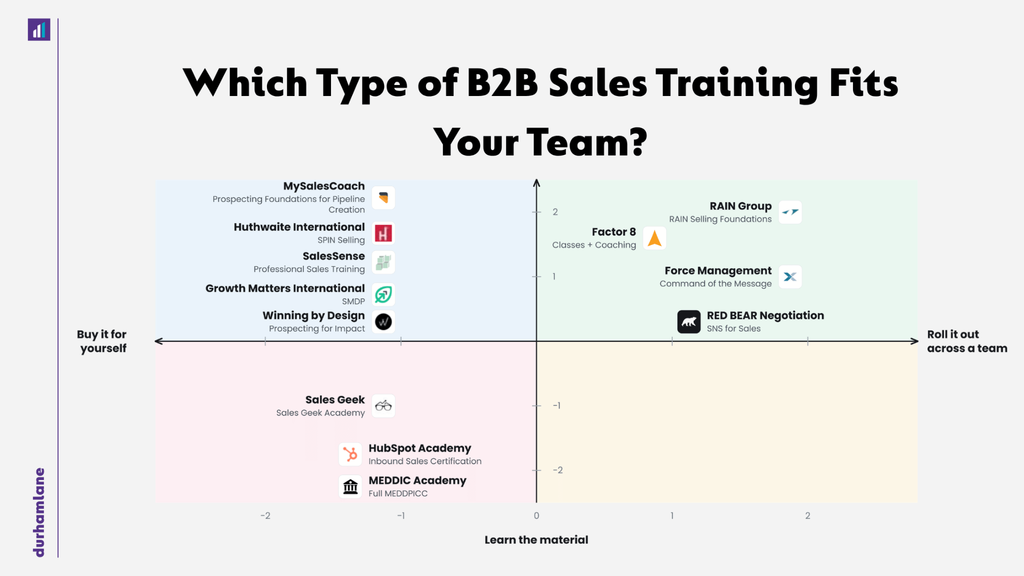
When buying for a team, start with the people attending and the sales situations they need to practise. Sellers in different markets might share a method while needing different examples. Managers taking SMDP are developing their own management practice, which calls for different work from an SDR prospecting course.
Factor 8’s Classes + Coaching supports a small team through call grading and group coaching. RED BEAR concentrates practice into a negotiation workshop. Force Management develops company-specific messaging with reinforcement from managers. At RS Americas, RAIN combined consultative-selling modules with assignments and application coaching. Shortlist two or three programmes that address the same problem, then compare their content, support and cost.
The 12 B2B sales training programs
1. Classes + Coaching (Factor 8)
For a small inside-sales team, building a coaching programme around a content library creates extra work for the manager. Classes + Coaching packages on-demand learning, live group coaching, call grading and manager involvement for teams of fewer than ten, with certification on completion.
Call grading brings the team’s own selling conversations into the room. Group coaching gives reps somewhere to work on the skills behind them. Factor 8 is rated 4.7/5 on G2, based on 93 reviews. Gartner Peer Insights feedback includes praise for attention to a virtual sales team’s training needs.
When booking for a team, agree which calls will be reviewed and how each rep will receive feedback alongside their day-to-day prospecting. New SDRs also need practice in qualification and handoff, so identify who will coach those parts of the job when planning the team’s development.
Price and access
There’s no public list price. Classes + Coaching is quoted for each team. Delivery is virtual, and Factor 8 supports global teams. The programme length, coaching schedule and contracting, currency and VAT terms are available on enquiry.
Factor 8’s earlier Coaching As A Service offer used a per-rep monthly model: six- or twelve-month terms, coaching once or twice a month, and FAQ pricing of $750–$1,900 per rep per month.
2. Command of the Message® (Force Management)
Command of the Message is closer to an organisational rollout than a seat-by-seat course. It suits a business that needs sellers to communicate value through a shared, company-specific approach. Leadership contributes to the messaging work, and managers reinforce it as sellers apply the framework to opportunities. Force describes a typical initial engagement as about one quarter, with reinforcement potentially continuing afterwards.
The Value Messaging Framework sits at the centre of the engagement. Framework development, teaching and continuing managerial work each need an owner. A sales leader commissioning the programme also needs a plan for maintaining that messaging as propositions and buyer conversations change.
Force Management is rated 4.7/5 on Gartner Peer Insights, based on 33 ratings. Feedback on a Command of the Message engagement highlights the team’s professional preparation.
Price and access
There’s no public per-person price. Force quotes each engagement, and a May 2026 analysis by B2B Sales Training reports costs for a framework-development phase and a wider engagement:
- An eight-week discovery and Value Messaging Framework phase at $40,000–$60,000.
- An engagement for a 120-person sales organisation at $100,000–$150,000, covering framework development, two to three days of training, manager certification and reinforcement-platform access.
Delivery is live virtual or in person across North America, EMEA and APAC. Train-the-Trainer and facilitator certification are arranged separately.
3. Sales Management Development Program (Growth Matters International)
SMDP turns the lens on the sales manager. Growth Matters International describes twelve months of development followed by access to a continuing professional-development platform. A business buying SMDP is investing in the managers who lead and develop its sellers.
In a provider-published conversation from 2025, Benjamin Rankin described individual coaching and the facilitator’s questioning approach. The facilitator demonstrated that approach while teaching it. Daniel Robus, also a Growth Matters facilitator, described receiving a coach when he joined SMDP, with accountability and help through roadblocks.
If you’re choosing SMDP, establish what you’ll bring to personal coaching and how that support continues across the twelve months. Bring a live management decision or a difficulty you’re working through, so the coaching has something real to bite on.
Growth Matters International’s sales-training services are rated 5.0/5 on Gartner Peer Insights, based on two ratings.
Price and access
You’ll need a quote for SMDP. Growth Matters has international programme experience.
4. Inbound Sales Certification (HubSpot Academy)
HubSpot keeps the entry point simple. Inbound Sales Certification is self-paced and free. The published workload is about three hours and six minutes, across seven lessons, 22 videos and five quizzes. Completion and assessment lead to the Inbound Sales certification, giving a new seller, owner or someone revisiting the foundations a compact starting point.
Because the course is self-paced, live feedback has to come from around it. If you’re supporting a new seller, choose an upcoming conversation to discuss with them. Ask which idea they’ll use and what they hope to learn from the buyer, then arrange observed rehearsal or call feedback when they need help applying it.
HubSpot Academy is rated 4.8/5 on G2, based on 689 reviews across its courses.
Price and access
The course is available at no charge through a free HubSpot Academy account. Learners worldwide can take it online.
5. SPIN Selling (Huthwaite International)
SPIN Selling centres on questioning in consultative sales conversations, and the programme isn’t confined to the taught session. Huthwaite offers open courses for individuals and smaller groups, plus private team training, with facilitated practice and help applying the approach at work.
Two classroom days or four virtual sessions look compact on paper. A separate digital course is self-paced over several weeks, while the open course adds real-world tasks and continued coach feedback after the taught sessions. SPIN Selling certification follows completion.
For a seller developing their questioning, workplace tasks provide material to discuss with the coach as they try the approach in conversations. When booking, establish what work to bring and how feedback is provided. Compare SPIN and RAIN on time with the instructor, tasks attempted at work and the coaching attached to those attempts. A two-day teaching block with follow-through and a longer programme spread time differently across the learner’s working week.
Price and access
Huthwaite’s UK price is quote-only, with fees shaped by group size, delivery and customisation. It also offers international delivery. UDC lists a Kuwait course for 1–4 November 2026 at KD 550.
6. Full MEDDPICC (MEDDIC Academy)
Full MEDDPICC is a self-paced route into complex-deal qualification. It suits a seller learning a shared qualification vocabulary or joining an organisation that already uses the method. The course has 33 lessons, with video learning and quizzes, and awards a certificate of completion.
MEDDIC training is rated 4.4/5 on G2, based on 18 reviews. Feedback praises clear, concise explanations and includes a request for more interactive examples to put the material into practice.
If you’re taking the course, keep a current sales opportunity or worked example beside you. A useful discipline is to separate three different knowledge states:
- A confirmed answer from the buyer.
- An inference that still needs checking.
- A question that remains unanswered.
Discuss those differences with someone who can examine your reasoning. A team manager arranging the training should decide who will provide that review and any live facilitation or personal coaching required alongside the course.
Price and access
The individual pricing is straightforward: $297 for the first year and $97 a year thereafter. Cancelling renewal preserves the purchased year of access. The online course serves international learners, with local tax treatment to confirm at purchase.
7. Prospecting (Foundations for Pipeline Creation) (MySalesCoach)
MySalesCoach pairs three group sessions with three individual sessions, so the learner gets shared material and dedicated time on their own prospecting work.
- Group instruction gives participants shared material to work on.
- Individual sessions give learners time to discuss problems and decisions as they put the material to use.
For an owner who is also the main salesperson, that focused discussion offers a way to work on their own prospecting difficulties with a coach.
MySalesCoach is rated 4.7/5 on G2, based on 142 reviews. Feedback highlights coach matching to the learner’s development needs and working style. It also describes UK–US scheduling difficulties resolved through flexible appointments.
Before taking an individual place, agree the session dates and preparation. Bring a prospecting problem and examples of your own work to the individual sessions, with time afterwards to act on the feedback.
Price and access
The commercial wrinkle is membership. The Prospecting Learning Path costs £995 + VAT per learner. Membership is advertised separately at £600/$800 a year, so confirm whether enrolment on the path requires it.
Delivery is virtual, with a UK purchasing route and international access. MySalesCoach also offers private-team Learning Paths.
8. RAIN Selling (Foundations of Consultative Selling) (RAIN Group)
RAIN Selling is a tailored team programme, so the calendar moves with the rollout. It suits a group adopting a shared consultative-selling method, with teaching and application arranged around the organisation’s work.
RAIN offers onsite, virtual, hybrid and Self-Study+ formats. The schedule is tailored to the team and delivery format. At RS Americas, Foundations ran over four months, with application assignments and application coaching around the modules.
RAIN Group is rated 4.7/5 on Gartner Peer Insights, based on 212 ratings. G2 feedback includes praise for practical examples and discussion, alongside concerns about dense content during two-day training and finding time to apply the material.
When arranging a team programme, agree the assignment and coaching attached to each module. Reserve time for employees to complete that work between sessions and establish how the coach will help with unfinished assignments or a difficult application problem. Manager training and coach-the-coach work are separate additions to agree with RAIN.
Price and access
Pricing follows the same pattern: Foundations is quote-only. RAIN has a UK and Ireland operation, an EMEA delivery network and global team delivery.
9. Situational Negotiation Skills™ for Sales (RED BEAR Negotiation)
RED BEAR compresses the learning into a two-day, 16-hour negotiation workshop built around simulations, application discussions, personal feedback and team exercises.
For a manager organising the training, choose situations and participants whose negotiation responsibilities make the shared exercises relevant. A group with widely differing responsibilities needs that design discussion before the two days are booked.
Price and access
RED BEAR sells the workshop to organisations, typically for groups of 12–24, and helps clients form an internal group of about twelve or more. There’s no public individual enrolment.
Fees are quoted according to the group, format and customisation. Delivery is in person or virtual, with worldwide team delivery. If you want support after the workshop, Coaching & Reinforcement is a separate option.
10. Sales Geek Academy (Sales Geek)
Sales Geek Academy is the subscription model in the list. You’re buying continuing access to courses, live learning and expert Q&A, either for yourself or a wider team. Individual courses commonly take 60–90 minutes.
The learning is ISP-endorsed and supports continuing professional development. The library lets learners choose their next subject, while live Q&A provides access to expert answers.
The practical question is usage. If you’re subscribing for yourself, choose the topics that address the sales work you want to improve and make time for the live sessions. For a team, agree those priorities with employees and decide who’ll review how the material shows up in calls.
Price and access
The UK pricing is unusually explicit:
- A licence for up to nine users costs £20 per user per month or £200 per user per year.
- A licence for up to 20 users costs £150 a month with annual billing, or £1,800 a year. Month-to-month billing costs £300 a month.
- A licence for up to 50 users costs £220 a month with annual billing, or £2,640 a year. Month-to-month billing costs £550 a month.
Larger licences are quoted. VAT is extra where applicable. UK prices are in GBP, and buyers elsewhere need to confirm access and commercial terms.
11. Professional Sales Training (SalesSense)
SalesSense spreads the work over 20 weekly one-hour sessions, with a maximum of eight learners including the purchaser. Instructor-led sessions combine exercises, simulations and workplace assignments, with tutor support. That weekly rhythm gives learners time to try the material, come back with questions and keep the practice moving.
Price and access
The scheduled course costs £995 + VAT per learner. SalesSense also lays out a full menu of alternatives, with VAT additional:
- One-to-one course at £1,995.
- Supported self-led study at £495.
- Individual module at £150.
- Private group programme at £7,995, delivered as ten two-hour or twenty one-hour sessions.
- Private group session at £450.
- Train-the-trainer option at £4,995, including a 100-participant licence.
Remote learners can join from anywhere, with face-to-face delivery available in the UK and EU.
12. Prospecting for Impact (Winning by Design)
Winning by Design keeps Prospecting for Impact to four weeks, with one two-hour facilitated session each week plus online work. Role-play and breakout work give participants opportunities to rehearse during the sessions, with certification on completion. Winning by Design is rated 4.8/5 on G2, based on 765 reviews of its services.
For an individual place, review the exercises against the prospecting situations you face and check the preparation expected between meetings. A buyer who needs ongoing individual coaching should compare that requirement with MySalesCoach’s individual sessions and the other prospecting options.
For private delivery, discuss the group’s shared working context with the provider. The manager commissioning the programme should agree which prospecting behaviour employees will bring back to work and who will review it in their next relevant calls.
Price and access
The price is easy to find: $1,500 per person for open enrollment and $30,000 for private team training for eight or more learners. The online calendar serves EMEA and other global time zones, including course times for UK learners.
How to choose a B2B sales training program
Start with the sales problem. The brochure comes later. An owner improving their own prospecting, a manager developing new SDRs and a sales leader aligning an international team need different programmes.
Four decisions keep the comparison grounded:
Identify the learner and the work that needs to improve
Specify the role, starting point and sales situations involved. If it’s an individual course, use your own development need. For employees, agree it with the people who’ll attend.
Compare two or three relevant programmes
Keep the problem constant, then put content, format, practice and coaching alongside the price per person, team or subscription. Check group size, dates, access duration, location and any licensing or qualification requirements.
Examine an exercise and its feedback
A syllabus tells you what’s taught; the exercise shows what the learner actually has to do. Ask the provider how the attempt is reviewed and how it connects to a real buyer conversation.
Arrange the support and time around the sessions
Allow for preparation, attendance and assignments. For team training, agree who’ll review practice, give feedback and support sellers as they use the skills at work. That may be a provider coach, the employee’s manager or a colleague, depending on the programme.
What should you look for beyond “this programme includes role-play”?
A useful role-play has a job beyond making the seller sound polished. Tie the exercise to a real selling task, review the learner’s attempt and connect the feedback to the buyer information the skill should uncover. In discovery training, that means working through an answer that changes the seller’s initial view and deciding what to ask or do next.
“Questioning skills” covers several tasks. A seller might need to develop an incomplete answer, investigate a consequence or test an assumption about the account.
- What remains unclear in the buyer’s answer?
- Which assumption needs testing?
- What should the seller ask next?
Clear wording and an unhurried pause are observable behaviours. The answer then needs interpretation. It might confirm a need, reveal a different priority or leave an issue unresolved. Feedback should examine the seller’s reasoning as well as how they delivered the question.
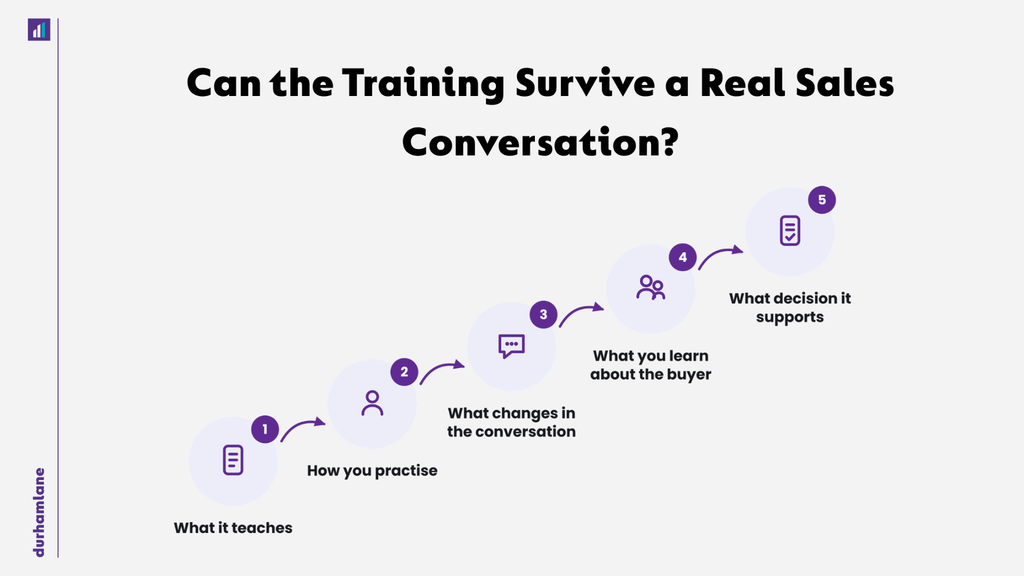
Ask the provider to work through one of its exercises from the skill taught to the decision a seller would make. For a team programme, agree which sessions the provider delivers and who will help employees develop the skill through practice and feedback between them.
What does “coaching included” actually mean?
“Coaching included” can cover very different levels of attention. Individual conversations, group feedback, call review and expert Q&A all do different jobs. Establish what work the learner brings, what feedback they get afterwards and how that support relates to the skill they’re developing.
Ask four questions before you treat the label as meaningful:
- Who will coach the learner?
- What work will they review?
- How will feedback reach the learner?
- What support continues between sessions?
A company buying team training also needs to establish the role of the employees’ managers. A provider coach might review programme assignments, while a manager discusses their use in live calls. Where managers are expected to coach, they need to know how to use a learner’s work to diagnose a skill and give feedback.
Recommended listen
When Kevin Beales, Founder and CEO of MySalesCoach, joined me, I asked about deal reviews being described as coaching. Kevin explained how pressure on the pipeline draws managers towards closing current opportunities, while sellers are looking for help developing their capability. A deal review works on the opportunity in front of you. Coaching also needs to develop the seller’s skill across future conversations.
We explored how external coaches, managers and peers contribute. Kevin emphasised an individual coaching plan with a clear priority and a way to recognise progress in the person’s work. The plan gives a manager something to revisit across conversations beyond the immediate status of a deal.
Follow one participant’s development need from teaching and application to coaching and the work afterwards. Identify what the provider, manager and peers contribute at each point.
From training to qualified conversations
What happens in a training exercise when the buyer’s answer makes the opportunity less attractive? At durhamlane, our Estimate then Validate. Never Assume mantra means testing the view we form during preparation against what the buyer tells us.
I once had a promising conversation with a potential client about training their salespeople. We had a good discussion and the call was coming to an end. I asked one last question about the budget they had put against the programme. Her answer revealed something far more consequential than an amount. She wanted to employ someone internally to train the team.
The buyer’s preferred alternative changed my assessment of the opportunity. I still saw potential, while recognising the risk that the company would hire its own person. When I followed up later, that’s exactly what the company had done.
The budget question had exposed the competition we were actually facing. Understanding why she preferred an internal hire became essential to judging an external training proposal. The conversation had produced better information and a more difficult selling position at the same time. That’s progress in qualification, even when it gives you a less comfortable view of the deal.
durhamlane in practice – Estimate, then validate
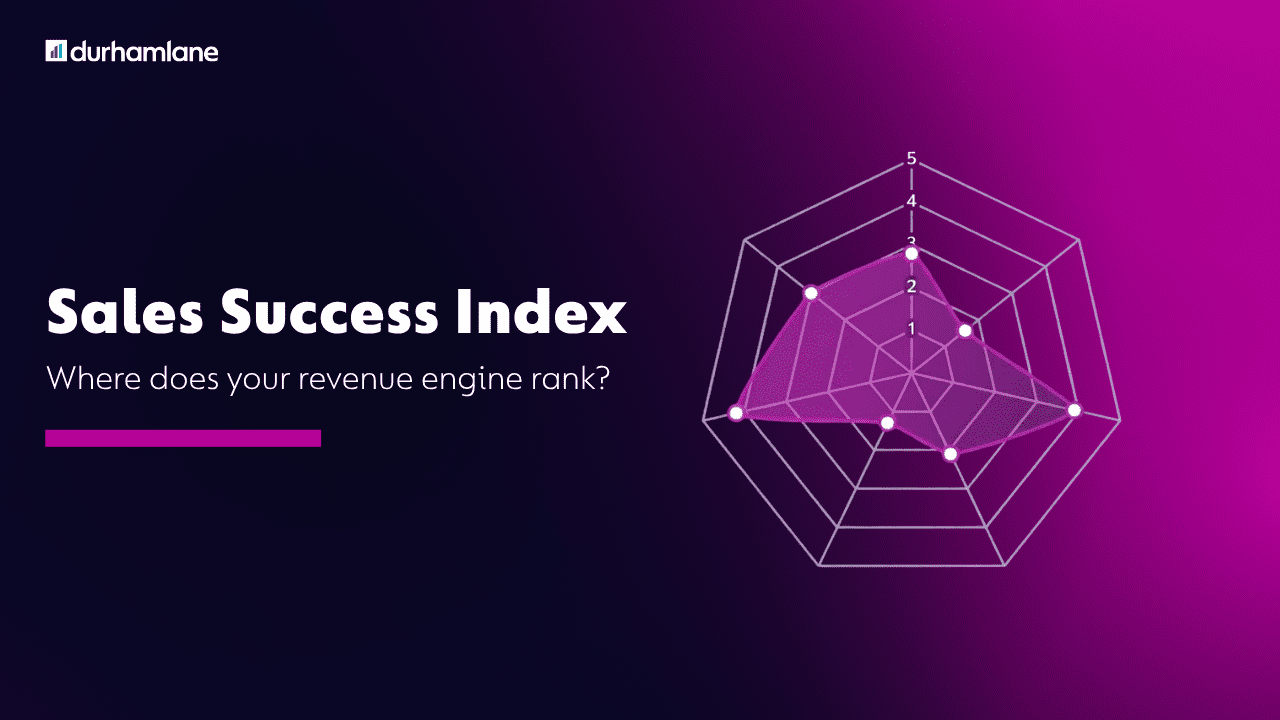
Our Magic35 diagnostic organises qualification around:
- Budget
- Defined Need
- Decision Maker
- Decision Criteria
- Compelling Event
- Timescales, and
- Competition
The areas help a seller identify what they understand about the opportunity and what they still need to establish.
The diagnostic’s endpoints distinguish 0 for no information from 5 for confirmed information. Her preference for an internal hire clarified the competition I was facing. I had firmer information on which to judge the external sale. Confidence in what you know about a buyer and confidence that the buyer will choose you are separate judgements.
Put that situation into a role-play and pause after the buyer’s answer. Ask the seller to explain what it changes before choosing the next question.
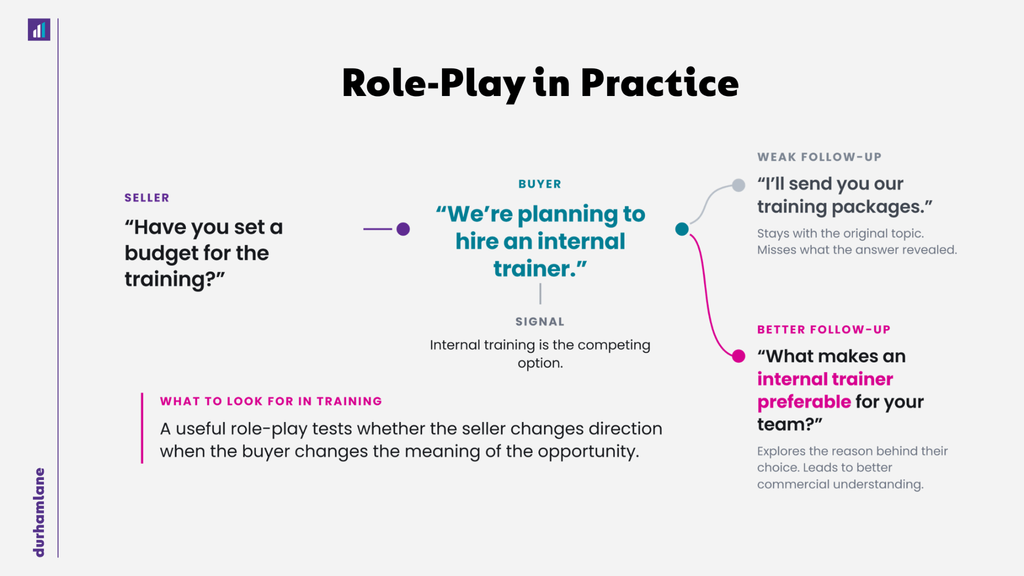
The seller also needs to record enough of the buyer’s reasoning for the next person to act on it. The manager reviewing the exercise should examine why the seller chose to investigate further, defer or stop pursuing, alongside how they delivered the question.
In our outsourced SDR teams, that work connects preparation, phone-led commercial conversations, qualification and sales-ready handoff. People listen to buyers, interpret their answers and decide how the account should progress.
The next seller needs to know what the buyer said, what changed our assessment and why we chose that next step.
The bottom line
Choose the programme that develops the sales work you or your team need to improve, with enough practice and support to use it on real accounts. Compare the price and format, then put a sample exercise under some pressure before you commit.
Look at what happens when the buyer says something unexpected. A polished question isn’t much use if the seller misses what the answer changes. The question, the interpretation and the next decision belong together.
When your team needs that development connected to live prospecting, qualification and handoff, get in touch with durhamlane. We can discuss the work an SDR team needs to do for your business, including the buyer context and qualification reasoning your sellers need when they take over an opportunity.
FAQ
Is a sales-training certificate the same as a professional qualification?
A course certificate doesn’t automatically meet a professional-qualification requirement. MEDDIC Academy offers a certificate of completion, HubSpot awards its Inbound Sales certification, and Sales Geek provides ISP-endorsed learning for continuing professional development. For a role requiring a particular qualification, check the exact award, assessment and recognition before enrolling.
Winning Strategies for Go-To-Market Challenges
Actionable solutions to elevate your go-to-market strategy.
Winning Strategies for Go-To-Market Challenges
Actionable solutions to elevate your go-to-market strategy.