

Key takeaways
- A B2B sales funnel shows how accounts, leads, or opportunities move from early awareness towards qualification, sales opportunity, and purchase. For some teams, it also extends into expansion.
- Funnel stages matter when they improve the quality of the decision to move an account forward. Clean reporting labels are secondary.
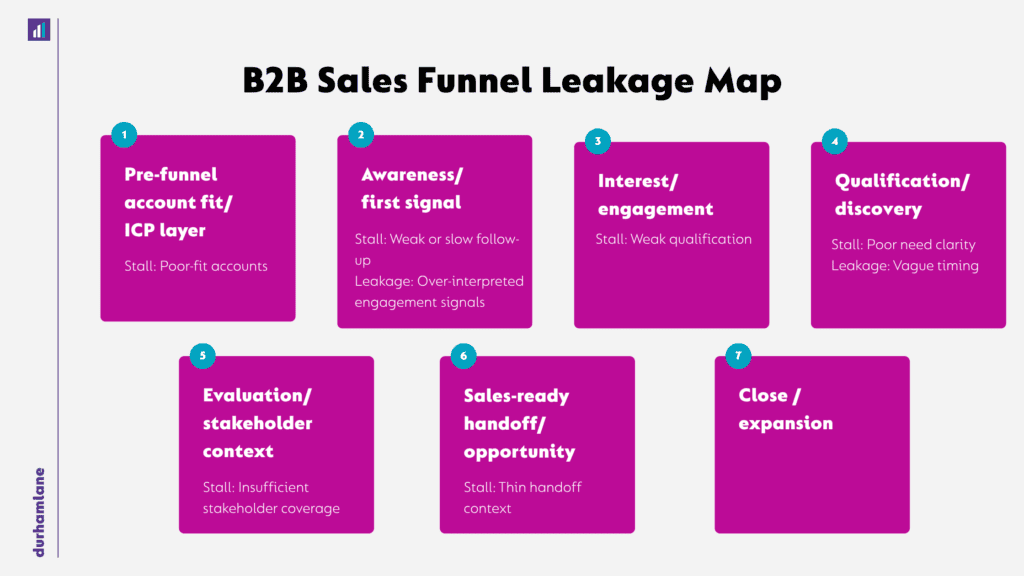
- Common leakage points include poor account fit, weak follow-up, unclear qualification, thin stakeholder context, vague timing, and poor sales-ready handoff.
- A sales funnel is not the same as a marketing funnel, sales pipeline, or sales process. Each helps diagnose a different part of revenue progression.
- For complex B2B teams, funnel movement often depends on SDR judgement, account intelligence, and qualification quality. The MQL-to-SQL handoff is where that movement either becomes useful pipeline or quietly breaks down.
A B2B sales funnel should give revenue teams more than a tidy way to label leads. In complex B2B sales, the useful question is whether the team knows enough about the account to justify moving it from one stage to the next.
That distinction matters because many funnels look active while still producing weak pipeline. Campaigns create engagement. SDRs make contact. MQLs move into follow-up. Sales receives names, notes, and activity history. But if account fit is unclear, buyer context is thin, or timing is vague, the funnel is not creating real progress. The same is true when the handoff does not explain why the next step is commercially justified. It is recording motion.
This guide explains what a B2B sales funnel is and how it differs from a marketing funnel, sales pipeline, and sales process. It also looks at where leakage usually appears and how to think about each major stage. The useful diagnostic question is what we know now that justifies moving this account, lead, MQL, SQL, or opportunity forward.
What is a B2B sales funnel?
A B2B sales funnel is a stage model for how buyers, leads, accounts, or opportunities move from early awareness or prospect status towards qualification, sales opportunity, and purchase. For some teams, it also extends into expansion.
The funnel narrows because not every account or lead should move forward. Some accounts are a poor fit. Some buyers are only researching. Some signals are too weak to justify sales effort. Some opportunities stall because the problem is not urgent, the buying group is unclear, or the next step has not been earned.
A B2B sales funnel becomes useful when it helps the revenue team judge whether demand is becoming more commercially qualified as it moves through the system. The stage label matters less than the reasoning behind the label.
B2B funnels are also usually less linear than simple B2C funnel models. Account fit, buying context, stakeholder involvement, timing, and sales/marketing handoff quality all shape whether progress is meaningful. A buyer may move backwards, pause, involve new stakeholders, or re-enter the funnel after a trigger changes their priorities.
B2B sales funnel vs marketing funnel, sales pipeline, and sales process
These terms are often used interchangeably, which is part of the problem. They overlap, but they are not the same thing.
| Term | What it means | What it helps diagnose | Common misuse |
| B2B sales funnel | Progress from early interest or prospect status towards qualified opportunity and purchase | Where accounts or leads advance, stall, or leak | Treated as a tidy diagram rather than evidence of qualification |
| B2B marketing funnel | Demand creation, engagement, nurture, and buyer education | Whether marketing is creating and developing relevant demand | Treated as proof that sales should accept the lead |
| Sales pipeline | Active opportunities sales is managing | Forecast, deal movement, and opportunity status | Confused with all demand or all leads |
| Sales process | The operating sequence used to create, qualify, progress, and hand over opportunities | Whether the team has a repeatable way to execute | Overdeveloped when the immediate problem is funnel leakage |
A marketing funnel is useful for understanding how demand is created and developed. A sales pipeline is useful for understanding active opportunities and forecastable deal movement. A sales process explains the work used to create, qualify, progress, and hand over opportunities.
The sales funnel sits between these ideas. It shows progress and leakage. Used well, it helps the team ask where demand is becoming more qualified and where it is being passed forward without enough substance.
Why B2B sales funnels leak
B2B sales funnels often leak at the handoff points between stages, as well as inside the stages themselves. The dashboard may show leads moving forward, even when the commercial reality underneath is much weaker.
A lead may become an MQL because it reached a score, downloaded the right asset, or attended the right session. That can make it visible. It does not prove that the team understands need, urgency, fit, buying role, or timing. Marketing engagement may create a useful reason to follow up, but it has not yet created a sales-ready conversation.
The same problem shows up in sales development. An SDR may follow up because the record has been routed, but still have too little account context to know why this company matters, what triggered the interest, or what question needs answering first. The activity happens. The commercial interpretation is thin.
Sales then receives a name, a meeting note, a score, and a record of touches. The missing piece is often a clear reason to prioritise the account now. One contact may have replied. One meeting may have been booked. One form may have been completed. The missing question is whether the account is actually better understood than it was before.
That is where leakage appears. Poor-fit demand enters the funnel. Follow-up happens without enough account intelligence. Qualification becomes a formality. Stakeholder involvement is assumed rather than tested. Timing is described in vague language. Sales inherits activity notes. What it often lacks is urgency, problem clarity, and a reliable next step.
The failure is usually systemic, not departmental. Marketing may report engagement, SDRs may complete the follow-up motion, and sales may accept the record because the stage says it is ready. The funnel looks organised while the qualification burden quietly moves downstream.
A healthy B2B sales funnel should expose that weakness before it becomes a weak opportunity. It should make teams ask whether the account deserves the next stage, whether the conversation has created sales-usable detail, and whether sales has a real reason to continue.
The major stages of a B2B sales funnel
There is no single universal B2B sales funnel stage model. Some models emphasise buyer journey. Some emphasise marketing nurture. Some focus on seller action, pipeline management, or account-fit logic.
For practical use, stage count is not the argument. The more important question is what each stage should prove before the account moves forward.
Account fit/target-market control
Account fit protects the top of the funnel from anonymous volume. Before a lead or account is treated as funnel-ready, the team needs at least a working view of whether it belongs there.
This does not mean every article about a B2B sales funnel needs a full ICP strategy section. The funnel should not reward activity from accounts that sales would never want to prioritise. If the fit is weak, later-stage effort becomes more expensive and less useful.
| Progression check: Does this account deserve focused follow-up, or is it only creating activity at the top of the funnel? |
Awareness/first signal
At the awareness stage, the buyer or account has become visible in some way. They may have seen content, responded to outreach, searched for a category, attended an event, or appeared on a target list.
The job is not to force a demo request out of a light signal. A better next step is to decide whether the signal deserves further engagement. A first signal may justify education, relevance testing, account research, or careful follow-up. It does not prove intent by itself.
| Progression check: Do we know why this signal matters, or are we moving too quickly towards a sales conversation? |
Interest/engagement
Interest becomes valuable when it creates context. A content download, webinar attendance, reply, referral, enquiry, or outreach response may all be useful signals. But they only matter commercially if the team uses them to understand what is actually happening inside the account.
What problem might the buyer be exploring? Does the account fit? Is the person relevant to the decision? Is there a timing cue? Is there a reason to continue the conversation? Without those questions, engagement becomes a stage label with weak evidence behind it.
| Progression check: Is this account showing meaningful buying context, or only visible activity? |
Qualification/discovery
Qualification is where the funnel should become more disciplined. A reply or a booked conversation is not enough. The stage has to establish whether sales involvement is commercially justified, whether the account belongs in nurture, or whether the opportunity should be disqualified before more time is spent.
Weak qualification often looks respectable in the CRM. The notes say what was discussed, but not why it matters. The buyer has described a topic, but urgency is still unclear. The account appears interested, but fit, timing, stakeholder relevance, problem seriousness, and next-step quality remain unresolved.
Useful qualification should clarify what problem surfaced, why it matters, what prompted the conversation, who is involved or missing, what uncertainty remains, and what next step has actually been agreed. It should make disqualification or nurture a valid outcome when the account is not ready, rather than treating every conversation as a reason to push forward.
This is where human judgement matters. Buyers do not always describe their situation in neat categories. A seller or SDR may need to ask professionally curious questions, interpret ambiguous answers, and notice what has not yet been said.
The danger is treating qualification as a form field. If the conversation produces only surface notes, sales inherits the work that should already have been done. The account appears to advance, but sales still has to rediscover the problem, retest fit, and work out whether there is a real reason to continue.
| Progression check: Do we know enough to justify moving this account forward? |
Evaluation/stakeholder context
Middle-to-late funnel progress depends on whether engagement reflects a real buying situation. In complex B2B, evaluation can involve internal debate, competing priorities, new stakeholders, shifting urgency, and uncertainty about timing.
One enthusiastic contact can create false confidence. They may understand the problem personally, but not own the budget, decision path, internal case, or priority. Continued engagement can hide the fact that no wider buying group has been validated.
The account may be interested and still not be ready for sales-owned pursuit. There may be no executive attention, no agreed urgency, no internal alignment, or no clear answer to what has to happen next inside the organisation. A visible contact can be useful without being able to move the company.
Stakeholder context does not require a heavy procurement map in this article. It does require the team to avoid guessing the buying group from one good conversation. Before a handoff, sales should know who else matters, what pressures are shaping the decision, what objections or competing priorities exist, what has already been discussed, and where uncertainty remains.
| Progression check: Are we seeing the buying context, or only the behaviour of one engaged contact? |
Sales-ready handoff/opportunity
Sales-ready handoff is where the earlier discipline either becomes usable or collapses.
A good handoff carries more than activity data. Sales needs to know why the account fits, what problem surfaced, what triggered the conversation, who is involved, what was agreed, what remains uncertain, and why the next step deserves attention now.
The weak version is easy to recognise. A meeting gets booked with only a thin reason behind it. A record is passed because the score, form field, or meeting status says it is ready. Sales receives a summary of touches and topics. It does not receive the urgency, decision path, buying-group reality, or unresolved questions needed to shape the next conversation.
That makes MQL-to-SQL movement a qualification and context-transfer problem before it is a reporting problem. An MQL should not become sales-ready simply because it has reached a score, clicked the right asset, or filled in the right field. Those signals may help prioritise follow-up, but they do not replace judgement.
A simple practical test is whether sales can pick up the conversation without starting again. If not, the burden has merely been transferred. Sales has to rediscover the problem, retest fit, clarify stakeholders, and rebuild momentum that should have been carried through the funnel.
| Progression check: Can sales prioritise this account with confidence, or has it only received a score, meeting note, or form-field trigger? |
Close/expansion
Some B2B sales funnel models include purchase, retention, expansion, and account development. That makes sense as an endpoint, especially where the funnel is being used as a broad revenue model.
Close and expansion should stay light here because the main focus is progress towards qualified opportunity and sales-ready handoff. Closing, renewal, procurement, customer success, and expansion each need their own operating detail.
| Progression check: Is this still part of funnel diagnosis, or has the article moved into a different playbook? |
Stage progression rule
An account should not move forward just because it created activity. Each stage should add one of three things:
- clearer fit;
- clearer buying context, or
- a stronger reason for sales to act.
If the next stage does not have better evidence than the previous one, the funnel is probably recording movement rather than progress.

Conventional funnel thinking vs account-based funnel thinking
Conventional funnel thinking is useful because it shows progress and leakage. It helps the team see where accounts or leads enter, move, stall, or fall away.
Account-based thinking adds a corrective lens. It asks whether the right accounts are entering the funnel in the first place, whether the buying group is understood, and whether effort is being wasted on poor-fit demand.
A funnel shows progress. Account-based thinking helps decide what deserves to enter the funnel.
That does not mean traditional funnels are dead. The funnel simply should not be used as a volume machine detached from account quality. In B2B sales, better account-fit judgement at the start often protects qualification and handoff later.
How to improve B2B sales funnel progression without turning it into a software project
Improving a B2B sales funnel does not have to start with a new platform, a full CRM rebuild, or a reporting project. Those tools may support the work, but they are not the work.
Start by clarifying stage entry and exit criteria. A team should know what qualifies an account to enter the funnel, what makes a lead worth follow-up, what separates engagement from readiness, and what justifies sales-owned progression. The criteria need to describe real commercial judgement, not sit behind a CRM label.
Then audit a sample of recent stage changes. For each one, ask what changed between entry and exit. Did the team learn something material about fit, problem clarity, urgency, buying role, decision path, or next step? Or did the account simply collect enough activity to be moved forward?
MQL and SQL definitions also need practical discipline. Compare recent MQL reasons against what sales actually needs to accept and continue the conversation. An MQL should tell the SDR or sales-development team why follow-up is worth prioritising. An SQL or opportunity should tell sales why the account is worth taking forward now. If those definitions are vague, the funnel will keep creating handoff friction.
Follow-up should be timely, consistent, and context-aware. That does not mean chasing every signal with the same script. The detail available should help the team decide how to respond, what question to ask next, which trigger to test, and what still needs to be understood before the account can sensibly move on.
Review recent handoffs as well. Do they explain urgency, fit, problem, buying group, agreed next step, and open questions? Or do they mainly show that someone clicked, replied, attended, or took a meeting? Thin handoffs make sales restart discovery, even when the funnel says the account has advanced.
Finally, identify where follow-up loses account context. It may happen at the first response, the second touch, the qualification call, the nurture return, or the sales handoff. Good-fit accounts can stall because nobody carries the right commercial detail forward.
Tools help with visibility, prioritisation, and reporting. They make activity and gaps easier to inspect. Qualification still depends on commercial judgement about whether the conversation is real, whether sales has enough to act, and whether the handoff carries useful buying context. The improvement work sits in sharper definitions, stronger follow-up, better judgement, and cleaner handoff.
Where durhamlane fits
For many B2B teams, the weak point in the funnel sits in the SDR work that turns demand into a properly qualified sales conversation, rather than in basic awareness of the model.
Leakage often starts with weak follow-up, thin account intelligence, underdeveloped qualification, and poor handoff. In those cases, the missing layer is usually practical SDR work. Another funnel diagram will not fix that. The work starts with better account research, better calls, and better questions. It continues through testing whether interest is real, clarifying who is involved, and handing sales a conversation that is actually worth pursuing.
That is where durhamlane fits. durhamlane provides outsourced SDR teams for B2B organisations that need stronger account intelligence, better phone follow-up, clearer qualification, and cleaner MQL-to-SQL handoff. AI and technology can support research, preparation, and consistency. The value still comes from trained SDRs who know how to turn interest into a useful sales conversation.
For inbound demand, durhamlane’s inbound lead conversion services support the gap between marketing engagement and useful sales follow-up. For outbound sales development, durhamlane’s outsourced SDR teams support targeted account engagement, qualification, and qualified opportunity creation in complex B2B sales environments.
The point is not to replace the funnel with a vendor. The real gap is the part of the funnel where activity has to become a credible sales conversation. A funnel can show where leads move. It still needs people who know how to ask the right questions, interpret the answers, and pass sales a reason to continue.
Final thought
A B2B sales funnel is not useful because it turns the buying journey into a neat shape. The value comes from showing where demand is becoming more qualified, where it is stalling, and where it is being moved forward without enough evidence.
A funnel that only records activity can make leakage look organised. A funnel that prompts better questions at each stage helps protect sales effort, improve handoff quality, and turn more of the right demand into qualified opportunity.
Get in touch
B2B sales funnel FAQs
What is a B2B sales funnel?
A B2B sales funnel is a model for how buyers, leads, accounts, or opportunities move from early awareness towards qualification, sales opportunity, purchase, and sometimes expansion. In complex B2B, the funnel is most useful when each stage improves account fit, buyer context, qualification, and handoff quality.
What are the main stages of a B2B sales funnel?
A practical B2B sales funnel can include account fit, awareness, interest, qualification, evaluation, sales-ready handoff or opportunity, and close or expansion. Different businesses use different labels, but the important question is what each stage should prove before the account moves forward.
What is the difference between a B2B sales funnel and a sales pipeline?
A B2B sales funnel shows how demand, leads, accounts, or opportunities progress and where they leak. A sales pipeline usually refers to active sales-owned opportunities and forecastable deal movement. The funnel diagnoses progression before and around opportunity creation. The pipeline helps manage opportunities once sales is actively working them.
What is the difference between a B2B sales funnel and a marketing funnel?
A marketing funnel focuses on demand creation, engagement, nurture, and buyer education. A B2B sales funnel focuses on how accounts or leads progress towards qualification, sales-ready handoff, opportunity, and purchase. They overlap, but marketing engagement should not automatically be treated as sales readiness.
Why do B2B sales funnels leak?
B2B sales funnels leak when accounts or leads move forward without enough commercial evidence. Common causes include poor account fit, weak follow-up, unclear qualification, vague timing, thin stakeholder context, and over-interpreted engagement signals. Leakage also happens when handoffs give sales activity data without explaining why the account is worth prioritising.
How can you improve a B2B sales funnel?
Start by clarifying stage entry and exit criteria, separating activity from evidence, and tightening MQL and SQL definitions. From there, improve follow-up discipline and review where handoffs are too thin. Tools can support visibility, but better progression usually depends on sharper qualification, better context, and clearer sales-ready handoff.