

Key takeaways
- B2B sales KPIs should show whether the team is creating enough qualified conversations, held meetings, accepted opportunities and pipeline to protect the revenue number.
- Meetings booked matter, especially when the business has a pipeline problem. They are not a revenue KPI until they lead to held meetings, qualified opportunities and pipeline progression.
- Use benchmarks as orientation bands. Avoid turning them into blunt targets. Always check the denominator, because dial-to-meeting, conversation-to-meeting, booked meeting, held meeting, SQL and opportunity are different metrics.
- Be strict on quality gates such as held meetings, qualification evidence, accepted handoffs and pipeline coverage. Treat raw activity, email opens and broad averages as diagnostic signals.
- Review different KPIs at different cadences, with activity daily, conversion weekly, pipeline monthly and revenue or quota trends quarterly.
A business at risk of falling short of its revenue number rarely solves the problem by tracking every possible sales metric. The harder question is whether your KPIs reveal the constraint early enough to act.
B2B sales leaders are working in a more complex buying environment. Gartner’s 2026 buyer research reports that 67% of B2B buyers prefer a rep-free experience, and a later survey by the same firm found that buyers still use sales reps to validate AI-generated insights and support critical decisions. Buyers want less friction and still need confidence. Forrester’s State of Business Buying 2026 adds the buying-group context. Business buying decisions now involve an average of 13 internal stakeholders and nine external participants, with procurement decision-makers involved more than half the time.
Those conditions make weak sales KPIs dangerous. A dashboard can show high activity, a full calendar and a promising pipeline while the team is still missing the real problem. Poor targeting, low-quality conversations, weak qualification and meetings that never become accepted opportunities may be sitting underneath the green report.
B2B sales KPIs exist to show whether the commercial engine is creating enough real buyer movement to support the revenue plan.
What are B2B sales KPIs?
B2B sales KPIs are measurable indicators that show how well a sales or sales-development team is creating, progressing and converting commercial opportunities. The best KPIs connect daily sales work to pipeline quality and revenue outcomes.
A strong KPI set includes more than revenue metrics. Revenue is the outcome and often arrives too late to manage the front of the funnel. A sales leader needs earlier signals, including target-account coverage, connection rate, positive conversations, meetings booked, meetings held, qualification quality, accepted handoffs and pipeline progression.
B2B sales KPIs vs sales metrics
A sales metric is any number the team can track. A KPI is a number the business is prepared to manage from. Calls made, emails sent, replies, meetings booked, opportunities accepted and revenue generated can all appear on a dashboard. They carry different decision value.
Raw activity tells a manager whether the work is happening. It doesn’t prove that the market is responding. Meetings booked show calendar commitment. They don’t prove that the meeting was worth having. Pipeline value points to commercial potential. It doesn’t prove the deal will close.
Good KPI management means reading those metrics as a chain of related signals.
Why KPI choice depends on sales motion and funnel stage
A useful KPI matches the sales motion, role and funnel stage it’s supposed to improve. An outbound SDR team needs different daily signals from an enterprise AE team. Companies with a pipeline creation problem should look hard at target-account coverage, connection quality, meetings held and qualification evidence. Teams with enough qualified opportunities and poor close rates may need to inspect deal strategy, stakeholder coverage, pricing friction or sales-cycle progression.
That is why a single “best KPI” list can mislead. The sharper question pairs tracking with action by asking what the team should track and what decision the KPI should help it make.
The KPI operating model linking activity with revenue
The simplest way to manage B2B sales KPIs is to separate the funnel into a chain of evidence. Early metrics show whether enough work is happening. Later metrics show whether that work is becoming buyer movement, accepted opportunity and revenue confidence.
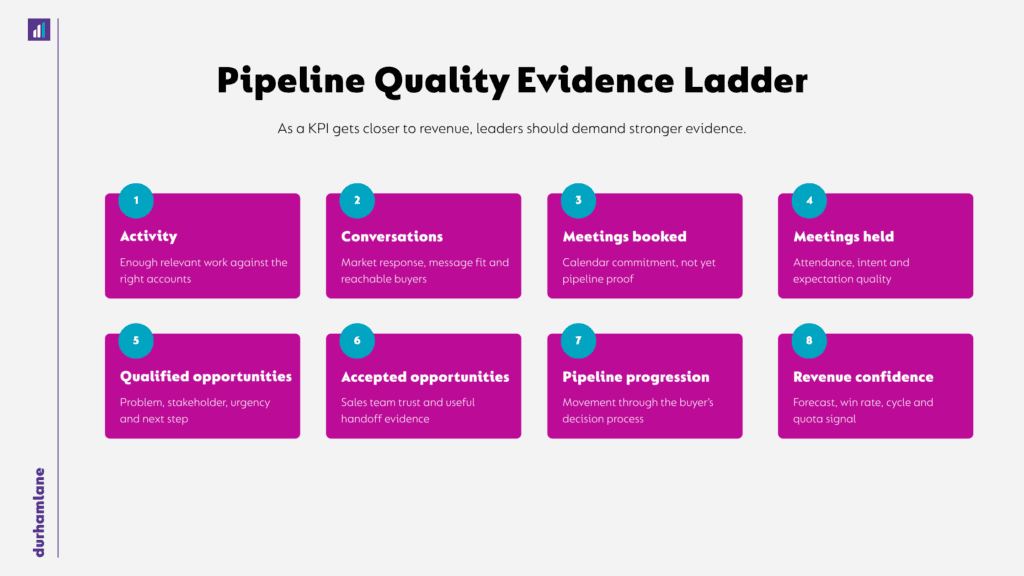
- Activity is the floor. Calls, emails, LinkedIn touches, sequences, account research and follow-up tasks have to happen against the right accounts before the team can expect consistent meetings.
- Conversation quality shows whether targeting, data quality, timing and proposition strength are working. Connection rate, reply rate, positive conversation rate and message relevance reveal whether the market is responding.
- Meeting and opportunity quality is where many B2B teams find the real constraint. Meetings booked, meetings held, meeting show rate, meeting-to-qualified-opportunity conversion, sales-accepted handoffs and next-step clarity show whether calendar activity is becoming useful pipeline.
- Pipeline and revenue metrics come later. Pipeline coverage, sales velocity, win rate, average deal size, sales cycle length, quota attainment and revenue sourced or influenced by sales development show whether earlier movement is turning into commercial confidence.
- The fifth layer is review cadence. A KPI improves performance only when the right person reviews it at the right rhythm and uses it to make a decision.
The top B2B sales KPIs to track
The best KPI set depends on your sales motion, market, ACV, cycle length and team maturity. Still, most B2B teams need a balanced view of the same core metric families.
| KPI | What it tells you | When to review | Strictness | How to improve |
| Target-account coverage | Fit and prioritisation in the accounts being worked | Weekly or monthly | Strict | Tighten ICP, segment by intent, remove poor-fit accounts and refresh contacts |
| Sales activity quality | Volume and relevance of the work happening | Daily for SDRs, weekly for managers | Diagnostic | Coach workflow, improve list quality, test channel mix and remove low-value tasks |
| Connection or reply rate | Reachability and message resonance | Weekly | Strict with context | Improve direct-dial and email data, test timing, personalise by trigger and sharpen the opening message |
| Positive conversation rate | Real buyer engagement from activity | Weekly | Strict | Refine call structure, use stronger business problems, train discovery and target better accounts |
| Meetings booked | Calendar commitment | Weekly | Strict as an intermediate signal | Improve CTA clarity, qualify before booking and align the meeting to a real business issue |
| Meetings held or sat | Booked meetings that actually happen | Weekly and monthly | Super strict | Improve confirmation, set expectations, qualify intent and involve the right stakeholder |
| Meeting-to-qualified-opportunity rate | Commercial usefulness of meetings | Monthly | Super strict | Define qualification criteria, strengthen handoff notes and reject weak-fit meetings earlier |
| Sales-accepted opportunity rate | AE trust in SDR-sourced pipeline | Monthly | Super strict | Agree acceptance criteria, inspect rejected handoffs and close feedback loops |
| Pipeline coverage | Qualified pipeline available for the revenue target | Monthly and quarterly | Super strict | Increase high-fit meetings, improve conversion quality and prioritise larger or better-fit accounts |
| Win rate, sales cycle and quota attainment | Full-engine conversion | Monthly and quarterly | Outcome strict | Improve qualification, mutual action plans, buyer enablement, stakeholder coverage and deal coaching |
The point is to connect each metric to the management decision it should trigger. That means naming what to inspect, what to improve and what to leave alone.
Which KPIs should leaders be strict on?
Leaders should be strictest on KPIs that prove real buyer movement. A metric deserves more scrutiny when it can be gamed, inflated or improved without creating better pipeline.
Quality gates to be strict on
Be strict on metrics that prove real buyer movement.
- meetings held before meetings booked
- meeting-to-qualified-opportunity conversion
- accepted handoffs from SDR to AE
- pipeline coverage against the revenue target
- stage progression on qualified opportunities
- lost reasons and disqualification reasons
- the integrity of CRM fields used for forecasting and handoff
These KPIs protect the business from mistaking motion for progress. If booked meetings rise and held meetings, qualification quality or AE acceptance falls, the KPI system should show the problem quickly.
Activity metrics to treat diagnostically
Activity still matters. Calls made, emails sent, sequence steps, LinkedIn touches and follow-up tasks show whether enough work is happening. Read them as diagnostic inputs. Proof of success comes later in buyer movement, qualification and pipeline progression.
Low activity points to a possible capacity, workflow or management problem. High activity with weak conversion points to targeting, data quality, message relevance, timing or proposition strength.
The mistake is pretending that activity is success.
Meeting volume needs quality gates
For many B2B companies, the immediate problem sits upstream of deal closing. The sales team doesn’t have enough qualified meetings and opportunities to work. That shortage puts meetings booked near the centre of the KPI system.
A booked meeting is an intermediate output. It can be valuable, neutral or actively misleading.
Booked vs held meetings
A booked meeting is valuable when the right stakeholder attends, the need is real, the account fits the ICP, the timing is plausible and the AE has enough qualification evidence to progress the conversation.
A neutral meeting happens when the prospect attends but doesn’t match the target account profile, has no business issue, or accepts a meeting out of curiosity.
A misleading meeting happens when the dashboard rewards booking volume while show rate, AE acceptance and opportunity creation are weak.
For SDR teams, KPI discipline starts with a practical distinction between calendar activity and qualified buyer movement. Booked meetings matter, but meetings sat and accepted opportunities are better signals of whether activity is turning into pipeline.
From held meetings to qualified pipeline
A held meeting is stronger than a booked meeting and still needs qualification. The meeting should produce evidence of the business problem, stakeholder role, urgency, current process, next step and reason the AE should care.
A meeting with no such evidence may be real and still not yet commercially useful. If accepted opportunities then stall quickly, the KPI system should push the team to inspect qualification quality, stakeholder coverage, proposition strength, next-step clarity and sales execution.
RELATED WATCH
SDR Team KPIs That Drive Revenue – Not Just Reports
For a deeper discussion of SDR KPI quality, benchmark context and dashboard pitfalls, watch the durhamlane webinar with Greg Casale (Reveneer), Kevin Kelly (PaceOps) and Tom Stearns (Stearns Consulting).
It will connect you wider with the booked-vs-held meeting distinction and the move from activity reporting to qualified pipeline evidence.
Benchmark B2B sales KPIs without fooling yourself
Benchmarks help leaders ask better questions. Copied targets without context make them risky.
Salesforce’s State of Sales Report 2026, based on a survey of 4,050 sales professionals across 22 countries, shows why the operating environment is difficult. It reports that 57% of sales professionals say customers take longer to decide, 42% of sales reps feel overwhelmed by too many tools, and reps spend 40% of their week selling and 60% on non-selling work.
Those findings don’t tell you what your meeting target should be. They explain why KPI interpretation needs operational discipline. Long cycles, tool burden, poor data and unclear routing can all distort sales performance.
What a benchmark can and cannot tell you
A benchmark shows whether your number is worth investigating. It helps leadership spot an outlier, challenge an assumption or decide where to look next.
It cannot tell you, by itself, what your target should be. A good number changes when the ACV, channel, buyer seniority, product category, industry complexity, geography and sales motion change.
Use benchmarks as context, then compare them with your own baseline. A mismatched denominator is a reason to reject the target.
How to keep the denominator attached
The safest practical habit is to name what the number actually measures before deciding what it means.
| Benchmark area | What to compare | Question to ask before using it | Common mistake |
| Dial-to-meeting conversion | Cold outbound call productivity | Is this based on dials, connects, conversations or meetings? | Comparing dial-to-meeting with inbound demo conversion |
| Conversation-to-meeting conversion | Call quality and relevance | Which conversations count as positive or qualified? | Counting only strong conversations and then over-reading the rate |
| Meetings booked per SDR | Capacity and planning | Is it paired with show rate and qualification quality? | Rewarding booking volume without checking meeting quality |
| Meeting show rate | Confirmation and intent quality | Does a held meeting become a qualified opportunity? | Treating attendance as proof of pipeline |
| MQL-to-SQL or lead-to-SQL | Sales and marketing alignment | Are MQL and SQL definitions agreed? | Comparing teams that use different lead definitions |
| SQL-to-opportunity | Qualification quality | What rule creates the opportunity? | Inflating performance with loose opportunity creation |
| Win rate | Full-funnel health | Does win rate vary by source, segment or deal size? | Using a late-stage metric to manage SDR activity alone |
| Sales cycle length | Forecasting and expectation setting | Is the cycle longer because of buyer complexity or poor execution? | Blaming sales process without checking stakeholder complexity |
The discipline is simple. Compare like with like before turning any benchmark into a target.
When to review each sales KPI
Cadence matters as much as the metric. A KPI reviewed at the wrong rhythm creates noise or arrives too late to change the outcome.
Daily and weekly diagnostics
Review activity metrics daily at SDR level. Reps need to know whether they are doing the right work, using the right lists and completing the right follow-up. Managers can inspect activity weekly to spot workflow problems. Leadership shouldn’t obsess over yesterday’s call count.
Review conversion metrics weekly. Connection rate, reply rate, positive conversations, meetings booked and meeting show rate move quickly enough to diagnose problems before a month is lost. A weekly review should ask what changed across data quality, message, timing, persona, account segment, sequence, call structure and qualification criteria.
Monthly pipeline-quality review
Review opportunity and pipeline metrics monthly. Meeting-to-qualified-opportunity conversion, AE acceptance, pipeline created, stage progression and lost reasons need enough volume to be meaningful. If meetings are happening and accepted pipeline is weak, the review should inspect fit, qualification and handoff.
Quarterly revenue-accountability review
Review revenue metrics monthly and quarterly. Win rate, sales cycle, quota attainment, average deal size, customer acquisition cost and revenue generated are essential. They arrive too late to manage SDR activity alone.
Use them to check whether the upstream KPI model is actually predicting the revenue outcome. If the leading indicators look healthy and revenue is weak, the business may be measuring the wrong leading indicators.
How to increase the KPIs that matter
Improving B2B sales KPIs means identifying the constraint and improving the metric closest to that constraint.
High activity with low conversion
Weak target-account coverage calls for ICP improvement before activity increases. A larger list of poor-fit accounts will create more noise. Segment by industry, buying trigger, account size, territory, incumbent technology, funding, hiring signal or strategic initiative.
Weak connection rate points first to data and timing, then to SDR skill. B2B sales calls guidance links connection performance to intent-led segmentation and contact-data quality. Check the inputs before assuming the rep lacks execution skill.
If positive conversation rate is weak, improve the opening problem and discovery structure. A prospect doesn’t become interested because a rep completed a sequence. Interest starts with outreach that connects to a recognisable business issue.
Booked meetings with weak opportunity conversion
If meetings booked are weak, inspect the ask. Many teams either ask too early, before enough relevance is established, or too vaguely, so the prospect has no reason to commit time. A stronger meeting CTA connects the meeting to a specific problem, stakeholder, outcome or decision.
If meetings booked are strong but held meetings are weak, inspect qualification and confirmation. A low show rate can mean the meeting was booked too softly, the value was unclear, the wrong person accepted, or the reminder process failed.
Held meetings with weak opportunities point to handoff quality. Did the SDR capture the business problem, stakeholder role, urgency, current process, next step, budget context and reason the AE should care? A meeting can happen and still lack the evidence needed for commercial qualification.
Accepted opportunities that stall
Accepted opportunities that stall point to buyer complexity. The Gartner buyer research cited earlier and Forrester’s State of Business Buying 2026 both point to the same operating challenge. B2B buying is more digital, more multi-source and more multi-stakeholder than a simple funnel suggests. A single interested contact may not be enough.
The KPI system should therefore track stakeholder coverage, next-step clarity and whether the opportunity is progressing through the buyer’s decision process.
Weak revenue despite healthy pipeline points to qualification, deal coaching and win/loss patterns. The problem may have moved downstream through poor commercial fit, weak differentiation, pricing friction, procurement risk, or insufficient executive alignment.
Use industry context and avoid invented averages
Industry context matters because the same KPI can mean different things in different B2B environments. The trap is pretending that every sector has a clean public average for every sales KPI.
The six industry contexts
Across complex B2B sectors such as finance, healthcare, insurtech, manufacturing, pharma and life sciences, and professional services, the same metric can point to different management decisions.
| Industry context | What changes in KPI interpretation | Useful KPI emphasis | Relevant sector context |
| Finance | Regulated, senior and budget-aware buyers make stakeholder access and reporting discipline more important | C-level conversations, qualified next steps, multi-stakeholder progression | Professional-services and finance-adjacent work such as the PwC case study shows why targeted outreach and qualified opportunities matter |
| Healthcare | Procurement, clinical stakeholders and budget pressure make quality evidence more important than meeting volume | Show rate, stakeholder role, qualification depth, opportunity readiness | Healthcare technology examples such as the Siemens Healthineers and Omron Healthcare case studies point to qualification depth and channel fit |
| Insurtech | Referral and partner-led growth can hide pipeline fragility | Buying-signal discovery, new-logo pipeline, qualified opportunity creation | Test whether pipeline is repeatable or too dependent on referral flow |
| Manufacturing | Large buying centres and technical explanation lengthen decision paths | Stakeholder mapping, technical-fit discovery, stage progression | The Fluke case study is useful for teams with lead volume but limited qualification capacity |
| Pharma and life sciences | Scientific and commercial stakeholders need different evidence | Qualification depth, commercial trigger, long-cycle pipeline coverage | Focus on qualification depth, stakeholder evidence and commercial trigger ahead of generic meeting volume |
| Professional services | Reputation-led pipeline is inconsistent unless outreach makes it repeatable | Senior decision-maker meetings, referral-to-pipeline conversion, pipeline consistency | The PwC work is relevant context for targeted outbound and qualified-opportunity creation in professional-services environments |
The practical lesson is direct. Don’t ask “what is the average KPI for B2B sales?” Ask what this KPI means in your buying environment and exactly what the number measures.
Sector examples sharpen that question. Fluke points to lead volume, qualification capacity and MQL-to-SQL pressure. Siemens Healthineers and Omron Healthcare point to channel choice, stakeholder understanding and qualification discipline in healthcare and medtech outreach. PwC points to targeted outbound for reputation-led firms that still need a repeatable route to qualified opportunities.
Diagnose the KPI pattern before changing the target
Use the symptom to choose the first inspection point. A KPI review works best when it diagnoses the pattern before changing the target.
| Activity is low First check: capacity, workflow, list quality and management rhythm. Do not assume: conversion is the core problem before activity capacity is understood. | Activity is high but conversion is low First check: target fit, data quality, timing, channel mix and message relevance. Do not assume: motivation is the issue until the inputs have been checked. |
| Meetings are booked but not held First check: qualification strength, confirmation process, stakeholder fit and whether the meeting value was clear enough for the buyer to attend. Do not assume: booked volume is pipeline creation. | Meetings are held but opportunities are weak First check: business problem, stakeholder role, urgency, current process, next step and handoff evidence. Do not assume: every attended meeting deserves AE time. |
| Accepted opportunities stall First check: stakeholder coverage, next-step clarity, buyer complexity and whether the opportunity is progressing through a real decision process. Do not assume: the issue still sits with SDR activity. | Pipeline looks healthy but revenue is weak First check: qualification, deal coaching, win/loss patterns, forecast integrity and whether earlier KPIs are predicting the wrong outcome. Do not assume: top-of-funnel volume will fix a late-stage quality problem. |
| RELATED TOOL B2B Sales Success Index 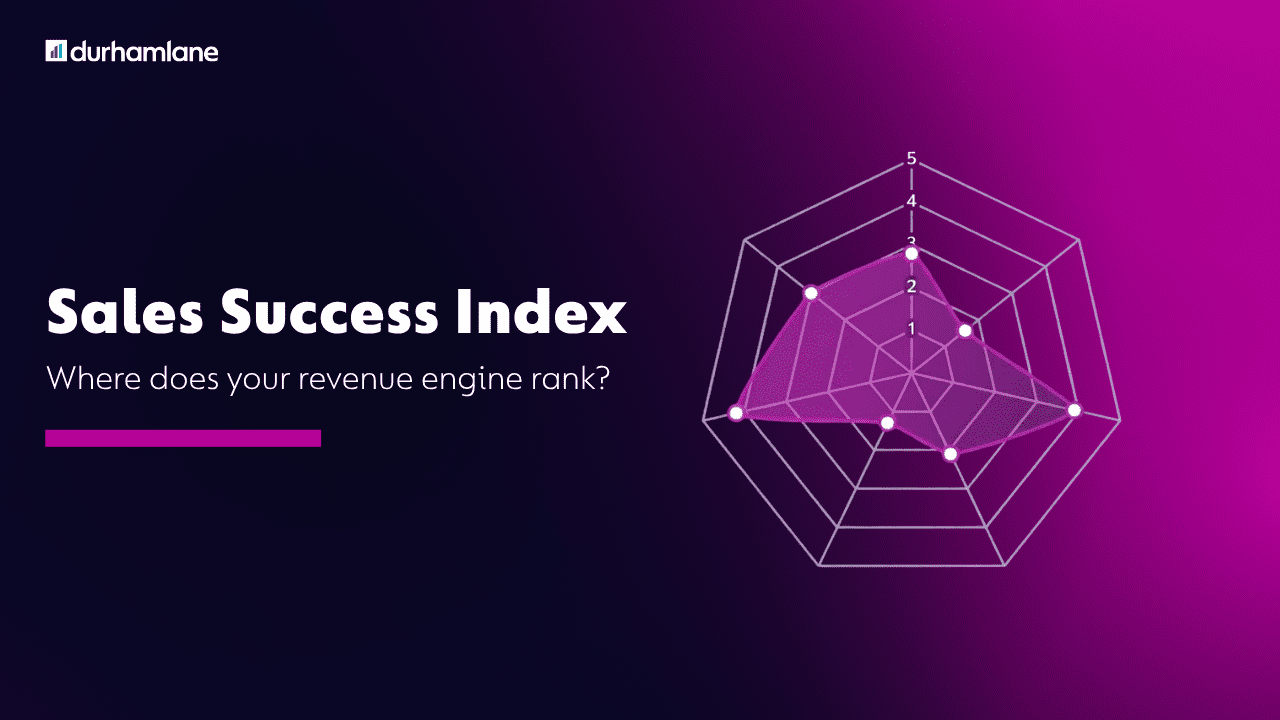 After the diagnostic review, the B2B Sales Success Index can help pressure-test where the sales motion may need attention across activity, conversion, pipeline quality, or sales-development execution. Treat it as a benchmark prompt, then check the result against your own denominators. |
Where durhamlane fits
If the KPI review shows that your team has enough qualified opportunities yet poor close rates, the answer may sit deeper in sales process, proposition, deal strategy or account management.
A review that shows weak target-account coverage, low connection, too few qualified meetings, poor show rate, weak handoff evidence or too few accepted opportunities points closer to sales development.
Sales development as the constraint
Adding more dashboard tiles doesn’t solve a sales-development problem. Improvement comes from the operating layer behind the metrics, including account selection, data quality, outreach relevance, live conversation, qualification, handoff and review cadence.
A managed SDR or outbound sales-development function helps at that layer. The fit is strongest when a company needs more high-quality meetings and clearer pipeline creation without relying on headcount and activity volume alone.
How outsourced sales development helps
durhamlane’s Outbound Sales Development connects account intelligence, value-first outreach, human conversation, qualification and handoff for complex B2B sales cycles. The Customer Acquisition route is the broader new-customer growth path. In both cases, activity matters. The focus remains qualified conversations, meetings held, qualified opportunities and revenue accountability.
Conclusion
B2B sales KPIs should protect the revenue number by showing where pipeline is being created, where it’s leaking and where the team is mistaking motion for progress.
The strongest KPI systems connect daily work to buyer movement, accepted opportunities and revenue confidence. That connection depends on context. Industry, stakeholder mix, sales cycle, data quality and buyer behaviour all change what a good number means.
A KPI review showing activity and too little qualified pipeline points past the dashboard. The sales-development review should look at targeting, account intelligence, live conversations, qualification, handoff and review cadence. durhamlane’s Outbound Sales Development helps complex B2B teams turn that operating layer into qualified conversations and sales-ready opportunities. Numbers on a dashboard don’t create pipeline.
Frequently asked questions
What are the most important B2B sales KPIs?
The most important B2B sales KPIs connect activity to qualified pipeline and revenue. For most teams, the front-end set includes target-account coverage, connection or reply rate, positive conversation rate, meetings booked and meetings held. The opportunity and revenue set includes meeting-to-qualified-opportunity conversion, accepted opportunities, pipeline coverage, win rate, sales cycle length and quota attainment.
How many sales KPIs belong on a B2B dashboard?
Track enough KPIs to see the chain from activity to revenue, with enough focus for the team to act. A practical dashboard usually has five to ten primary metrics, supported by diagnostic metrics that managers can inspect when performance dips.
Are meetings booked a good sales KPI?
Yes, as an intermediate KPI. Meetings booked are useful when paired with meetings held, qualification quality, AE acceptance and pipeline progression. On their own, they risk rewarding volume without revenue impact.
What is the difference between leading and lagging sales KPIs?
Leading KPIs show controllable work or early conversion, such as activity, connection rate, reply rate and meetings booked. Lagging KPIs show outcomes, such as accepted opportunities, pipeline created, win rate, quota attainment and revenue. Good sales management uses leading KPIs to improve the work before lagging KPIs confirm the result.
How should sales teams use benchmarks?
Use benchmarks as orientation bands. Fixed targets require checking the source, denominator, segment, channel, date, sales motion, industry context and quality gate. Then compare the benchmark with your own baseline.
Which B2B sales KPIs deserve the strictest review?
Be strict on KPIs that prove quality, including held meetings, qualification evidence, accepted handoffs, meeting-to-qualified-opportunity conversion, pipeline coverage and stage progression. Be less strict on raw activity metrics and use them diagnostically when conversion drops.