


Key takeaways
- B2B sales statistics are most useful when they help sales and revenue leaders benchmark performance, then decide where execution needs attention.
- The strongest benchmarks cover quota attainment, meeting creation, coaching cadence, outreach response, buyer access, and lead response. They should also show how AI-supported productivity and sales-ready handoff affect the wider sales-development motion.
- MySalesCoach’s 2026 sales coaching report adds an important performance layer. It shows that teams coached weekly or more report stronger quota attainment than teams coached monthly or less often.
- Buyer and outreach statistics still matter. They should be read as operating signals because a reply rate, response-time figure, or buyer-preference statistic only becomes useful when it changes how a team prioritises, qualifies, follows up, or hands over an account.
- The commercial question is how those benchmarks translate into better sales-development execution. That means looking at account context, phone-led follow-up, sharper qualification, coaching discipline, and cleaner handoff into sales.
What B2B sales statistics actually benchmark
Most people searching for B2B sales statistics want a reference point. They are trying to judge whether their team is performing at a healthy level, where other teams sit, and which numbers should prompt a closer look.
That makes benchmark selection important. Quota attainment and meeting creation give a first indication of whether sales activity is producing enough commercial outcomes. From there, coaching cadence, outreach response, buyer access, and lead response help explain the conditions behind that performance. AI-supported productivity and handoff quality extend the same test into the wider sales-development motion, where activity has to carry enough context and discipline to turn into usable pipeline. The numbers only have practical value once a leader can connect the benchmark to the decision it should inform.
Each source needs a clear job in the benchmark picture. Gartner and 6sense frame buyer access, seller relevance, and account timing. Demandbase and Forrester then add buying-group complexity, shared account view, and the pressure created by more fragmented go-to-market conditions. RevenueHero and Lavender move the benchmark set into response discipline and message quality.
HubSpot, Salesforce, MySalesCoach, and McKinsey extend the same operating question into productivity, coaching, AI-supported work, and human judgement. Together, those sources show that interest reaches qualified pipeline only when teams handle timing, relevance, follow-up, qualification, and handoff with enough commercial clarity.
How to read B2B sales statistics
Sales statistics have practical value for sales and revenue leaders once the evidence behind each number is clear. Analyst press releases often signal market pressure, though the full methodology may sit outside the public summary. Buyer surveys bring buyer preferences and behaviour into view. Vendor reports usually surface operating patterns inside a product or customer base. Product datasets are stronger for message-performance benchmarks, especially where sample size and exclusions are visible. Experiments help expose process failures that a team may overlook inside its own funnel.
That distinction matters because each number should lead to a different decision. A quota figure starts a performance and coaching conversation. Buyer-access data shifts the focus toward relevance and timing. Response-time findings move the question to ownership and routing. Email benchmarks test attention, engagement, and the quality of the next step. AI and productivity data widen the view again, since added capacity has value if it improves preparation, prioritisation, and the work that still needs human judgement.
The same caution applies to recycled sales claims. Familiar statistics about follow-up counts, first responders, or cold call success rates may sound authoritative after repeated citation. They deserve less weight unless the original source, sample, and context are visible.
Used well, B2B sales statistics give leaders a benchmark and a next operating question. The number has a practical job. It should help a team decide where performance, qualification, follow-up, capacity, or handoff deserves closer inspection. Read alongside pipeline data, it shows progress and leakage together. Used well, it helps the team ask where demand is becoming more qualified and where it is being passed forward without enough substance.
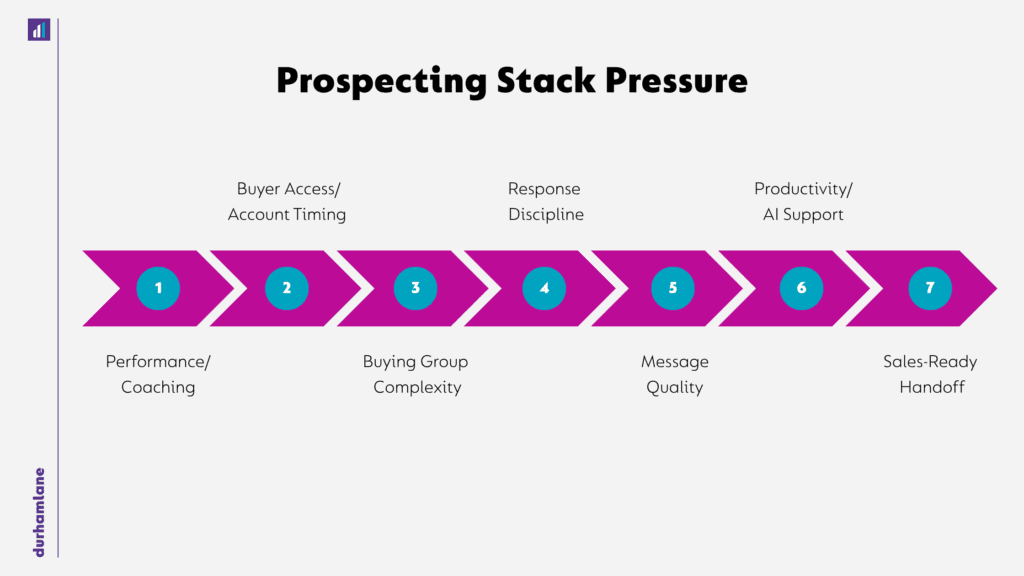
B2B sales statistics are easier to use when they are grouped around the decisions they support. The table below connects each statistic cluster to the operating question a sales or revenue leader needs to answer next.
| Benchmark area | Source signal | What the benchmark shows | Sales-development question |
| Quota and coaching cadence | MySalesCoach 2026 sales coaching report | The level of structured coaching behind quota attainment, and how far rep development goes beyond activity review | Is coaching frequent and practical enough to improve performance beyond activity review? |
| Buyer access | Gartner buyer-access findings | The relevance of seller contact before a rep asks for buyer attention | Does outreach show account context before asking for time? |
| Account timing | 6sense timing and shortlist findings | Sales entry timing, especially the chance to shape preference before the field narrows | Are account signals visible early enough to shape the conversation? |
| Buying-group complexity | Demandbase buying-group findings and Forrester 2026 GTM Singularity research | The risk that one engaged stakeholder is masking weak progression across the wider buying group, and the need for a shared account view in more fragmented go-to-market conditions | Is qualification testing buying stage, stakeholder role, authority, urgency, problem fit, and next-step quality before sales time is committed? |
| Response and routing discipline | RevenueHero response and routing experiment | The speed and ownership behind declared interest as it moves toward qualification | Who owns response, routing, and follow-up standards? |
| Message quality | Lavender email benchmark | The difference between replies that show useful commercial engagement and replies that only show surface-level interest | Is the message earning a qualified next step, or only a reply? |
| Sales productivity and AI support | HubSpot sales statistics, Salesforce 2026 State of Sales statistics, MySalesCoach coaching data, and McKinsey 2025 State of AI survey | The extent to which tools, AI agents, and coaching support improve preparation, prioritisation, judgement, and consistency around live commercial conversations | Does added capacity make human conversations better prepared, better timed, and easier to hand over? |
| Sales-ready handoff | Pattern across the evidence | The quality of account context sales receives before accepting, progressing, and forecasting the conversation | Can sales accept, progress, and forecast the conversation with confidence? |
Sales coaching statistics and quota attainment benchmarks
Quota attainment is one of the clearest sales benchmarks, although it rarely explains itself. A rep can miss target because of territory quality, account fit, weak prioritisation, poor messaging, limited manager support, or too little time spent on the right commercial conversations. Coaching cadence helps separate those possibilities because it shows whether managers have a regular mechanism for improving performance during the sales motion, with activity review serving as one part of that rhythm.
MySalesCoach’s 2026 sales coaching report gives this benchmark a sharper operating context. The report says 41% of reps are never or rarely coached, while 19% receive coaching monthly. Another 28% receive weekly coaching, and 12% are coached multiple times per week. That distribution matters because coaching frequency then shows up in quota attainment. Teams coached weekly or more report 76% quota attainment, compared with 56% for monthly coaching and 47% for quarterly-or-less coaching.
The coaching-frequency pattern moves the issue out of the HR or enablement category and into sales performance. When a team is below target and coaching is irregular, the management rhythm around the rep deserves the same scrutiny as rep effort or market conditions. The report also points to the management gap behind that rhythm. Lack of time is the largest stated barrier to coaching, followed by difficulty assessing coaching impact and the need for more support on how to coach effectively.
The leadership layer is just as important. MySalesCoach reports that only 34% of leaders have received support to become a more effective coach, and only one in five leaders say they have a coach themselves. That creates a practical problem for sales organisations. Managers are expected to improve rep behaviour, yet many have not been developed for the coaching work that quota performance increasingly depends on.
The practical benchmark is therefore managerial as much as individual. If quota attainment is under pressure, coaching frequency and manager capability deserve inspection alongside activity volume, lead quality, and rep motivation. The issue is whether managers have the time and support to intervene early enough, before weak performance hardens into a repeated pattern.
B2B buyer behaviour statistics and seller relevance
Gartner’s 2025 sales survey of 632 B2B buyers, conducted in August and September 2024, reported that 61% of B2B buyers prefer a rep-free buying experience. The same findings said 73% actively avoid suppliers that send irrelevant outreach. Those numbers give sales leaders a clear relevance benchmark. Buyer resistance is strongest where seller contact feels generic, poorly timed, or disconnected from the account’s situation.
The same research also keeps the seller’s role in view. Gartner reports that buyers value sellers for contextual intelligence and fit-related decisions. That distinction matters because buyers may want more control over the process and still need useful human input when they are weighing context, fit, trade-offs, and internal consequences. Poor seller contact loses access. Useful seller input still has commercial value.
For SDR teams, the standard for outreach becomes more demanding. Generic messages reach buyers at a point where they are already protecting their time. Account-aware outreach has to show why the account is worth approaching, what problem may be active, and why the timing could matter now. This is where outbound sales development needs stronger account context. In complex B2B sales cycles, outreach works best as targeted human engagement, shaped by commercial relevance and the quality of the conversation being created.
6sense’s 2025 Buyer Experience Report adds the timing benchmark. It says the average buying cycle shortened from 11.3 to 10.1 months, while the point of first contact shifted from 69% to 61% of the way through the journey. The same report says the winning vendor was on the Day One shortlist 95% of the time. Together, those figures suggest that many buyers narrow the field before sellers receive an obvious signal.
For sales development, that timing pressure is uncomfortable and useful at the same time. Waiting for buyers to raise their hand can leave an SDR team chasing accounts after preferences have already formed. Better account intelligence gives the team a stronger basis for engaging while interest is still forming, so the first conversation starts with more context and a clearer reason to speak.
Buying-group statistics and opportunity progression
Buying-group statistics test whether interest is spreading through an account or sitting with one contact. Demandbase reports that 72% of B2B purchases involve multi-stakeholder complex buying groups. That benchmark matters because a promising conversation with one person may make an account appear more advanced than the wider decision process really is.
For SDR and sales teams, qualification has to prove more than contact engagement. A useful first conversation should open the account view, then test buying stage, stakeholder role, authority, urgency, problem fit, and the quality of the next step. Sales needs to know whether the wider group understands the problem, has reason to act, and can support progression.
Magic 35 gives that qualification work a clearer structure. In a complex B2B sale, it helps the SDR conversation turn those qualification points into account-level evidence before the opportunity reaches sales. The handoff should depend on that wider account picture, because a positive conversation with one contact only gives sales part of the context.
Forrester’s 2026 GTM Singularity research gives a fresher view of the same buying complexity. It argues that traditional go-to-market approaches are breaking down as B2B buyers gain more information access, AI becomes part of the buying journey, and siloed sales and marketing practices lose force. For sales development, that reinforces the need for a shared view of the account before an opportunity is treated as ready for sales.
The sales-development implication is practical. Real meetings can remain fragile. Willing contacts may open the account without proving wider consensus. Handoffs may carry interest without giving sales the context needed to progress the account. Buying-group benchmarks expose that gap and push qualification toward a clearer account-level view of progression.
Sales follow-up statistics and response-time benchmarks
Lead response is a useful benchmark because it tests what happens after a prospect has declared interest. At that point, the question moves from demand creation to ownership. The business has to route the account, respond with enough context, and move the conversation toward qualification before momentum fades.
RevenueHero’s 2025 speed-to-lead experiment submitted demo requests to 1,000 B2B websites. It reported that 63.5% never responded, that the average wait among responders was 29 hours, and that only 11.3% had intelligent routing. Those figures make response discipline visible as an operating gap. Many teams spend heavily to create demand, then lose commercial value at the point where declared interest should be easiest to handle.
The leakage is not only about speed. A missing response loses the conversation. A slow response creates delay. Poor routing sends a good-fit account to the wrong owner or leaves it sitting in the wrong queue. Generic follow-up adds another failure point because the prospect may receive a reply without a meaningful route into qualification.
That makes response discipline a benchmark for ownership, routing, and follow-up quality together. A sales-development process needs to define who responds, how quickly the account moves, what context the follow-up carries, and how the next step is qualified. The commercial standard is whether declared interest reaches a sales-ready conversation before the buyer’s attention moves elsewhere.
An inbound lead conversion process has to turn declared interest into a managed path toward sales. That means engaging, nurturing, and qualifying MQLs until they are ready for a commercial conversation with enough context to progress.
Sales prospecting statistics and email-quality benchmarks
Email benchmarks are useful when they separate attention from sales-qualified engagement. Open rate shows whether a message gets far enough to be seen. Clicks and replies move the question closer to active engagement. Meeting quality and qualification decide whether that engagement has commercial value.
Mailchimp’s Email Marketing Benchmarks give a broad email-performance baseline. In its Business + Finance category, Mailchimp reports an average open rate of 31.35% and an average click rate of 2.78%. That gives sales and marketing teams useful context for attention and click behaviour. Cold outbound sales has a different job because the message is trying to create or reopen a commercial conversation. Campaign engagement gives part of the picture. Reply quality and next-step quality move the assessment closer to sales development.
Lavender’s Cold Email Benchmark Report brings the evidence closer to outbound prospecting. It is based on a product dataset of 231,818 cold emails, with performance broken down by department, seniority, and industry, and with exclusions for out-of-office and bounce replies. That gives sales teams a more specific view of how cold-email messages perform across different audiences.
The two sources answer different questions. Mailchimp helps a team judge whether the subject line, sender, timing, and audience fit are strong enough to earn attention. Lavender helps test whether the message creates enough relevance for someone to respond. A reply then needs commercial interpretation. It may show curiosity, timing, irritation, politeness, or real buying interest.
For outbound teams, the useful pattern sits between audience fit, message relevance, reply quality, and the next step created. A good email can open a door, warm an account, support a sequence, and carry context before or after a call. The opportunity test happens through qualification. Phone-led sales development matters because someone has to ask better questions, interpret hesitation, test fit, and understand whether interest has a realistic path into a qualified opportunity.
Sales productivity statistics, AI agents, and rep capacity
Sales productivity statistics matter because added capacity has to improve the sales-development motion as well as increase activity. The useful benchmark is the quality of preparation, prioritisation, coaching, follow-up, and live selling that the added capacity supports.
HubSpot’s sales statistics place AI inside day-to-day sales work. Its reported figures point to AI support across manual-task reduction, customer understanding, personalisation, self-service buying, and sales-marketing alignment. That makes HubSpot useful as a sales-technology benchmark for leaders judging whether tools are improving visibility, decision quality, and rep workflow.
Salesforce’s 2026 State of Sales statistics add the AI-agent layer. Salesforce reports that reps spend 60% of their time on non-selling tasks, and that 85% of sales reps with agents say AI frees them to focus on higher-value work. It also reports that 36% of sales teams with agents use them for coaching. For leaders, those figures shift the productivity question from adoption to operating effect. Agents need to remove drag from the rep’s day and give managers a more consistent way to support performance.
McKinsey’s 2025 State of AI survey gives the broader adoption context. It reports that 88% of organisations now use AI in at least one business function. It also finds that 23% of respondents say their organisations are scaling an agentic AI system somewhere in the enterprise, and that another 39% have begun experimenting with AI agents. The adoption baseline has moved, which makes repeatable operating value the harder test for sales teams.
MySalesCoach’s 2026 coaching data adds the human-performance layer. The report argues that AI can support coaching, consistency, and admin relief. Human judgement remains central to behaviour change. For SDR teams, productivity gains have to support account understanding, urgency testing, signal interpretation, and next-step judgement.
For SDR teams, useful AI support improves account research, role preparation, data quality, coaching rhythm, follow-up discipline, and handoff context. The productivity gain matters when it gives trained people better conditions for qualification. Fit, hesitation, buying context, and next-step quality still need human judgement.
| Related durhamlane report The Top 2025 Sales and Marketing Insights You Probably Missed 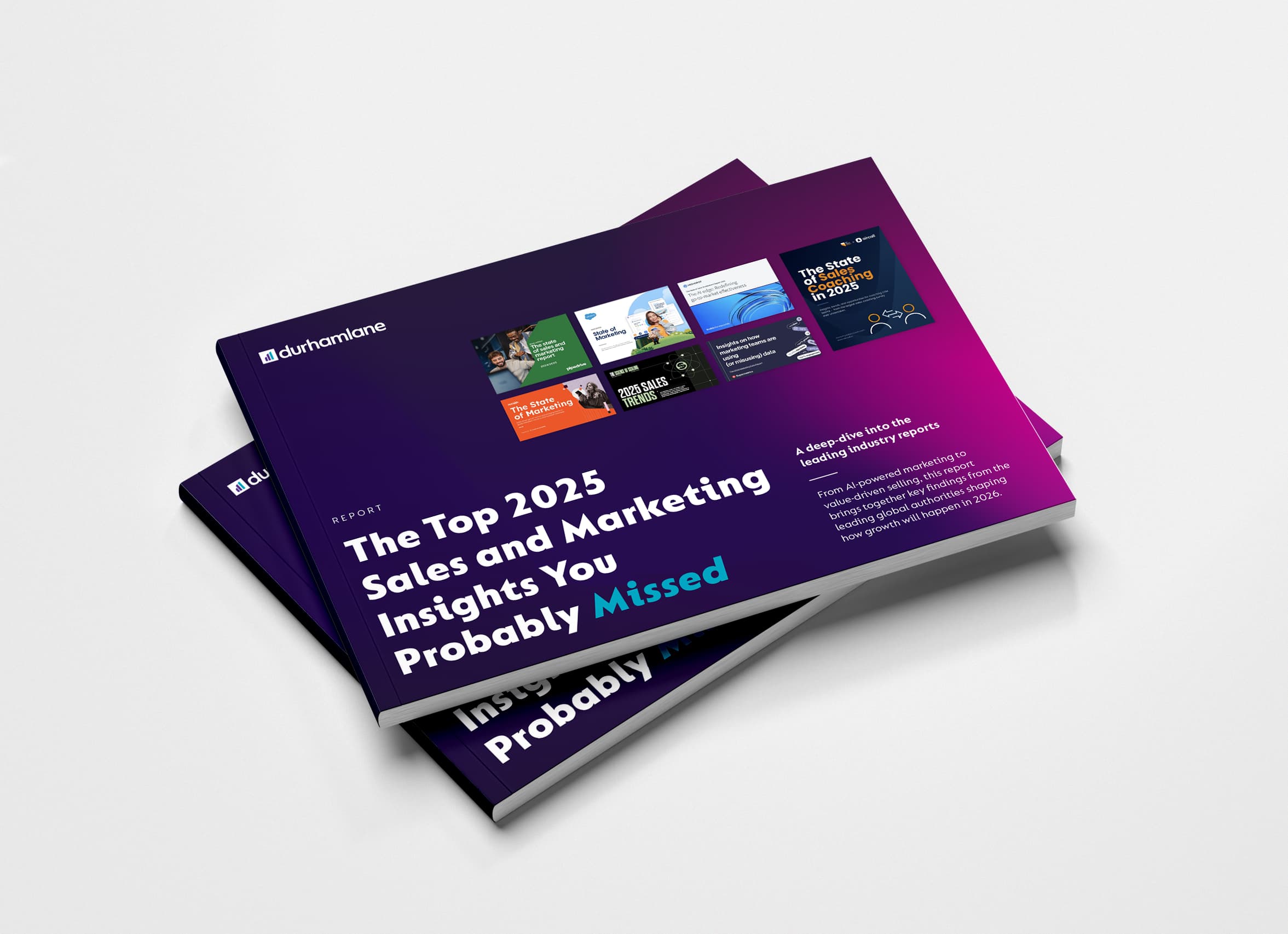 durhamlane’s report brings together leading 2025 sales and marketing studies and translates their headline findings into the growth pressures teams face in 2026. The strongest themes run through AI adoption, data quality, coaching, enablement, buyer expectations, and sales-marketing alignment, giving revenue leaders a broader context for the operating questions behind sales benchmarks. The commercial thread is clear. Buyers expect relevance, teams need cleaner data, and technology has to improve the work around real accounts. The report works as a practical companion to benchmark review by showing where stronger insight, better coaching, aligned teams, and disciplined execution help commercial conversations move forward. |
What these statistics mean for SDR teams
For SDR teams, the value of these benchmarks is practical. They show where the sales-development motion needs more control before an account reaches sales.
- Timing and relevance need to come before outreach. Gartner and 6sense make account intelligence a pre-contact requirement. SDRs need to understand why an account is worth approaching, what problem may be active, and why the timing could matter before they ask for attention.
- Progression needs to be tested before handoff. Demandbase and Forrester’s 2026 GTM Singularity research put buying-group complexity and shared account view at the centre of opportunity progression. A useful SDR process tests buying stage, stakeholder role, urgency, authority, problem fit, and next-step quality before a conversation reaches an account executive.
- Follow-up and message quality need clear ownership. RevenueHero, Mailchimp, and Lavender put response discipline and outreach quality inside the same operating question. A team has to know who owns follow-up, how quickly declared interest should move, and whether outreach is creating attention that can become a qualified next step.
- Capacity needs to improve judgement as well as activity. HubSpot, Salesforce, McKinsey, and MySalesCoach point to a sales environment where AI, coaching, and workflow support can improve preparation and consistency. Extra capacity earns its place where it sharpens prioritisation, improves account context, supports coaching rhythm, strengthens follow-up, and gives sales a cleaner handoff.
The practical test is whether the SDR motion creates conversations that sales can accept, progress, and forecast with confidence. That requires account context, disciplined qualification, accountable follow-up, useful messaging, managed capacity, and a clear handoff standard.
Where durhamlane fits
The benchmark pattern points to a specific operating need. Sales and revenue leaders need more control over the sales-development layer between market signal and sales handoff.
That is where durhamlane fits. Its phone-led, human-powered SDR delivery helps complex B2B teams turn account signals, inbound interest, and outbound activity into qualified opportunities. The model brings account research, timely follow-up, disciplined qualification, coaching rhythm, and clear handoff standards into one managed layer.
Technology supports the work around that layer. AI helps with research, preparation, data quality, coaching rhythm, and workflow consistency. Trained people keep responsibility for qualification, judgement, and the commercial conversation.
The proof is in the handoff. Sales should receive the account context, the problem being tested, the stakeholders involved, the timing signal, and the agreed next step. With those details in place, benchmark gaps become operating priorities and sales can focus on opportunities with enough substance to progress.
| Related durhamlane discussion Getting More From Marketing  In this Inside the Funnel episode, we spoke with Mark Green, EMEA Vice President at Domo, about why B2B teams need to move beyond baton-passing between marketing and sales and operate as a connected revenue team. The discussion is useful for teams reviewing benchmark gaps because it moves the issue past campaign output. Marketing signal, SDR follow-up, and sales ownership need to work from a shared account view. When that connection is weak, demand can look healthy before the route into qualified opportunity is clear. For revenue leaders, the value is practical. The episode gives a sharper way to think about what happens after interest has been created, who understands the account, who owns the next action, and how the conversation reaches sales with enough context to progress. |
If your benchmarks point to weak timing, inconsistent qualification, slow follow-up, stretched SDR capacity, or unclear handoff, start with the operating gap behind the number. Speak to durhamlane about how to make the sales-development layer more accountable. durhamlane’s sales audit and diagnostic route helps identify where performance, pipeline coverage, productivity, and handoff quality need stronger execution, then maps the work required to create sales-ready opportunities.
Get in touch
FAQ
What are the most important B2B sales statistics?
The most important B2B sales statistics are the ones that help leaders compare performance and decide where execution needs attention. Quota attainment, coaching cadence, and meeting creation show outcome pressure. Buyer access, account timing, and buying-group progression show how opportunity context develops. Lead response, email engagement, AI-supported productivity, and handoff quality move the question into execution. Their value comes from linking each benchmark to the decision it should inform.
Are cold outreach statistics reliable?
Cold outreach statistics are useful when the source, sample, and metric are clear. Open and click benchmarks give a broad attention baseline for email performance. Cold-email product datasets give a more specific view of reply behaviour, message quality, audience fit, seniority, function, and industry variation. A reply still needs commercial interpretation before anyone treats it as evidence of opportunity quality.
How should sales leaders use these benchmarks?
Sales leaders should use benchmarks as prompts for inspection. Low quota attainment brings coaching cadence, manager support, territory quality, and account fit into view. Slow response raises questions about ownership and routing. Weak replies point to message relevance and audience fit. Buying-group friction puts pressure on qualification depth and handoff quality. The benchmark matters most when it makes the next operating decision clearer.
Where does AI fit in B2B sales?
AI fits around the work that helps sales teams prepare, prioritise, coach, follow up, and manage data more consistently. It supports research, personalisation, admin relief, coaching rhythm, and signal interpretation. In complex B2B sales, trained people still need to qualify buyers, interpret context, test urgency, and decide whether a conversation is ready for sales.