

Key takeaways
- The EU AI Act is already in force and applies in phases. For sales and marketing leaders, August 2026 is best read as one point in a longer timeline for reviewing AI use.
- A self-contained compliance exercise belongs with the right specialists. Commercial leaders need a clearer map first. That means knowing where AI appears across outreach, content, chatbots, recruitment, vendor tools, and human review.
- AI-generated and AI-assisted sales activity needs careful handling. The pressure points are transparency, misleading personalisation, buyer interaction, and automated content.
- Vendor responsibility does not remove the need for internal visibility. Commercial teams still need to know what AI their tools use and what those tools produce. They also need to know where human judgement sits.
- durhamlane’s commercial view is that AI should support better preparation, research, coaching, data quality, and consistency. Trained people remain responsible for relevance, qualification, and sales-ready handoff.
This is a commercial heads-up for sales and marketing leaders. Legal advice, compliance judgement, scope decisions and system classification belong with the right specialists.
The penalty framework is one reason the topic has reached leadership conversations. The upper tier covers some infringements, such as prohibited-practice breaches and certain data-related non-compliance. In those cases, fines can reach €35 million or 7% of worldwide annual turnover, whichever is higher.
The EU AI Act matters to commercial leaders because AI is no longer sitting at the edge of sales and marketing work. It is already part of the ordinary operating layer. The tool list only shows part of the problem. The sharper question is where those tools begin to influence the work itself. That includes prospect interaction and content, as well as hiring, team management, vendor selection, and sales handoff.
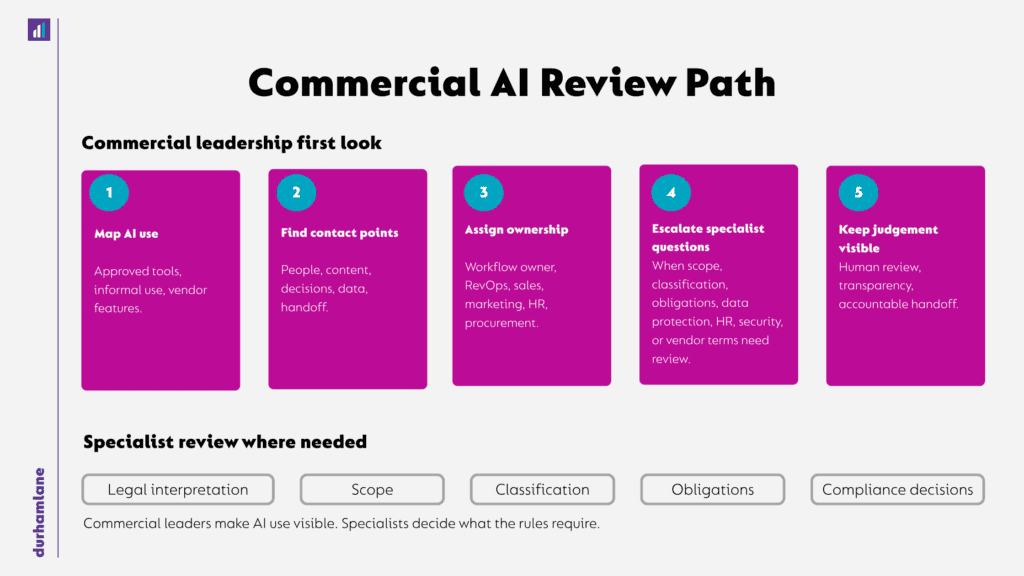
That is why the EU AI Act now belongs in commercial leadership conversations as well as legal and vendor discussions. Commercial leaders need to know where AI touches people, content, decisions, and third-party tools. Once those uses become invisible operating assumptions, they are much harder to review properly. For sales, marketing, revenue, GTM, and RevOps leaders, visibility is the clearest starting point. First map where AI is shaping the workflow and which decisions it influences. Then bring in the right specialists before those assumptions harden.
The job here is to make the commercial map clearer. First, leaders need to see how AI is touching the workflow. Then the right questions can move to the right owners. That could be legal, compliance, data protection or HR. For vendor and tooling issues, it could be procurement, security or vendor management.
The focus is narrower. Start with the places where AI is already entering your team’s work. Some of those places face the market, such as outreach, prospect interaction, content, lead qualification, and call review. Others sit inside the operating model, where hiring, management, and vendor selection can carry the same risk into less obvious parts of the business. The EU AI Act gives commercial leaders a reason to make those uses visible before unclear assumptions settle into the workflow.
How the EU AI Act timeline works in practice
The EU AI Act, formally Regulation (EU) 2024/1689, creates a risk-based framework for AI systems in the EU. It separates AI use by risk level. Prohibited practices sit at one end, high-risk systems require closer scrutiny, and some uses carry transparency obligations. Lower-risk uses sit elsewhere in the framework.
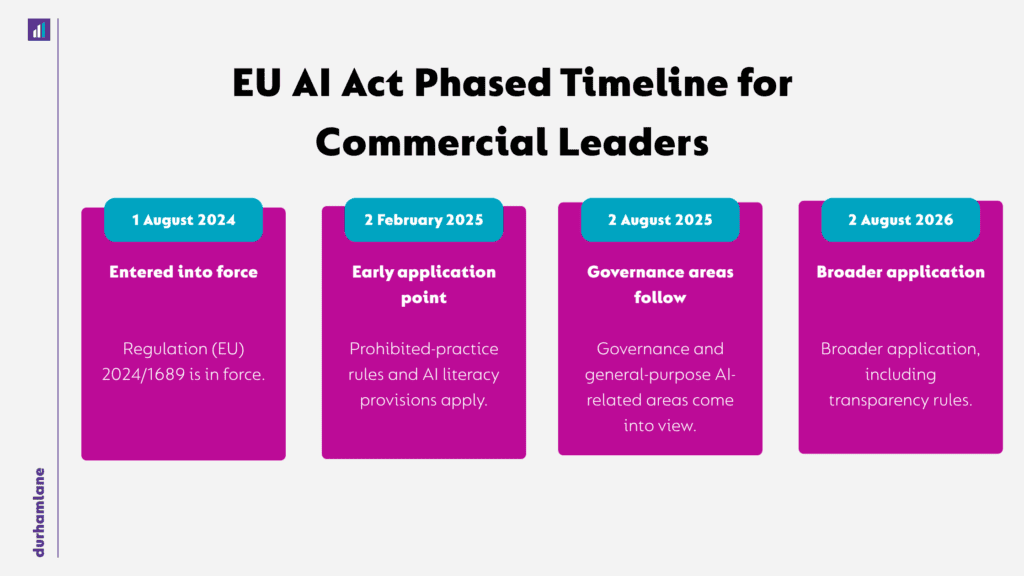
For sales and marketing leaders, date discipline comes before any practical review. The Act entered into force on 1 August 2024. The August 2026 milestone still deserves attention, though it isn’t the starting point and doesn’t mean nothing applies before then.
Article 113 sets out the phased application. Some rules, including prohibited-practice rules and AI literacy provisions, applied from 2 February 2025. Other governance and general-purpose AI-related areas followed from 2 August 2025.
The Commission’s AI Act overview describes 2 August 2026 as a key date for broader application, including transparency rules. Important exceptions remain, and some high-risk systems still depend on later implementation details.
Commercial teams often hear the timeline reduced to a simple August 2026 summary. That shorthand is fine for awareness. Planning needs the official position. Legal interpretation belongs with lawyers. Sales and marketing plans still need firmer ground than a shorthand date.
Visibility is still the firmest anchor. Begin with the basic questions. What AI is being used? Who controls it? What does it produce? Where does it interact with people? Where might specialist review be needed?
Why sales and marketing leaders need visibility over AI use
Sales and marketing teams rarely adopt AI through one large, visible programme. More often, it enters the workflow in pieces. A tool drafts campaign copy, researches an account, qualifies a chatbot conversation, scores a prospect, filters a CV, summarises a call, or suggests a coaching point. By the time leadership sees the pattern, AI is already part of daily execution.
The review should go wider than internally built AI models. Commercial teams need visibility wherever AI enters a business workflow. That includes direct interaction with people, AI-generated or manipulated content, recruitment and worker-management tools, and vendor features that add AI into everyday sales or marketing activity.
“Our vendor handles that” is often where the conversation starts. It shouldn’t be where visibility stops. The business still has to know which AI tools are in use and what those tools produce. From there, the review becomes more practical. Which outputs are people relying on? Who has enough information to assess the workflow with the right internal teams?
For businesses outside the EU, geography alone doesn’t settle the question. UK, North American, and other international teams can still have EU-facing prospects, customers, candidates, systems, or outputs. Once those connections exist, scope is worth checking with the right specialists.
Start with a workflow map. Panic creates urgency. Visibility gives the right specialists something real to review.
Where the EU AI Act may touch sales and marketing workflows
Use this table as a first-look map for commercial leadership. Its job is triage. It groups the main places where AI can enter sales and marketing work, so the right internal owners can review the detail before assumptions settle into the workflow. Classification, obligations, and legal interpretation still sit with the relevant specialists.
| Review zone | What to map first | Route early to |
| Internal AI readiness | Approved uses, data limits, AI literacy, informal tool use, and escalation routes. | Legal, compliance, L&D, RevOps, data protection |
| Prospect-facing AI | Chatbots, AI agents, qualification bots, and any AI-mediated interaction before a human conversation. | Legal, marketing ops, product, CX |
| Content and outreach | AI-generated or manipulated content, assisted sales copy, scaled personalisation, and market-facing messaging. | Legal, sales, marketing, RevOps, brand |
| People-related decisions | Recruitment, CV screening, worker management, performance monitoring, promotion or termination inputs, and tools that claim to infer emotion. | HR, legal, procurement, data protection, people managers |
| Vendor stack and oversight | AI inside CRM, sales engagement, enrichment, marketing automation, call intelligence, routing, data handling, review, and escalation workflows. | RevOps, procurement, security, legal, vendor management |
AI literacy and internal AI policy
AI literacy is one of the clearest starting points because it shows up in everyday team behaviour. Article 4 requires providers and deployers to take measures, to their best extent. Those measures are directed at ensuring a sufficient level of AI literacy for staff and others dealing with AI systems on their behalf. The level expected depends on role, knowledge, experience, context, and the people affected by the AI system.
For sales and marketing leaders, this starts closer to the workflow than the legal training room. Do people understand the tools they use? Are those tools approved for that use? What data stays out? How should outputs be reviewed, and when does a question need escalation?
Shadow AI turns this from a training issue into an operating risk. When SDRs, marketers, managers, or agencies experiment without visibility, leadership can’t assess the use case, data exposure, transparency implications, or buyer impact. The Commission’s AI literacy repository gives teams an official reference point. The commercial work starts closer to home, with internal clarity.
The strongest exit question is simple. What do we know now that we did not know before, and does it justify the next owner investing more time?
Accounts should not move forward just because the workflow says they can. They should move forward when the team has enough evidence for the next owner to spend time well.
Chatbots, AI agents, and prospect-facing transparency
Prospect-facing AI should come next in the review. Buyers may meet a website chatbot, AI agent, automated assistant, or qualification bot before they ever speak to a person. That makes the experience, the handoff, and the system’s limits commercially visible.
Article 50 includes transparency obligations for certain AI systems intended to interact directly with natural persons. The obviousness point matters here. A buyer who can plainly see that they’re dealing with AI creates a different review question from one who can’t. The Commission’s 2026 draft transparency guidance consultation also shows why this area needs careful, practical interpretation.
Leadership doesn’t need this article to settle the exact wording for a chatbot notice. The first check is operational. Where do AI-mediated interactions happen? Is the user experience clear? What is the bot allowed to do? Who owns the handoff when a human needs to take responsibility? A human route can improve the buyer experience. The legal question still needs its own specialist review.
AI-generated content and the sales-copy grey area
AI-generated content needs careful handling in sales and marketing, especially now that AI-assisted cold email and outbound copy are ordinary parts of seller workflow. The Act’s transparency provisions reach certain AI-generated or manipulated content. Synthetic audio, images, video and text sit in that territory, along with deepfakes and some public-interest text. Sales copy creates the harder commercial edge. An email draft, nurture sequence, LinkedIn message, landing page and webinar follow-up won’t always raise the same question.
Based on the current position, this area needs caution before blanket answers. Assume every AI-written sales email needs a label, and the advice becomes too blunt. Treat assisted copy as irrelevant, and the business may miss a real transparency review point. A sensible review starts with the content and the role it plays. It then looks at how the material was generated, how much human editing shaped it, how the reader may perceive it and what current guidance says.
Commercial leaders should draw a clearer line between assisted drafting and heavier AI use. Bulk generation, synthetic media, public-facing educational content, and misleading personalisation belong in a more careful review. The commercial risk is already visible when a message pretends to be deeply researched, but is really built from thin data. Trust breaks before the legal question even reaches the room.
Recruitment, team management, and emotion recognition
The EU AI Act can also reach sales and marketing through hiring and management. Outbound activity is only one part of the commercial workflow. Annex III lists AI systems intended for recruitment or selection in high-risk categories, subject to Article 6 classification rules and guidance. Targeted job ads, application filtering, and candidate evaluation all sit in that review territory.
Sales and marketing leaders often rely on recruitment partners, HR platforms, assessment tools, or outsourced hiring support. Once AI enters that chain, leadership needs visibility before the tool becomes normal process. If AI filters, evaluates, ranks, or influences candidates, the use case needs specialist review. It shouldn’t be quietly absorbed into the workflow.
Worker management follows the same visibility logic. AI that allocates tasks, monitors behaviour, evaluates performance, or influences decisions about salespeople and marketers can affect people inside the business. Call coaching, sentiment analysis, productivity metrics, and performance dashboards may serve different jobs and sit in different review lanes. Leaders still need to know what the system claims to do and how much weight managers give to its outputs.
Emotion recognition deserves its own pause. Ordinary commercial language and legally specific AI claims can blur quickly here. The Act treats AI systems used to infer emotions in workplace and education contexts as a prohibited-practice area, with exceptions such as medical or safety reasons. It defines emotion recognition by reference to biometric data. That distinction is important for commercial teams. Ordinary sales sentiment or call-coaching notes belong in a different review lane unless a specialist says otherwise.
Sales technology, vendors, and third-party AI tools
Most commercial teams will meet the EU AI Act through vendors before they meet it through internal AI development. AI features often arrive inside tools the team already uses every day. CRM, sales engagement, enrichment, and conversation intelligence tools may already shape commercial execution. Marketing automation, chatbots, recruitment platforms, and data providers can bring the same question into adjacent parts of the workflow. A vendor feature can slip into the operating rhythm before anyone has asked what it does, what it changes, or who owns the review.
Vendor review is therefore a commercial leadership issue. Leaders don’t have to own the legal analysis. They do need enough visibility to ask better questions. Which tools use AI? What do they generate or infer? What data goes in? Does the output act as a suggestion, draft, score, or decision input? Can the vendor explain intended purpose, model use, data handling, and controls?
The AI Act uses terms such as provider and deployer. Broadly, a provider develops or places an AI system or model on the market, while a deployer uses an AI system under its authority in a business context. Exact role depends on facts. The commercial risk is false comfort. Vendor responsibility and internal ownership can both sound reassuring until nobody can say who reviewed the workflow.
Human oversight and commercial judgement
Human oversight has a specific legal role in high-risk AI contexts. In commercial work, it does a different kind of job. Sales and marketing leaders need to know when AI outputs are shaping workflows that affect people, buyer experience, account prioritisation, or sales handoff. If those outputs become invisible decision-makers, leadership loses sight of where judgement is actually being exercised.
In sales development, AI can make weak activity look efficient. More messages, richer account data, cleaner call summaries, lead scores, and automated routing can all create the appearance of control. Better commercial judgement doesn’t automatically follow.
The operating question is simple. Where does a trained person still test the output, check the buyer context, and take responsibility for the next step? Human review doesn’t create a legal guarantee. It keeps judgement close to buyer conversations, qualification decisions, recruitment actions, and sales-ready handoff.
What this means for human-led, AI-assisted sales development
The EU AI Act isn’t a reason for sales and marketing teams to step away from AI. Used carefully, AI can sharpen research, preparation, coaching, and data quality. The real value shows when those gains carry into training reinforcement and more disciplined execution across complex B2B sales development.
The danger starts when support turns into opaque automation and judgement gets pushed out of the process.
That weakness shows quickly. AI can produce fake personalisation at scale, push low-fit accounts through sequences, inflate engagement signals, or dress thin research up as insight. Buyers feel the gap. Sales inherits weaker conversations. Leadership gets pipeline noise instead of usable evidence.
Regulation makes that operating weakness harder to ignore. The weakness itself is commercial. Strong SDR work depends on reading the account and the buyer properly, catching the timing, and handing the conversation over cleanly. AI can support that discipline. Commercial judgement turns the support into usable sales development.
That is the operating discipline behind durhamlane’s outsourced SDR work. durhamlane provides SDR teams for complex B2B sales environments, where the work has to produce more than outbound activity. Qualified opportunities come from sharper targeting, stronger account intelligence, value-led conversations, and a handoff sales can actually use.
In an AI-assisted environment, human-led discipline becomes more important. AI can help an SDR prepare, rehearse messaging, improve consistency, summarise context, and support coaching. The trained person still has to make the commercial call. The account has to fit. The message has to hold up. The buyer problem has to be real. The next step has to be sales-ready.
That boundary matters commercially. durhamlane doesn’t provide EU AI Act legal advice, AI governance support, or compliance assurance. durhamlane’s work sits in sales development. AI-assisted processes perform better when ownership is visible, judgement stays with trained people, and accountability remains close to the commercial conversation.
| ON-DEMAND WEBINAR What the EU AI Act means for sales and marketing teams in EMEA  Join Richard Lane, Jake Spence, Josh Guthrie and Ollie Whitfield for durhamlane’s discussion on AI use in commercial teams. They cover hiring and AI screening, monitoring, prospect-facing chat, sales copy and vendor tools. The conversation comes back to one operating question for revenue leaders. How do you make AI visible, keep human judgement close to the work and know when specialist review belongs in the conversation? |
Final thought: use the Act as a prompt to make AI use visible
As mentioned on our webinar, this is high-stakes stuff, particularly for international businesses. Josh Guthrie caught the governance risk neatly when he warned that “the compliance piece and the guide rails can get left behind when teams move quickly with AI”. Jake Spence brought it back to operating discipline, noting that “good businesses will already be building AI policies and best practice”.
That is the right closing point for sales and marketing leaders. AI should not be treated like contraband. It should not be left roaming the building without a badge either. Know which tools are being used, what they produce, who controls them, and where they touch people or decisions. Once AI use is visible, the right people can review it properly. Until then, the business is relying on assumptions. That is a weak foundation for both regulation and revenue.
Get in touch
EU AI Act FAQs for sales and marketing leaders
Does the EU AI Act apply to sales and marketing teams?
Yes, in some contexts. The EU AI Act can become relevant when sales and marketing teams use AI in EU-facing prospect interactions, content workflows, recruitment, team management, or vendor tooling. Non-EU businesses should check scope where EU-facing prospects, customers, candidates, systems, or outputs are involved. Applicability depends on the facts, so specialist review matters for business decisions.
Does the EU AI Act affect AI-generated sales emails?
It can, depending on the content and workflow. Certain AI-generated or manipulated content can carry transparency or marking relevance, but ordinary sales-email disclosure is legally sensitive. Treat blanket answers with caution. Review what was generated, how much human input shaped it, who receives it, and what current guidance says.
Do chatbots need to disclose they use AI?
Direct AI interaction is a key transparency review area under Article 50. People may need to know when they’re interacting with AI, although the review can change if that interaction is already obvious from the circumstances and context. Exact wording depends on the system and use case. A human route can improve buyer experience. Legal review still has to settle what the specific system requires.
What should sales leaders review first?
Start with visibility. Map approved and informal AI use, prospect-facing AI interactions, AI-generated content workflows, recruitment and team-management tools, vendor AI features, and human review points. The goal is a clear workflow map before specialists step in. Sales leaders need to know where AI touches people, content, decisions, and vendors.
Is durhamlane offering EU AI Act compliance advice?
No. durhamlane works in sales development. Legal interpretation, AI governance, regulatory risk, and compliance assurance belong with qualified specialists. This article gives sales and marketing leaders a commercial heads-up. Scope, obligations, system classification, and compliance decisions should be checked against official sources such as the AI Act Service Desk and appropriate specialist advice.