

Key takeaways
- Sales development training prepares SDRs and BDRs for qualified buyer conversations at the front of the sales process.
- Strong SDR training starts with ICP, account context and buyer pressure ahead of product detail.
- Reps need practice across research, opening questions, qualification, CRM discipline, handoff and coaching.
- Managers measure training best through observable SDR behaviours before broad revenue claims.
- AI supports rehearsal and review, while SDRs remain responsible for listening, judgement and qualification.
Product knowledge alone doesn’t make an SDR ready for a buyer conversation.
Inside a busy revenue team, that gap is easy to miss. Product education teaches facts, messaging and positioning. Role-specific training helps reps recognise the right accounts, understand buyer pressure, ask sharper questions, qualify with discipline and pass context forward.
For B2B teams selling into complex markets, the distinction carries commercial weight. Sales development comes before the main sales conversation. The SDR may be the first human signal a buyer receives from the company. Generic training produces activity. Role-specific sales development training prepares the rep to create a conversation worth continuing.
Good sales development training acts as a readiness system. Account research, live conversation skills, qualification, CRM discipline, coaching and feedback have to reinforce one another. In practical terms, SDRs prepare for buyer contact, learn from each conversation and improve the handoff that follows.
What is sales development training?
Structured sales development training prepares SDRs and BDRs to identify, engage and qualify potential buyers before the first meaningful buyer conversation.
Role boundary is important here. Salesforce describes SDRs as owning top-of-funnel activity prior to buying readiness. Their responsibilities include prospecting, qualification, nurturing and booking meetings for sales. At that point, research, outreach, qualification and handoff have to operate together.
In practice, the training has four areas:
- Market and product grounding with ICP creates a commercial map, so outreach starts from account fit instead of a generic list.
- Outreach and conversation practice help the SDR open with context, ask a question worth answering and keep the buyer engaged.
- Qualification and CRM discipline turn the call into a usable sales signal, with enough detail for the sales colleague who follows.
- Handoff, coaching and review make learning visible after the conversation, rather than leaving improvement to memory or confidence.
Credibility in the moments leading into a real sales opportunity is the aim.
Onboarding deserves the same logic. New SDRs require a small set of usable anchors ahead of product detail:
- ICP identifies the companies that fit the commercial motion.
- Buyer problem connects the account to a reason for outreach.
- Question quality helps the SDR test the account view instead of rushing into a pitch.
- Qualification lens clarifies which conversations deserve to move forward.
- Strong call examples provide a practical model for tone, pacing and handoff detail.
Clarity and repetition create early readiness. Someone who memorises every feature ahead of buyer context may sound prepared inside the company and still feel lost on the call.
Role-specific discipline is different from broad sales training. General sales training can cover discovery, demo, proposal, negotiation and close. Sales development starts earlier. Preparation is aimed at first meaningful contact with a buyer who could be busy, sceptical or unaware that the problem deserves attention.
Training opens with operating questions. Who is this account? Which pressure is likely to be felt by the buyer? Credible timing creates a reason to speak now. Live conversation then tests the most important account judgement.
Those questions are commercial in their nature. Product knowledge alone can’t carry the conversation without account context.
Why generic sales training is too broad for SDRs
Generic sales training has value. SDRs require knowledge of the company, the market, the offer and the sales process. Problems appear once training stops with that foundation.
Most reps in this role don’t control the full buying journey. Their job is to create the conditions for a better sales conversation. Fit recognition, connected outreach and attentive listening all contribute to that job. Disciplined qualification and clean handoff context are just as important because the next seller inherits the quality of the SDR’s judgement.
Emphasis changes with the role. Closing sellers may require deeper negotiation and proposal skills. SDRs require account preparation, question quality and objection handling. Qualification logic and account-priority judgement come close behind.
Commercial context belongs at the practical centre of SDR training because the rep has to earn a conversation ahead of product explanation.
Role focus changes the training emphasis.
| Training area | Generic sales training emphasis | Sales development training emphasis | Why this helps ahead of buyer conversations |
| Product knowledge | Features, benefits and positioning | ICP, account context and buyer pressure | The first conversation has to feel connected to the buyer’s world. |
| Pitching | Clear value presentation | Questions, listening and adaptation | Early contact improves as the rep learns before pitching. |
| Sales process | Deal stages and next steps | Qualification and handoff context | The SDR’s output shapes the quality of the next conversation. |
| Activity volume | Calls, emails and touches | Outreach tied to account context | More activity helps only after the message earns attention. |
| Tool use | Platform navigation | CRM and data discipline | Poor notes weaken handoff and learning. |
| Training event | Workshop or onboarding module | Coaching, feedback and repeated practice | Judgement improves through review and repetition. |
| AI support | Faster content or task automation | Practice, preparation and feedback | Technology supports readiness while the SDR owns the conversation. |
The lesson is simple. Program design has to fit the job at the front of the sales process.
Begin with ICP and buyer understanding
Buyer understanding begins with a question many reps rush past. Who are we trying to speak with, and why would that person care?
An SDR who understands the ICP does more than fill a list. They look at an account and form a stronger view of the opportunity. From there, the rep sees which role could feel pressure, which situation could create urgency and which question would open a credible conversation.
durhamlane’s ICP thinking is useful in this part of the training system because it keeps account selection, buyer context and commercial fit close together. That connection moves product confidence toward buyer readiness.
Early buyer conversations are fragile. Prospects could be busy, doubtful or unaware that the issue deserves attention. Product confidence with thin buyer context makes a rep sound like every other seller. Prepared reps ask better first questions.
A trained SDR may know the script. Commercial readiness appears once the rep can explain why the account, buyer and opening question belong together.
Before live outreach, the rep should be able to answer five practical questions:
- Why does this account fit the ICP?
- Which buyer role is most likely to feel the problem?
- What pressure, trigger or business context makes outreach relevant now?
- What first question would test the account view without rushing into a pitch?
- What evidence would make the conversation worth handing to sales?
SDRs don’t have to become industry analysts. Repeatable preparation creates enough structure for clear thinking:
- Company fit checks the account against ICP, size, sector, situation and likely buying context.
- Buyer role identifies the person or team most likely to feel the problem day to day.
- Likely pressure connects the account to a business issue, operational friction or timing trigger.
- Timing signal creates a reason for outreach now, rather than at some vague future point.
- Test question turns research into a live view for the buyer to confirm, reject or refine.
- Qualification route helps the SDR decide which evidence belongs in the handoff.
Buyer conversations also teach the team. Call reviews, manager feedback and strong call examples reveal the words buyers use, the problems they recognise and the assumptions that collapse during a real conversation.
Judgement training teaches SDRs to estimate, test, listen and adjust.
Train the conversation and then the script
Scripts help new SDRs find structure. Good scripts reduce anxiety, standardise core messages and make onboarding easier. Conversation readiness requires more than the script itself.
Skill lies in using structure while staying alive to the buyer. Practice includes call openings, context setting, question design, listening, note-taking, resistance handling, qualification judgement, handoff discipline and manager review.
Each practice area has a different job:
- Opening context helps the buyer see why the conversation is worth continuing.
- Question design helps the SDR test the account view with care.
- Listening and note-taking protect the buyer’s language for the handoff.
- Resistance handling keeps the conversation human under pressure.
- Qualification judgement separates curiosity from sales-ready movement.
- Handoff discipline leaves the next seller with enough context to continue well.
- Manager review turns individual calls into coaching themes.
How qualification turns a call into a handoff
The qualification lens matters because an SDR isn’t trying to pass every conversation forward. durhamlane’s Magic35 Diagnostic Toolkit sets out a structured qualification framework for judging whether a conversation is credible, relevant and worth sales attention.
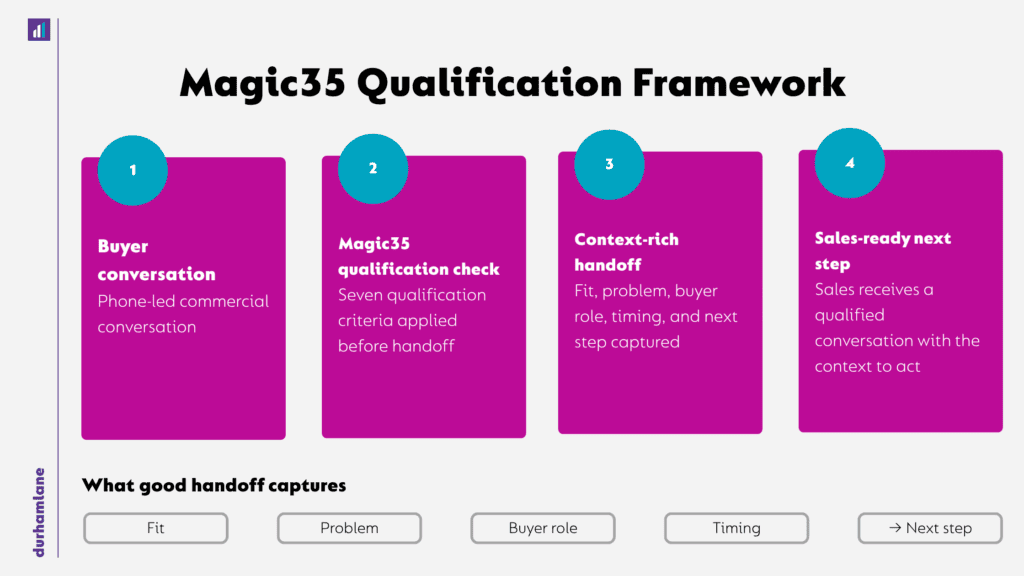
For SDR training, the useful lesson is practical. Reps need a shared standard for separating interest from genuine opportunity. That standard should shape the questions they ask, the notes they capture, the context they pass forward and the moments when they decide not to force a weak conversation into pipeline.
Question quality turns preparation into a live test. Better questions help the SDR check the account view, leave the buyer room to explain and lower the risk of sending a poor-fit account forward.
Recorded calls provide new SDRs with concrete examples of pacing, buyer language and handoff quality. Over time, reps learn the pattern, then make it their own. Human, connected and commercially disciplined conversation is the aim.
Build a repeatable SDR readiness loop
One-off training rarely changes behaviour on its own. Improvement comes through a loop of preparation, action, review, coaching and refinement.
Selling Power’s 2026 sales training guidance frames modern sales training around workflow, reinforcement and the gap between knowledge and execution. Its lens fits SDR training. Knowledge isn’t enough. Reps require a system that helps the right behaviour appear during live sales execution.
A readiness loop begins ahead of buyer contact and continues after it. Preparation combines ICP understanding, an account view and a credible message. Outreach and live conversation test that thinking. Later review looks at fit, question quality, handoff clarity and notes.
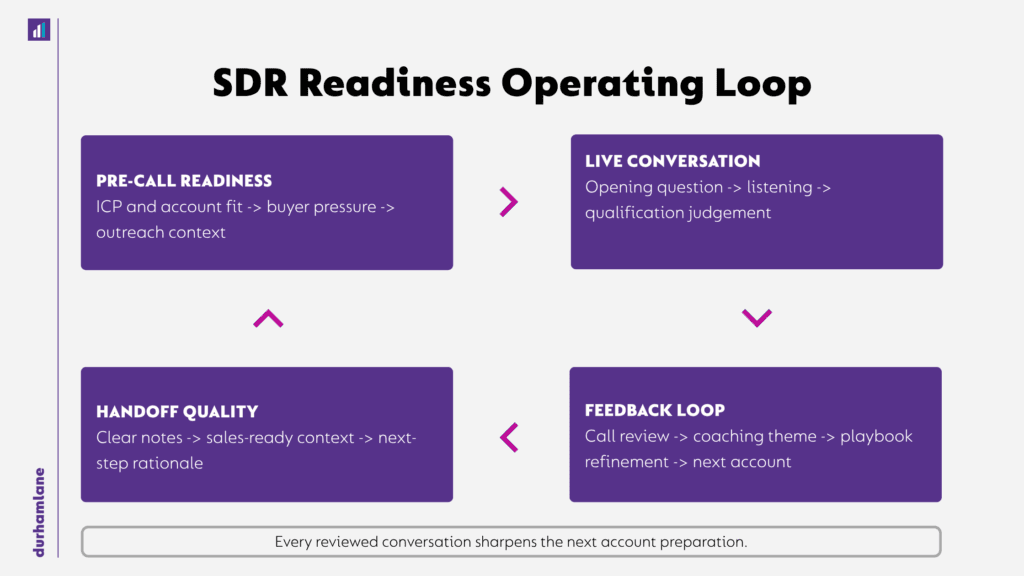
Pre-call readiness connects ICP, account fit, buyer pressure and outreach context. The live conversation tests that preparation through the opening question, listening and qualification judgement. Handoff quality turns the conversation into clear notes, sales-ready context and a reason for the next step. The feedback loop brings call review, coaching themes and playbook refinement back into the next account.
Managers also coach with more precision through the loop. Vague feedback such as “be more confident” does little. Account choice and research depth require one coaching move. Opener quality, question design, qualification judgement and handoff notes require others.
Good training makes those differences visible.
Where AI and sales technology fit
AI and sales technology now surround many sales development motions. They support research, practice, CRM hygiene and call review. Reporting and coaching also improve through disciplined use. Reps get more rehearsal and better feedback after the call.
Where AI helps, and where judgement stays human
Boundary discipline is important. AI practice is a training aid. Buyer understanding and live judgement remain human responsibilities.
Hyperbound supports AI roleplay for simulated sales conversations, scenario practice and coaching feedback ahead of live calls. For SDR training, it makes rehearsal technology concrete. Simulation helps an SDR practise pressure, pacing and response quality before a real buyer is on the line. It doesn’t replace account context, attentive listening, qualification judgement or manager coaching.
For SDR teams, a healthier technology frame includes five practices:
- Use AI for preparation and practice while keeping the rep accountable for buyer understanding.
- Treat roleplay as safer rehearsal that prepares the SDR to listen more closely in live calls.
- Review calls to identify usable coaching themes.
- Read CRM signals as training evidence, especially after notes, handoffs or follow-up quality slip.
- Keep the human seller responsible for relevance, judgement and trust.
Technology is strongest once it reinforces the same operating loop the training is trying to build.
| RELATED LISTEN Cold Calling in the Age of AI  In our Inside the Funnel episode, the conversation with Justin Michael explores AI-era outbound, clean data, human curiosity and phone-led sales conversations. Listen alongside this section for a sharper view of why better tools still depend on preparation, judgement and a human conversation worth having. |
Measure readiness ahead of revenue claims
Leaders have to measure training with care. Downstream pipeline and revenue matter. Market timing, proposition and territory also shape those outcomes. Offer strength, sales follow-up and buyer urgency shape them too.
What to measure before claiming training works
Readiness quality offers leaders a stronger measurement route because it connects training to behaviour ahead of broad commercial claims. The logic also fits the Kirkpatrick Model, which separates reaction and learning from behaviour and results so leaders avoid treating completion or activity as proof on its own.
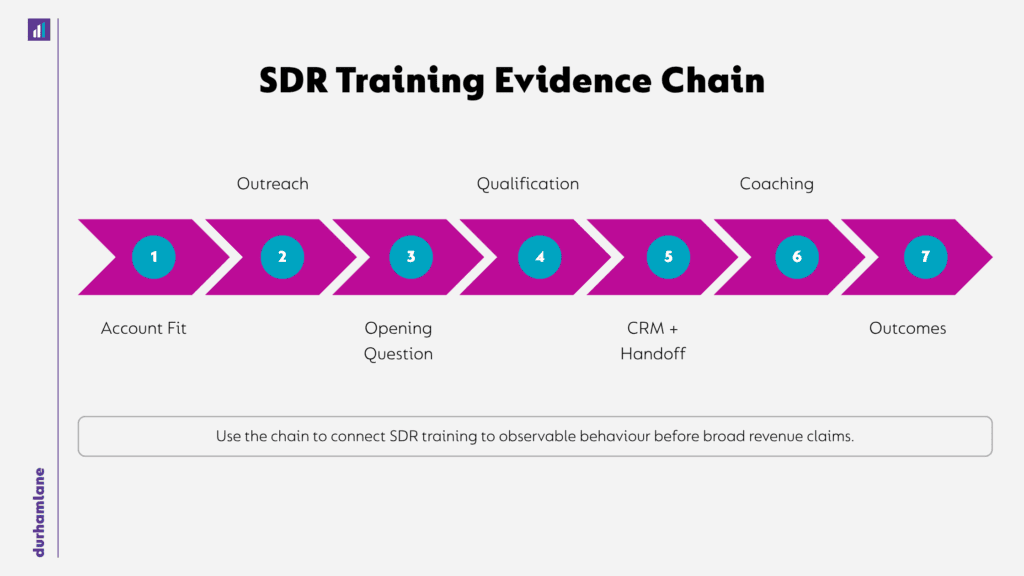
For SDR teams, the useful evidence chain starts with preparation quality. Account-fit reasoning shows whether the rep understands why a company belongs in the motion. Outreach relevance connects that account view to the buyer’s world, while opening question quality tests whether the SDR is prepared to learn before pitching.
From there, qualification consistency, CRM note quality and handoff completeness show whether the conversation is becoming useful sales evidence. Coaching response and recurring manager feedback then reveal whether the training system is changing later conversations or simply producing the same gaps in new accounts.
Qualification still needs a shared standard. durhamlane’s Magic35 Diagnostic Toolkit sets out a consistent qualification lens, so handoff quality is not left to each rep’s private judgement.
Commercial outcomes matter. For training measurement, the stronger route is to connect those outcomes to observable SDR behaviours first. Leaders look for improvement in conversation quality, qualification discipline and handoff clarity ahead of broad claims about business results.
Mature programs create a shared language for improvement. SDRs understand what good preparation looks like, managers coach against visible evidence, and marketing and sales see whether handoffs contain enough context. Improvement then moves through the operating loop instead of treating every weak conversation as an isolated rep problem.
Turn SDR Training Into an Operating Model
Sales development training fades when it’s treated as a course. As a system, it gains value across preparation, conversation, qualification, handoff and ongoing learning.
B2B teams need a practical standard. Are our SDRs ready for the buyer conversations we ask them to create?
That question leads naturally to an operating model. Teams require trained people, clear ICP thinking, qualification discipline, coachable data and technology that improves preparation. Managers also need the right evidence and a process that keeps learning close to live outbound execution.
From training system to operating model
durhamlane fits this operating problem because its sales development work is built around real B2B outbound conversations rather than classroom training alone. Our sales and marketing mantras reinforce business fit, curiosity, preparation and conversation quality. durhamlane’s proactive outbound sales development teams bring the wider operating layer into view, with people, process, data and technology working around live outreach.
That combination matters for SDR training. The rep needs more than product confidence, and the manager needs more than a one-off course to improve performance. A stronger operating model joins account understanding, qualified conversations, coaching evidence and outbound execution in the same system.
For teams that want a more structured path from account understanding to qualified buyer conversations, durhamlane makes that operating problem practical.
To discuss what the operating layer could look like for your team, speak with durhamlane.
Frequently asked questions
What is sales development training?
This training prepares SDRs and BDRs to identify, engage and qualify potential buyers near the front of the sales process. Core topics include ICP understanding, account research and outreach preparation. Questioning, qualification, CRM discipline, handoff and coaching belong in the same training system.
How is sales development training different from sales training?
General sales training may address the full sales cycle, including discovery, demos, negotiation and closing. Sales development starts earlier. It prepares reps for credible buyer conversations, stronger account context, disciplined qualification and a clear handoff.
What belongs in SDR training ahead of buyer contact?
Ahead of live buyer contact, SDR training includes ICP, account research, buyer roles and business pressures. Practice also includes opening questions, listening, qualification judgement, CRM notes, handoff context and coaching feedback, so each conversation improves the next one.
How do sales leaders measure whether SDR training is working?
Leaders review account-fit reasoning, outreach relevance and question quality. Qualification consistency, handoff completeness, CRM hygiene and response to coaching also matter. Stronger measurement connects commercial outcomes to behaviours managers can track and improve.
Does AI roleplay help with sales development training?
AI roleplay helps SDRs practise scenarios ahead of live buyer conversations. Roleplay is strongest as a rehearsal and feedback aid. Buyer understanding, listening, adaptation and qualification remain human responsibilities during the real conversation.