


Key takeaways
- AI in B2B sales is strongest at improving seller workflow. Research, enrichment, prioritisation, preparation, CRM hygiene, coaching, forecasting, and next-best-action guidance all sit around that flow.
- AI doesn’t remove commercial judgement. Signals, scores, summaries, and suggested actions require interpretation to qualify as sales action.
- Some buyers prefer more digital, self-directed journeys. Confidence, validation, and credible human support continue to shape decisive moments.
- Poor data, weak governance, and over-automation make sales teams faster at the wrong tasks.
- Strong sales motions connect better inputs with human conversation, disciplined qualification, and sales-ready handoff.
AI is already changing B2B sales. The simple “machines replace sellers” story misses the point because the real change is happening around the seller, in the research, data, prioritisation, coaching, admin, forecasting, and workflow decisions that shape what sales teams do next.
Real advantage follows. AI helps teams find account context faster, identify signals, draft first-pass outreach, summarise calls, update CRM records, and recommend the next best action. Speed and signal don’t automatically create better sales pipeline. Sales teams risk automating poor targeting, personalising messages that feel generic, or producing clean summaries that miss the commercial substance of a conversation.
In complex B2B sales, simply having more AI isn’t the advantage. The advantage comes from applying AI to improve the workflow around judgement, so teams identify the accounts that deserve attention, the signals that matter, the buyers who warrant a conversation, the threshold for qualified interest, and the context sales requires ahead of a valuable handoff.
What is AI in B2B sales?
AI in B2B sales refers to the use of artificial intelligence to automate, analyse, or orchestrate parts of the sales workflow, and to assist the sales activity inside that flow. Predictive AI identifies patterns, generative AI creates or summarises content, and agentic AI coordinates tasks across systems.
In practice, AI contributes to account research, contact enrichment, lead scoring, signal monitoring, outreach preparation, call summaries, CRM updates, forecasting, sales coaching, and next-best-action recommendations. The best use is broader than “write more emails” and gives sales teams a better way to decide how much attention each account and action deserves.
How AI fits into the sales workflow
Most B2B sales teams feel pressure in the same places. Account research takes time, admin builds up, inconsistent CRM data creates friction, prioritisation gets unclear, follow-up slows, handoff weakens, and coaching capacity stays limited. AI reduces manual work and makes patterns easier to see.
In practice, workflow AI summarises account news ahead of a call, identifies missing CRM fields, groups prospects by likely requirement, surfaces recent engagement signals, drafts a first version of a message, or flags a deal risk for manager review. Salesforce’s 2026 sales reporting offers a clear view of common sales AI applications across prospecting, lead scoring, forecasting, and email drafting.
AI vs traditional sales automation
Traditional automation follows rules. Emails send after a delay, leads are assigned after field changes, and tasks are created after triggers. AI handles less rigid input. The same systems analyse language, summarise information, identify patterns, generate content, recommend actions, and coordinate task sequences.
That doesn’t make it automatically better. In sales, an action has value only if it matches the account, buyer, timing, and commercial objective. AI assists the decision by bringing context into view, while the team remains the decision-maker for qualification, buyer trust, and sales readiness.
Why AI Matters Now: The B2B Sales Confidence Gap
AI deserves attention now because both sides of B2B sales are changing at the same time. Sellers have more tools, data, automation, and suggested actions. Buyers have more self-service information, AI-assisted research, peer validation, and internal stakeholders involved in decisions.
The result is a confidence gap. More information in the system doesn’t always create certainty. Buyers gain little from sellers who repeat online content. They look for validation at the point a decision turns specific, risky, political, technical, or commercially important.
Buyers want less friction and enough confidence to move forward
Gartner reported in March 2026 that 67% of B2B buyers preferred a rep-free experience. Sales teams shouldn’t assume every buyer wants a seller involved at the first moment. Buyers often want control, speed, and low-friction access to information.
But that is only half the picture. Another Gartner finding, published in May 2026, reported that 69% of B2B buyers preferred to validate AI-generated insights with sales reps. Forrester’s 2026 business buying insights makes a similar point through another angle. GenAI is reshaping discovery and evaluation, and buyers continue to rely on trusted human interactions and networks to validate decisions and reduce risk.
Buyers aren’t choosing between AI and people. The right kind of help has to arrive at the right moment. Generic selling creates friction. Credible human validation creates confidence. That’s where coaching earns its place — managers can show SDRs with concrete examples of pacing, buyer language and handoff quality. Over time, reps learn the pattern, then make it their own. Human, connected and commercially disciplined conversation is the aim.
Sellers have more signal, but still need judgement
AI gives sellers more signals across intent data, engagement patterns, account changes, recommended actions, conversation summaries, and buying-committee clues. Those signals are valuable inputs. On their own, they fall short of a qualified buyer.
Downloaded reports may mean interest, research, competitor monitoring, student activity, or nothing meaningful. Summary detail can look complete and miss the commercial reason a prospect hesitated. Next-best-action recommendations have value after the team checks the account, stage, and buyer problem.
The seller’s role changes here. Brochure-mode selling creates less value, and stronger sellers act as validators, interpreters, qualifiers, and guides.
The Best Use Cases for AI in B2B Sales Today
Top AI applications in B2B sales improve the quality, speed, or consistency of sales activity and keep human accountability in the decisive moments.
Research, enrichment, and targeting
AI speeds account-context building for sellers and SDR teams. AI summarises company news, identifies industry pressures, enriches contact records, groups accounts by fit, and compares a prospect with the ICP.
Sharper targeting protects the rest of the sales motion. Poor targeting creates waste across every later step. Automation makes weak targeting move faster. Applied well, AI gives teams a stronger starting point ahead of outreach.
There is a boundary here. We don’t need another prospecting tools guide. Better account intelligence earns its place after the team applies it to make sharper choices about which accounts deserve attention, what counts as fit, and what the team should stop doing. AI strengthens a clear B2B sales strategy. It isn’t a substitute for one.
Prioritisation, next-best action, and outreach preparation
AI also helps teams decide what to do next. Gartner’s 2026 survey on AI-enabled next-best actions makes the same point. High-value sales AI includes content generation and, more importantly, workflow support that gives sellers clearer priorities inside the sales motion.
Tasks include ranking accounts, flagging stalled opportunities, recommending follow-up, surfacing changes in buyer activity, and preparing talking points ahead of a call. Commercial decision-making stays with the sales team. Recommendations are inputs to judge against account alignment, timing, and the next practical step.
Outreach preparation is another practical use case. AI drafts first-pass emails, suggests message variants, summarises account context, and gives sellers more relevant hypotheses. The seller’s job is to make the message true, timely, and credible. Personalisation earns attention when it feels like relevance, never automation wearing a name tag.
CRM, forecasting, coaching, and conversation intelligence
AI reduces some operational drag that weakens sales quality. AI summarises meetings, suggests CRM updates, creates tasks, identifies missing fields, flags deal risks, and gives managers call patterns to review.
For sales leaders, the CRM is a common place for sales reality to drift. Notes get thin, stages get stale, and handoffs miss required AE context. AI helps organise and preserve information. Human review decides whether that information is commercially meaningful.
Coaching follows the same logic. Conversation intelligence surfaces patterns, objections, talk ratios, next-step gaps, and missed discovery moments. Behaviour change requires management, coaching, practice, and judgement.
| AI application | What AI improves | Risk to control | What humans still own |
| Research and enrichment | Faster account and buyer context | More data can hide poor fit | Judging relevance and timing |
| Prioritisation / next best action | Clearer signals and suggested moves | A score can look like a decision | Deciding what is commercially credible |
| Outreach preparation | Faster first drafts and account-specific inputs | Personalisation can still feel generic | Making relevance feel real to the buyer |
| CRM/admin | Notes, summaries, tasks, and cleaner records | Risk of missing commercial substance | Preserving valuable context |
| Coaching/conversation intelligence | Patterns, moments, and coaching prompts | Analysis outpaces behaviour change | Manager judgement and seller development |
| Forecasting/deal risk | Risk signals and next-step visibility | Over-reading signals | Interpreting deal reality |
Where AI can weaken B2B sales
AI improves B2B sales inside strong motions. In weak motions, the same tools magnify problems. The risk extends beyond AI getting something wrong. The bigger risk is misplaced confidence in activity that deserved earlier challenge.
More outreach can become more noise
Generative AI makes it easier to create more messages, more variants, more sequences, and more follow-up. Strong targeting and message logic turn that activity into an advantage. The same volume can damage trust when the team simply scales weak relevance.
B2B buyers are already managing more information, more internal stakeholders, and more digital research. AI volume turns noisy in the absence of judgement. The commercial question starts with “does this buyer have a reason to care now?” before the team asks “can we send more?”
Bad data makes AI faster at the wrong tasks
AI depends on the data, context, and workflow around it. Bad CRM fields, outdated contacts, weak ICP definitions, duplicate records, and unclear qualification standards reduce the quality of AI-shaped action.
Enterprise AI research makes the same point at a wider operating level. Deloitte’s 2026 State of AI report highlights the shift between pilot and scale, and IBM’s 2026 AI control-gap research shows governance and visibility lagging behind deployment in some environments. Sales teams can’t treat AI as a shortcut around data quality, accountability, or control.
AI signals are not the same as qualified intent
AI identifies engagement, summarises behaviour, and suggests priority. Models don’t automatically know whether a prospect has budget, authority, urgency, internal alignment, or a problem worth solving.
That distinction deserves attention because AI outputs often look organised. A neat summary creates a false sense of clarity in a B2B sales motion. Scores look objective, and recommended actions read like decisions. Qualification depends on commercial evidence, buyer context, live conversation, and judgement.
How AI changes the sales team’s role
AI doesn’t make the sales team irrelevant. It changes where the team should spend its effort, reducing low-value manual work and putting more pressure on high-value judgement.
SDRs spend less time on low-value prep and more time on judgement
SDRs and sellers can use AI to speed up account research, summarise context, draft messages, capture notes, prepare call plans, and review conversations. That should free time for better work. Better work means thinking about fit, timing, relevance, buyer pain, stakeholder context, and the next buyer conversation.
Claims that AI replaces SDRs are too blunt. AI handles tasks. Commercial responsibility for buyer pursuit, conversation quality, and sales-ready handoff stays with people.
In complex B2B sales, seller judgement appears at the point a script breaks. A buyer hesitates, reframes the problem, introduces a hidden stakeholder, gives a vague objection, or reveals that the apparent signal lacked meaning. AI prepares the seller for those moments, and the conversation tests whether the preparation holds.
Handoff quality gets more important
AI generates more context than sales teams used to have. Handoff quality standards rise. SDRs, marketing, revenue operations, and account executives need a clear agreement on the context worth carrying forward.
Useful handoffs explain the account context, the buyer’s stated problem, the qualification evidence, the stakeholder situation, the next step, and the reason sales should act now.
Richer AI inputs create value after sellers know how to apply them. Strong discovery, qualification discipline, purposeful follow-up, and context-rich handoff are the B2B sales techniques that turn a signal into a sales-ready next step.
How to implement AI in B2B sales without losing control
The best AI implementation in B2B sales starts with the sales constraint first, then the tool. Poor targeting, weak follow-up, bad data, unclear qualification, and inconsistent handoff make the problem harder to see after another AI tool is added.
Start with the sales constraint before the tool
Ahead of choosing an AI application, ask which sales problem requires improvement. Is the team spending too long researching accounts? Are SDRs pursuing low-alignment leads? Is follow-up too slow? Are handoffs thin? Is CRM data unreliable? Are managers unable to coach at scale? Are AEs ignoring SDR-sourced meetings because the qualification evidence is weak?
Each problem points to a different AI application. Research assistance, data hygiene, lead prioritisation, call summaries, coaching analysis, next-best-action guidance, and workflow automation solve different problems. McKinsey’s 2026 B2B growth insights frames AI inside a broader commercial operating model involving personalisation, execution, accountability, and governance.
RELATED WATCH
In our webinar, Hiring a GTM Engineer, the conversation with Abbas Somji (InboxKit / The Playbook Agency) and James Donaldson (Stakki) looks at why teams can waste time, budget and pipeline when they add GTM engineering, automation or AI-led workflows before diagnosing the real sales constraint.
Watch it alongside this section for a practical view of why better tools still depend on clear strategy, process ownership and the sales problem the team is trying to fix.
Clean the data before scaling automation
AI depends on available information. Data quality is both a sales issue and a systems issue. Teams require clear account definitions, current contact records, CRM hygiene, source-of-truth rules, and agreement on what different signals mean.
Lead scoring, next-best actions, and customer-facing workflows are especially sensitive to data quality. Models built on weak data risk producing sophisticated-looking output and sending attention to the wrong place.
Define where humans review, approve, and escalate
AI implementation requires defined human review points ahead of workflow scale. Which outreach drafts require approval? Which summaries require human correction? Which accounts require manual review ahead of outreach? Which agentic workflows are allowed to run automatically, and which ones must escalate?
Deloitte’s 2026 agentic AI governance overview and IBM’s 2026 control-gap research point in the same direction. More autonomous AI means organisations need clearer monitoring, guardrails, decision boundaries, and human oversight.
For sales teams, governance is the way to protect buyer trust, data quality, qualification standards, and brand reputation. Bureaucracy for its own sake creates drag. Clear control points keep the sales motion accountable.
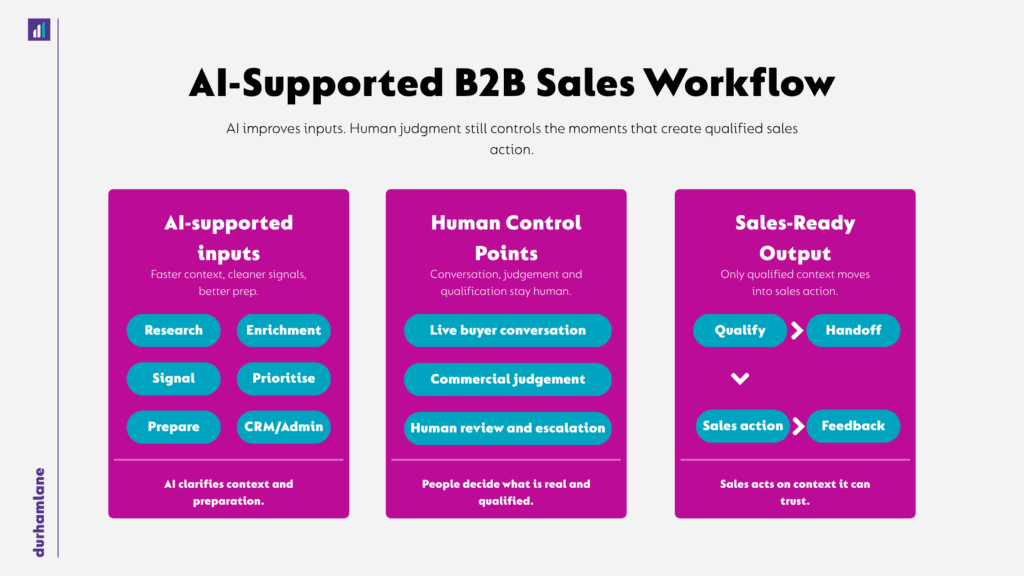
The workflow moves from research, signal, and prioritisation into buyer conversation, qualification, handoff, and sales action. AI strengthens the input layer of the sales workflow so decisive control points stay visible and accountable through live conversation, commercial judgement, qualification, escalation, and sales-ready handoff.
What Comes Next? AI Agents, Buyer-Side AI, and the Future of B2B Sales
The near future of AI in B2B sales is unlikely to be one single tool. Embedded AI across CRM, sales engagement, revenue operations, enablement, coaching, forecasting, and buyer-facing workflows is the more likely pattern.
Near future: AI embedded into CRM and revenue workflows
Sales teams should expect AI to grow more native to everyday systems. AI is likely to monitor account changes, recommend follow-up, draft messages, prepare call plans, summarise meetings, update CRM records, identify deal risks, and coordinate tasks across tools.
BCG’s 2026 article on AI sales agents shows how agentic systems assist customer education, lead handling, and handoff. Quality control remains necessary for this future.An AI agent that acts on bad product knowledge, weak data, or unclear escalation rules risks creating the same trust problems as a poorly trained human process, only faster.
Further future: buyer-side AI raises the value of credible human judgement
Further out, buyer-side AI is likely to gain influence. Buyers may apply AI to summarise vendors, compare options, draft requirements, prepare questions, and pressure suppliers for clearer evidence. Sellers are likely to face buying groups that are more informed, more sceptical, and more prepared ahead of direct conversation.
Human sellers remain important under that shift. Standards rise. Buyers with fast access to broad information require sellers to bring interpretation, context, relevance, commercial insight, risk reduction, and confidence.
Future B2B sales depends less on automated selling for its own sake and more on better commercial decision-making. AI improves the inputs. Sales teams own the judgement.
The Real Advantage: Turning Better AI Inputs Into Qualified Conversations
AI makes B2B sales faster, more informed, and more consistent. AI supports research, targeting, signal detection, outreach preparation, coaching, documentation, and next-best-action planning. Buyer qualification, trust, and valuable handoff context depend on human sales development.
Human sales development carries the decisive commercial task.
Replacing sales development with AI misses the operating issue. Input conversion is the missing system, turning AI-shaped account intelligence into conversations, qualification evidence, and handoff that sales is able to act on.
Conversion depends on strategy and technique. Strategy decides which accounts deserve attention, which signals are commercially meaningful, and what makes an opportunity worth sales time. Technique turns the signal into buyer-specific discovery, relevant follow-up, qualification discipline, and a handoff that carries the commercial context forward.
Execution constraints make the requirement operational. Account intelligence must move into targeted outreach, live buyer conversations, feedback loops, and sales-ready next steps. durhamlane’s Outbound Sales Development sits in that layer, turning sharper inputs into trusted sales conversations.
Teams sometimes lack visibility into the source of the conversion break. Problems might sit in targeting, data, follow-up, qualification, handoff, tooling, process, or capacity. In that situation, diagnosis is safer than more automation. B2B Sales Audit & Diagnostic identifies leakage in the sales motion ahead of more tooling.
Conclusion
AI in B2B sales is no longer a future topic. It already shapes how teams research accounts, prioritise action, prepare outreach, manage CRM, coach sellers, forecast pipeline, and think about the buyer journey.
The winning issue extends beyond adoption alone. Discipline is the control point. Teams need to know which sales problem they are solving, the points where AI should support workflow and where human review belongs, and how AI-shaped activity converts into qualified pipeline without creating more noise.
For complex B2B sales, the strongest model places AI around better human judgement. Better inputs, preparation, conversations, qualification, and handoff create the value.
If that’s the gap your team is trying to close, durhamlane’s Outbound Sales Development motion is built around turning account intelligence and outreach into qualified conversations and sales-ready handoff.
To discuss this further, get in touch.
Frequently asked questions
What is AI in B2B sales?
AI in B2B sales is artificial intelligence applied to parts of the sales workflow. Common examples include account research, data enrichment, lead scoring, outreach preparation, CRM updates, call summaries, coaching, forecasting, and next-best-action recommendations.
What are the best use cases for AI in B2B sales?
Strongest use cases usually sit around workflow inputs and operational consistency. They include research, enrichment, targeting, prioritisation, outreach preparation, CRM/admin, conversation intelligence, coaching, forecasting, deal-risk analysis, and next-best-action guidance. Value comes when those inputs help people make better commercial decisions.
Will AI replace B2B sales reps or SDRs?
AI automates tasks. Complex B2B sales relies on human judgement for relevance, conversation quality, qualification, objection handling, stakeholder context, trust, and handoff. AI changes the activity around sellers more than it removes the requirement for skilled sales development.
How should B2B teams implement AI in sales without hurting quality?
Start with the sales constraint first. Decide whether the problem is targeting, data quality, slow follow-up, weak qualification, handoff, coaching, admin, or forecasting. Then choose AI applications that address that problem, clean the data, define human review points, and monitor buyer experience.
How will AI agents change B2B sales?
AI agents are likely to handle more workflow coordination, research, routing, reminders, summaries, and customer-facing tasks. Lead handling and handoff are likely areas too. Stronger guardrails, escalation rules, monitoring, data quality, and human accountability gain importance as agents gain capability.