

Key takeaways
- B2B sales prospecting tools work best when each category has a defined role in the SDR process.
- Contact data, CRM, phone systems, and email tools solve different operating problems. So do signals, conversation intelligence, and AI.
- A larger stack still leaks pipeline. That happens when ICP, follow-up, CRM discipline, coaching, qualification, and handoff standards are weak.
- AI supports research, admin, notes, role-play, coaching, and signal interpretation. SDR judgement stays central.
- Tool choice should follow the sales motion, target accounts, and channel mix. It should also follow CRM maturity, SDR capacity, and management discipline.
Buying more prospecting tools is easy. Getting them to produce reliable qualified opportunities is the harder commercial problem.
Many B2B teams already have contact data, CRM, email sequences, diallers, intent signals, call recording, and AI support. The stack may look mature on paper. Then the board asks why qualified pipeline still feels thin, why MQLs sit untouched, why CRM notes are unusable, or why sales receives meetings with weak context.
The gap usually sits in the operating system around the software. A contact record does not tell an SDR whether the account is worth pursuing. Sequencing will not make the message relevant. One signal does not prove buying readiness. Call recordings only improve performance when someone turns them into coaching.
The failure becomes visible where leadership expected technology to remove friction. Marketing can show lead flow. RevOps points to activity. Sales sees meetings booked. The commercial question remains open. Did the SDR reach the right account with enough context to justify the handoff?
This guide explains the main categories of B2B sales prospecting tools and gives controlled examples of where named tools fit. Each example is tied back to the SDR motion it supports. The goal is to help revenue, sales, marketing, GTM, RevOps, and SDR leaders think about the stack as a managed prospecting system.
What are B2B sales prospecting tools?
B2B sales prospecting tools are software products that help teams identify, research, contact, prioritise, track, and learn from potential buyers.
That definition covers several jobs. Some tools help SDRs find accounts and contacts. Some preserve activity history and qualification context in CRM. Others support the daily motion of calls, cadences, email steps, and meeting notes. That same layer can also cover intent signals, call review, coaching, or AI-assisted admin.
The useful question is where each tool belongs in the workflow. Data platforms usually come first, where the team needs to find the right people. CRM then keeps the commercial memory of the account, while sales engagement carries the outreach steps and reminders. Once conversations begin, conversation intelligence turns calls into coaching material. AI supports the SDR before the next call through preparation.
Those jobs connect, yet each one serves a different part of the motion. Treat every tool as a pipeline engine and the stack quickly turns noisy. Activity, records, tasks, and dashboards start to accumulate. Qualified opportunity creation still depends on account fit, relevant outreach, human conversation, disciplined qualification, and a handoff that sales can use.
Why tools alone do not create qualified pipeline
The fastest way to waste a sales-tech budget is to buy tools for symptoms while leaving the SDR motion untouched.
If the ICP is vague, the contact database fills the CRM with plausible names at poor-fit accounts. Without a shared qualification standard, every MQL can look urgent to sales and marketing while still going nowhere. Messy CRM fields blur follow-up quality for managers. Sequences without phone discipline give prospects touches without a credible conversation. Call recordings left untouched allow the same weak discovery habits to repeat.
These are operating failures. More tooling can expose them faster as activity volume rises, then hide them again behind dashboards that look busy.
Weak tool performance is often a sign of a broader B2B prospecting pipeline problem. Software selection is only one part of the issue.
The stronger work starts upstream from the stack. A B2B sales strategy and leadership has to clarify which accounts matter, which problems are commercially worth pursuing, how qualification is defined, and what kind of sales motion the business can support.
A documented B2B sales playbook then turns that strategy into rules SDRs can follow. That is where CRM discipline, cadence rules, call standards, coaching rhythm, and handoff expectations become visible. Without that operating layer, prospecting tools create more movement than progress.
| RELATED LISTEN Graphic Sales: Why Your Playbook Comes Before AI  In this episode of Inside the Funnel, Richard Lane speaks with Tom Stearns and Peter Cleary about why outbound teams often scale the wrong things, and why prospecting playbooks need to come before sequencing, automation, or AI. • Why thinking has to come before sequencing; • What a real prospecting playbook should make visible; and • Why AI works best when it supports a documented sales motion, rather than replacing one. |
The main categories of B2B sales prospecting tools
A useful stack map starts with the role each category plays before it gets to vendor logos. B2B prospecting stacks usually combine seven categories.
| Category | SDR workflow job | Example tools | Watch-out |
| Contact data and sales intelligence | Find accounts, contacts, roles, account context and plausible routes into the buying group. | LinkedIn Sales Navigator, ZoomInfo, Apollo.io, Cognism | Data availability is not the same as account qualification. |
| CRM | Preserve account history, activity, qualification status, next steps and handoff context. | HubSpot Sales Hub, Salesforce Sales Cloud | CRM only helps when fields, notes and next steps are usable. |
| Phone, dialler and sales engagement | Manage calls, cadences, reminders, outreach steps and activity visibility. | Salesloft, Outreach, Aircall, HubSpot, Apollo.io | Automation can mask weak conversation quality. |
| Email sequencing and infrastructure | Support email steps, sender setup, domains, authentication and workflow rules. | Salesloft, Apollo.io, Hunter.io | Email volume still needs relevance, restraint and technical control. |
| Signals and intent | Surface timing clues and account-prioritisation inputs for SDR review. | ZoomInfo, LinkedIn Sales Navigator, 6sense, Demandbase, Leadfeeder | Signals help the team decide where to look next. Qualification still needs evidence. |
| Conversation intelligence and coaching | Capture calls, notes, transcripts, summaries, patterns and coaching evidence. | Gong, Fathom, Hyperbound, Salesloft Conversations | Recording only helps when managers review and coach from it. |
| AI support layer | Assist research, admin, notes, summaries, role-play, signal review and workflow consistency. | Hyperbound, Fathom, Gong, Salesloft, Outreach, HubSpot | AI should reinforce SDR judgement, not replace it. |
The exact mix will differ by sales motion. A high-volume outbound team will feel different workflow pressure from a narrow enterprise account motion. The sharper question is what the SDR team needs to improve first. Is the problem account selection, speed, call quality, signal interpretation, CRM discipline, qualification depth, or the context sales receives at handoff?
The categories should behave like a sequence. Data shapes the account universe, and CRM preserves the record around each account. Phone, sales engagement, and email tools turn that record into disciplined action. Signals help the team decide where attention is timely. Conversation intelligence turns calls into material managers can inspect, while AI supports preparation, notes, admin, role-play, and review. A weak or disconnected category passes the problem forward to the next one.
Contact data and sales intelligence tools
Contact data and sales intelligence tools help SDRs identify accounts, contacts, roles, and possible routes into a buying group. Examples include LinkedIn Sales Navigator, ZoomInfo, Apollo.io, and Cognism.
Their value depends on how the data is used. A large contact list can give the team reach, yet reach has little commercial value if the account list is weak. The SDR still has to ask whether the company matches the ICP, whether the contact has a plausible role in the buying process, and whether the outreach can be tied to a real business problem.
This category should also connect cleanly into CRM. If enrichment creates duplicate records, vague job-title assumptions, or disconnected notes, the team inherits a hygiene problem. Better data should make account selection and preparation sharper. It should never become permission for indiscriminate list building.
CRM as the prospecting system of record
CRM is the operating memory of the prospecting motion. A useful CRM record should show who has been contacted, what happened, and what was learned. The same record should make the next step, qualification status, and sales context clear enough to continue the conversation.
HubSpot Sales Hub and Salesforce Sales Cloud are familiar CRM examples, although the principle applies to any CRM. The system is where activity becomes management visibility and handoff context. Notes, fields, tasks, call outcomes, qualification status, and next steps have to be useful enough for someone else to understand the account without replaying every touchpoint.
Weak CRM discipline shows up late and painfully. A meeting gets booked, but the AE cannot see why the account matters. A follow-up task exists with too little context behind it. A lead gets marked as qualified without a clear qualification standard.
The CRM should make the handoff inspectable. Sales needs to see the account problem, the stakeholder’s role, the reason for outreach, and the stage of the conversation. The record also has to show the objections already raised, the next action, and the evidence behind qualification. “Interested” is not enough. Sales receives a meeting, but no commercial thread.
A Magic35-style qualification lens fits naturally here. Before the handoff, the team needs a clear view of what makes an opportunity sales-ready. CRM then captures the evidence, rather than acting as a passive archive of SDR activity.
Phone, dialler, and sales engagement tools
Phone, dialler, and sales engagement tools support the execution layer of prospecting. This category includes call systems, cadences, reminders, and email steps. It also covers task queues, meeting workflows, and activity visibility.
Sales engagement examples include Salesloft and Outreach, Aircall, HubSpot, Apollo.io, and other tools may support parts of the same workflow depending on the stack.
The commercial point is phone-led execution. Inbox automation leaves too much judgement untouched. SDRs still have to decide when an account deserves a call, how to open the conversation, and how to respond when the buyer gives partial information. They also have to separate polite interest from a sales-ready opportunity.
Good engagement tooling helps teams keep rhythm. Follow-up becomes harder to forget, and managers gain a clearer view of what happened. Weak messaging still stays weak. A shallow call still fails qualification. The tool sets up the movement; the SDR has to create the conversation.
Email sequencing, email infrastructure, and domain health
Email tools sit in two related lanes. One lane manages outreach workflow: sequences, templates, follow-up steps, reminders, and replies. The other lane concerns infrastructure: inbox setup, domains, authentication, sending rules, and domain-health monitoring.
Salesloft and Apollo.io may support email steps as part of a broader workflow. Hunter.io is an email discovery example. Some teams also use specialist tools to manage cold-email sending operations, although prospecting strategy should not become an email-volume exercise.
This category needs caution because email tooling can make weak outreach scale quickly. Relevance still matters. So does restraint. SDRs should know why the account was selected, why the message is being sent now, and when a phone follow-up makes more sense than another automated touch.
Infrastructure acronyms such as SPF, DKIM, and DMARC matter when the team is responsible for outbound email operations. They do not remove the commercial requirement to contact the right accounts with a message worth answering. Email systems support the motion, but strategy has to define that motion.
Signals, intent data, and trigger-event tools
Signals help teams decide where attention is useful right now. Intent data, website activity, funding news, hiring patterns, and job changes can all point to movement. So can content engagement, account movement, and other trigger events.
ZoomInfo, LinkedIn Sales Navigator, 6sense, Demandbase, and Leadfeeder are examples that may appear in this category depending on the specific signal type and stack design.
Signals are useful because timing matters. An account that has just been hired for a relevant role, changed leadership, visited a high-intent page, or shown category-level research behaviour may deserve review. That review still requires commercial interpretation. The SDR has to connect the signal to account fit, likely pain, role relevance, and outreach timing.
The risk comes from over-reading the signal. A website visit is not a qualification event. Intent data is not a booked meeting. And a job change is not a budget holder asking for help. Signals should focus SDR attention. Human judgement still has to decide whether the account deserves action and what kind of action makes sense.
Conversation intelligence and coaching tools
Conversation intelligence turns calls and meetings into material that managers, SDRs, and sales teams can review. Tools such as Gong, Fathom, Hyperbound, and Salesloft Conversations may support call capture, transcripts, summaries, notes, pattern review, role-play, or coaching workflows.
The recording is the raw input. Coaching is the operating mechanism.
Each gap in the process has its own cost. Managers who do not review calls turn the tool into a searchable archive of missed moments. SDRs without practical feedback repeat the same call problems. Summaries entering CRM without qualification judgement hand sales a cleaner note with the same weak substance.
Used well, conversation intelligence supports manager-led review. Managers can see where SDRs lose control of calls, where qualification is thin, where objections are mishandled, or where a promising account was handed over without enough commercial context. That makes coaching more specific. The same review rhythm helps teams reinforce the playbook with real conversations instead of abstract training sessions.
AI as a cross-category support layer
AI belongs across the stack as a support layer for SDR execution. Before the call, it handles account research and preparation. After it, meeting notes, transcript summaries, CRM admin, and follow-up prompts. Around the work itself, it supports role-play, coaching inputs, signal review, data hygiene, and workflow consistency.
Hyperbound is relevant where AI-assisted role-play and coaching are in scope. Fathom and Gong may support notes, transcripts, summaries, or conversation review. Salesloft, Outreach, HubSpot, Apollo.io, and other platforms may include AI-assisted workflow functions depending on current product configuration.
The boundary matters. AI can help organise research, draft preparation notes, summarise a call, flag a follow-up item, or give a manager more material to inspect. The judgement layer still sits with trained people.
A prospecting stack becomes risky when AI is treated as a shortcut around account fit, message relevance, commercial curiosity, qualification, or handoff quality. In complex B2B sales environments, buyers respond to relevance and credibility. AI can assist that work. The sales development motion still depends on a human voice and judgement.
That is the same logic behind human-led, tech-enabled SDRs. Technology should sharpen preparation, relevance, and consistency. While trained SDRs own judgement, qualification, and the conversation.
How to choose B2B sales prospecting tools for your SDR operating model
The right tool stack starts with the sales motion. A team pursuing mid-market technology buyers with a phone-led outbound motion will make different choices from a team handling inbound enterprise leads from complex buying groups.
Start with the operating question before the vendor question. When prospecting is breaking down, the first job is to identify where the motion is under pressure. That usually points to the tool category worth inspecting first.
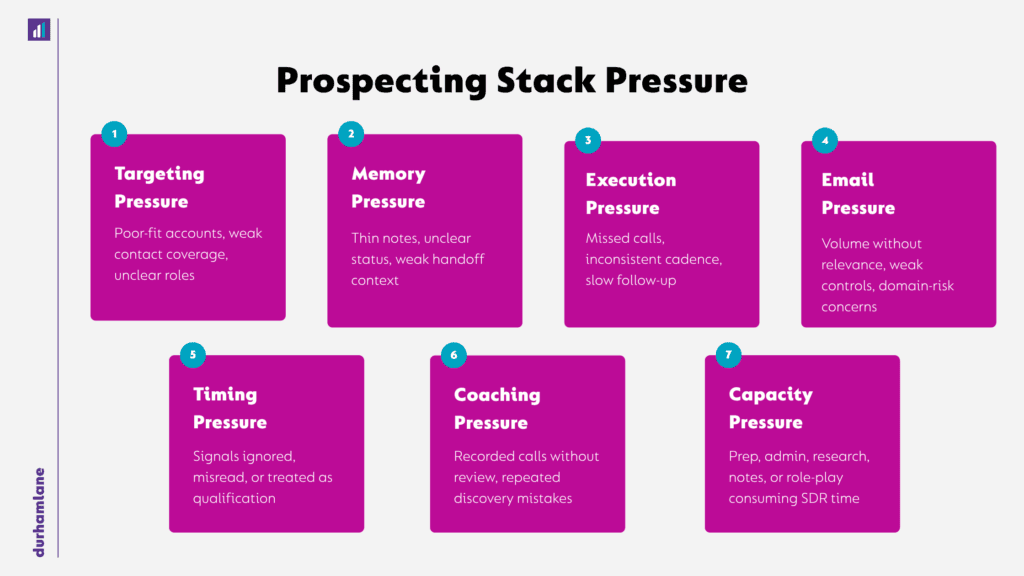
Check adoption pressure. A sophisticated platform will fail if SDRs do not use it cleanly, managers do not inspect it, and RevOps cannot maintain it. Tool overlap matters too. The team may already own capability that is unused, poorly configured, or disconnected from daily SDR behaviour.
Cost is better understood as total operating load. Licences are only the visible line item. Onboarding, data governance, CRM setup, and training all add drag. Along with management time, reporting, admin, unused features, and stack overlap. A cheaper tool becomes expensive when it creates rework. A larger platform becomes wasteful when the team lacks the operating maturity to use it.
The buying decision should start with fit. A tool has to match the ICP, the channels the team actually uses, and the operating conditions around the motion. CRM maturity, data quality, SDR capacity, and manager capacity all shape whether the tool can be used well. Handoff requirements and the existing stack matter because the tool has to carry context into the workflow that already exists. The harder question sits underneath the whole decision. Is the business missing a tool, or is the existing motion being used badly?
The vendor name comes late in the decision. Before that, the team has to know which operating gap it is trying to close. Purchase is only the beginning. Someone still has to manage the behaviour once the tool is live.
When software is masking an SDR execution problem
There is a point where another licence stops repairing anything.
The stack may already include contact data, CRM, sequencing, dialling, signals, AI notes, and call recordings. Standards still go missing. SDRs chase weak accounts, follow-up varies by rep, and CRM notes give sales too little to work with. Intent signals get over-read, calls lose qualification depth, and coaching never settles into a steady rhythm. Handoff shrinks to “meeting booked” where sales needed “commercial context transferred.”
That is where leaders have to separate tool selection from operating discipline. The stack may be adequate even as the execution model goes under-managed.
Some teams need tighter internal ownership. A clearer ICP and stronger CRM rules give the motion firmer ground, while disciplined SDR coaching, call review, and a trusted qualification standard make the execution inspectable. Elsewhere, capacity is the real constraint. Internal leaders know what good prospecting should look like, but lack the people, management time, phone-led rhythm, or SDR training structure to run it consistently.
The distinction matters because buying another tool can feel like progress while the same execution gap survives. A new intent platform helps little if nobody has time to review accounts. Stronger CRM configuration still depends on SDRs knowing what evidence to capture. Conversation intelligence changes call quality only when managers can run a coaching rhythm. Tidy AI notes do not improve pipeline if the team still accepts thin qualification.
That second problem space is where durhamlane can help. Its model combines phone-led, human-powered SDR execution with AI-accelerated support for complex B2B sales environments. Technology supports research, preparation, reporting, coaching, data quality, signal interpretation, and execution consistency. Human SDRs still carry the judgement behind qualified pipeline. They decide which account to pursue, what problem to test, when to call, how to qualify, and what context sales needs next.
A managed SDR operating system makes the stack accountable. Tools should help SDRs create better commercial conversations and cleaner handoffs. If the stack is busy while pipeline quality stays weak, software is probably showing the problem more clearly than it is solving it.
Conclusion
B2B sales prospecting tools are useful when they help SDRs choose better accounts, act on timely signals, keep CRM context usable, learn from real conversations, and give sales a handoff with substance.
The stack cannot carry that motion by itself. Data, CRM, engagement tools, signals, conversation intelligence, and AI create value when they sit inside a managed SDR operating model.
durhamlane helps B2B teams turn prospecting tools, data, and SDR activity into a more disciplined path to qualified conversations. Weak follow-up, inconsistent qualification, unclear handoff, or limited SDR capacity can all hold back results.
Let’s talk about where the sales development motion is breaking and what it would take to fix it.
Get in touch
FAQ
What are B2B sales prospecting tools?
B2B sales prospecting tools help teams identify, research, contact, prioritise, track, and learn from potential buyers. The category usually covers contact data, CRM, sales engagement, phone systems, email workflow, signals, conversation intelligence, and AI support. Their value depends on how well they fit the SDR operating model.
What tools do SDR teams need?
Most SDR teams need some combination of contact data, CRM, phone or sales engagement tools, email workflow, signals, conversation intelligence, and AI support. The mix depends on the sales motion. Account complexity, channel mix, SDR capacity, management model, and handoff requirements decide how deep each category needs to go. There is no universal stack.
What is the difference between sales prospecting tools and CRM?
CRM is the system of record for accounts, contacts, activity, qualification status, and handoff context. The rest of the prospecting stack works around that record. Contact tools help teams find people, engagement tools run outreach and calls, signals point attention, and conversation tools capture what happened. CRM should hold the usable commercial memory those tools create.
Are AI sales prospecting tools replacing SDRs?
AI can support the work around the SDR. That includes research, admin, meeting notes, call summaries, role-play, coaching inputs, signal review, and workflow consistency. Account-fit judgement, message relevance, qualification, and the commercial conversation still belong with trained people. In complex B2B sales, AI works best when it helps SDRs prepare better and execute with more discipline.
How should teams choose prospecting tools?
Teams should start with the operating gap. ICP, sales motion, phone reliance, and channel mix show what the tool has to support. CRM maturity, SDR capacity, coaching model, handoff requirements, adoption readiness, and stack overlap show what the team can realistically manage. Categories come before vendors. A tool should solve a workflow problem the team is prepared to own.
Are sales prospecting tools enough without a sales development process?
No. Tools require operating standards, CRM discipline, qualification rules, follow-up rhythm, coaching, and sales-ready handoff. Without those controls, the stack may create visible activity while pipeline quality stays weak. A process gives the tools a role, and SDR execution turns that role into qualified conversations.