

Key takeaways
- A B2B sales process is not the same as a stage list. A useful process defines how accounts move, who owns the work, and what evidence makes progression credible.
- Strong processes do not treat every signal as readiness. An email open, webinar attendance or form fill may show interest. The team still needs evidence of fit, problem, timing and next step.
- Tools can make the workflow visible. They cannot repair weak qualification, unclear ownership or handoffs that leave sales guessing.
- Most process failures appear before an opportunity is truly sales-ready. Account intelligence is thin, follow-up slows down and qualification stays vague. Sales receives a record of activity without enough context to progress the conversation.
- Outsourced SDR teams can help when the front end is underpowered. They strengthen research, outreach, qualification and follow-up discipline, so sales receives a clearer handoff.
Many B2B teams already have the visible parts of a sales operation. The CRM has stages. Marketing is creating activity. Outbound cadences are running, inbound leads are coming in, and the dashboards are full. What is often missing is the process that turns all of that movement into commercial evidence and qualified buyer conversations.
That distinction matters. A tidy pipeline can still hide a weak process. The real test is whether the team knows what should happen next, who owns it and what evidence is needed. Before an account or lead is treated as sales-ready, the process should make the buyer’s position clear and give sales enough context to continue the conversation properly.
This guide treats the B2B sales process as an operating system for execution. Stages, qualification, handoff, tools, ownership and front-end SDR support all have to work together. When they do not, the team can look busy while sales still lacks the evidence needed for the next serious conversation.
What is a B2B sales process?
A B2B sales process is the repeatable workflow a B2B organisation uses to move target accounts or leads towards a qualified sales opportunity. It starts with first signal or outreach, then moves through qualification, sales conversation, proposal, decision and post-sale feedback.
The definition is straightforward. The work is not. In B2B, the process has to connect what the buyer is doing with what the seller does next. It also has to define the evidence, ownership, tools, timing, channels, handoff and review behind that movement.
A generic sales process might start with a simple sequence. Prospect. Connect. Qualify. Present. Negotiate. Close. That can be a useful baseline. Salesforce, for example, explains the sales process through stages and stresses the importance of defining exit criteria between those stages.
The problem is that B2B buyers rarely move through one clean path. A single account can involve several kinds of stakeholder. One person may sponsor the problem commercially. Others may judge technical fit, budget, procurement risk, day-to-day use or final approval.
The buyer may also move backwards as new information appears. They may compare suppliers digitally before speaking to sales, then pause because of internal timing, budget, risk or implementation concerns. Gartner describes this as a nonlinear B2B buying journey. Its analysis explains how buyers complete different “buying jobs” across digital and human interactions.
What the process has to make clear
A useful B2B sales process should answer four practical questions:
- Where is the buyer really in their decision?
- What has the team learned that justifies the next step?
- Who owns the next action?
- What context needs to be handed over before sales treats the account or lead as ready?
That is why a B2B sales process cannot simply push every buyer from one box to the next. It has to manage movement while leaving room for the way complex buying actually happens.
B2B sales process vs sales funnel, pipeline, playbook, methodology and strategy
These terms often get mixed together. They are related, but they do different jobs.
| Term | Use it for | Watch for |
| Sales process | The workflow that shows what happens next, who owns it and what evidence is needed. | Treating it as a list of CRM stages without operating detail. |
| Sales funnel | The visible movement from wider demand to narrower opportunity and revenue stages. | Treating movement as progress when the underlying evidence is weak. |
| Sales pipeline | The current set of active opportunities, stages and forecasted value. | Filling the forecast with opportunities that are not properly qualified. |
| Sales playbook | The documented rules, messaging, cadences and resources used to run the process consistently. | Writing it once, then ignoring it when buyer behaviour changes. |
| Sales methodology | The selling approach used inside the process, such as consultative selling or a qualification framework. | Using it as a slogan without changing daily seller behaviour. |
| Sales strategy | The commercial choices that define market, ICP, positioning, routes to market and growth priorities. | Confusing strategic direction with day-to-day process execution. |
The sales process is the execution layer. Strategy decides where the business should play. The playbook documents how the team should work. Methodology shapes the conversations inside that workflow. Funnel and pipeline reporting show movement. The sales process is where those inputs become daily decisions about evidence, ownership, next action and handoff.
Why B2B makes the process more complex
B2B makes the sales process harder because readiness, authority and evidence rarely sit in one place.
The buyer may not be ready when they first engage. One person might download a guide. Another may control the budget. A technical stakeholder may be worried about integration risk. A commercial buyer may care more about cost, payback and strategic fit.
In a B2B software sales process, the route to a decision can be even longer. Product demos, security reviews, technical validation and implementation planning may all be needed before a serious buying decision is realistic.
The channel mix adds another layer. Buyers may move between website content, email, events, LinkedIn and phone calls before they ever reach a sales meeting. Demos, review material and follow-up conversations may then shape whether the account is genuinely ready to progress.
McKinsey’s work on the B2B growth equation describes this shift towards omnichannel sales models. The point is practical for sales teams. Suppliers need to understand how customers use different channels across the journey, rather than treating each interaction as a separate signal.
A strong process therefore cannot stop at the question of stage. It has to ask what the team has learned about the account, who owns the next action and whether there is enough commercial evidence to justify progression.
Why a defined B2B sales process matters
A defined B2B sales process gives the business a common standard for judging progress. It does not fix pipeline on its own. It makes poor judgement harder to hide.
Without a clear process, activity can look like momentum. A lead is contacted. A sequence is completed. A meeting is booked. A CRM stage is updated and the forecast changes.
None of that proves the account is a good fit. It does not prove the buyer has a real problem, the timing is credible or the next conversation is commercially useful.
The difference is visible in handoff quality.
A weak MQL handoff sounds like this. “This person downloaded an asset and opened two emails.”
An evidence-led handoff sounds different. “This account matches the ICP. The contact is connected to the buying group. They are exploring a problem that maps to our use case. There is a recent trigger that suggests urgency. The next step is a call to clarify scope and timing.”
Both examples may appear in the CRM as a lead passed to sales. Only one gives sales a reason to prioritise the conversation.
A defined process helps marketing, SDRs, AEs, RevOps and leadership work from the same operating standard. It clarifies which signals matter, what qualifies movement and when a human conversation is needed. It also defines what tools should record and what information has to survive from one owner to the next.
It also makes improvement possible. When the process records only activity, the team can count movement without understanding where deals are weakening. When it records commercial evidence, the team can ask sharper questions.
That is how the process stops sales effort being wasted on accounts that were never properly qualified.
The B2B sales process stages and what each one needs to work
Most B2B sales process steps can be grouped into a practical sequence. The work starts with account selection and first engagement. It then moves through qualification, discovery, decision support, close and post-sale learning.
The exact shape will vary by model. An enterprise software company, a professional services firm, a manufacturer and a SaaS vendor should not copy the same process blindly. The useful question is what each stage needs to prove before the account moves forward.
| B2B sales process stage | What the stage needs to prove | Common failure |
| ICP and account targeting | The account fits the market, use case, trigger profile and contact base the team can realistically pursue. | Targeting is too broad, so SDR effort goes into weak-fit accounts. |
| Prospecting and demand capture | There is a relevant reason to engage, beyond a name in a database or a signal in a campaign report. | Activity is high, but outreach has no clear commercial reason. |
| First engagement | The buyer has shown enough interest, role relevance or problem signal to justify a real conversation. | The team treats any reply, form fill or meeting as qualification. |
| Qualification | The account has credible fit, problem clarity, timing, stakeholder context and a next step worth pursuing. | Qualification becomes a checklist or a calendar booking. |
| Discovery and sales conversation | Sales understands the business problem, current process, constraints, stakeholders and success criteria. | The AE has to re-qualify because the SDR handoff lacked context. |
| Opportunity creation | There is enough evidence to create a sales-owned opportunity with a clear next action. | A meeting becomes the reason for opportunity creation, even when fit, problem and next step are still unclear. |
| Proposal and solution alignment | The buyer has agreed on the problem, decision criteria, commercial case and likely route to implementation. | A proposal is sent before the buyer has agreed what they are trying to solve. |
| Decision and close | The team has buyer-verified next steps, approval context, final blockers and a realistic implementation path. | The forecast relies on optimism rather than confirmed buyer movement. |
| Post-sale handoff and feedback | The original pain, promised outcomes, risks and stakeholder context are passed into onboarding and future learning. | Learning disappears after close, so the sales process does not improve. |
Use the table as an evidence check. Each stage should show what the team has learned before the account moves forward.
A useful stage definition should include entry criteria and exit criteria. Entry criteria explain what makes an account or lead eligible for a stage. Exit criteria explain what must be true before it moves forward. HubSpot’s sales process guidance makes a similar practical point. A process should create structure, help teams track what works and guide buyers through the buying journey.
The strongest exit question is simple. What do we know now that we did not know before, and does it justify the next owner investing more time?
Accounts should not move forward just because the workflow says they can. They should move forward when the team has enough evidence for the next owner to spend time well.
What has to be in place behind the stages
The visible stages are only one layer of the B2B sales business process. The matrix is useful because it shows the work attached to each stage. For that work to happen consistently, the business needs operating discipline behind the stage labels.
That starts with an ICP the team can actually use. A broad statement such as “enterprise technology companies” will not guide day-to-day decisions. SDRs and sellers need usable account criteria, role assumptions, trigger events and disqualification rules. They also need a clear view of where effort should not be spent.
Channel logic has to be intentional as well. Phone, email, LinkedIn, website signals, events, referrals, review content and paid campaigns should not behave like separate worlds. A buyer might attend a webinar, visit a product page and then receive a generic outbound message. The tools may be functioning, but the process has failed to interpret the signals.
The CRM also needs to record evidence rather than motion. A stage label should earn its place. It should show why the account is there, what evidence supports the next step and who owns the action before the team moves it forward.
The playbook has to keep learning from real conversations. Messaging, qualification questions, objection handling, industry notes, call structures and follow-up rules should change when the evidence changes. If AEs keep rejecting SDR meetings for the same reason, the playbook needs attention. If marketing leads regularly lack role context, the MQL definition needs attention. If buyers keep misunderstanding the proposition, the messaging needs attention.
Sales leadership and RevOps also need review rhythms that examine process quality. Pipeline meetings should ask where evidence is missing. Marketing and sales reviews should look at acceptance, progression and lost reasons. SDR coaching should focus on conversation quality and qualification judgement, rather than activity volume alone.
Tools can organise data, track communication, automate reminders, reveal engagement, support research and make reporting easier. The commercial judgement still has to come from the process. A system can show that a buyer moved. It cannot decide on its own whether that buyer is commercially qualified.
Qualification evidence and what should move a lead or account forward?
Qualification is where many B2B sales processes quietly weaken. The team may have a framework, but the real progression standard becomes softer. Someone replied. Someone booked a meeting. Someone looked senior. The account name was attractive enough to keep pursuing.
That creates pipeline that looks active and then becomes hard to convert.
Useful qualification evidence should answer five practical questions.
The first is fit. The account needs to match the type of customer the business is deliberately trying to win. Sector, size, geography, maturity, use case, technology environment, growth pressure and disqualifying constraints all matter. The account has to resemble the customers the business is actively trying to win. If the fit is only theoretical, the lead is not yet a good use of sales time.
The second is problem evidence. A buyer may show interest without having a live commercial issue. The process should separate curiosity from pain, and pain from urgency. A useful lead record should explain what problem was observed, stated or inferred. It should also make clear how strong that evidence is.
The third is buying-process connection. A junior researcher may be useful, but they are not the same as an economic buyer. The process should capture role, influence, access to stakeholders and likely involvement in the decision.
The fourth is timing. Timing does not have to mean the buyer is ready to buy now. It may come from a funding event, regulation change, new market, product launch, renewal window, growth target, leadership change, event follow-up or stated project. The point is to understand what makes the conversation timely. Without that, the lead remains a vague future possibility.
The fifth is a credible next step. “Send information” is usually weak. “Speak with the operations lead next week to map the current process.” That is already stronger than “send information”. It gives the next owner a real path forward.
Qualification evidence should also include reasons not to progress. If an account is the wrong size, outside the priority market or too early, the process should say so. The same applies when the account is locked into a contract or missing a relevant stakeholder. Disqualification protects the pipeline. It stops sales time being spent where there is no credible route to a qualified opportunity.
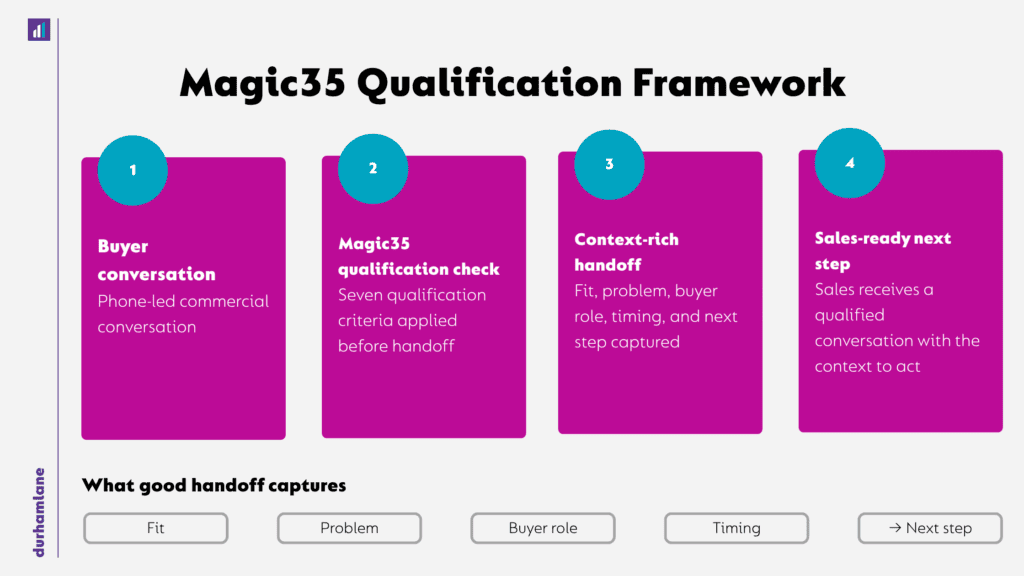
For durhamlane, this is why the Magic35 qualification framework belongs in sales-process discussions. The useful point is not that every company should copy one scoring model. Sales-ready opportunity creation needs qualification discipline strong enough to separate activity from viable commercial conversations.
Sales-ready handoff and where the process often succeeds or fails
The handoff from marketing to SDR, SDR to AE, or sales to customer success is where process quality becomes visible.
A weak handoff passes the next task along. A strong handoff gives the next owner the judgement needed to continue the conversation properly.
An SDR-to-AE handoff should say more than “meeting booked”. It should explain why the account matters, what triggered engagement and who the buyer appears to be. The handoff needs the problem discussed and the buyer’s existing level of knowledge. Objections, stakeholder context, timing and agreed next step also matter. With that context, the AE can enter the meeting without making the buyer repeat the same ground.
That context matters because B2B buyers notice when the process resets. If they explain the same problem to marketing, then to an SDR, then to an AE, the process has failed from the buyer’s perspective. The CRM may show clean stage movement. The buyer experiences friction.
A sales-ready handoff should cover the essentials:
- Account fit and priority reason
- Buyer role and likely influence
- Stated or inferred problem
- Evidence of urgency or timing
- Stakeholders mentioned or missing
- Current solution or workaround
- Objections, constraints or risks
- Agreed next step
- Recommended AE angle
- Disqualification risks, if any
This does not require a huge internal document. It requires discipline. The team should know what “sales-ready” means before the meeting is passed.
Inbound lead conversion is a useful example. Many organisations generate inbound demand. The process breaks later, when follow-up is inconsistent, qualification is thin or marketing and sales disagree about the next action. durhamlane’s inbound lead conversion services page frames this as a sales-readiness problem. Marketing demand has to become qualified opportunity through disciplined follow-up and SDR qualification.
The same logic applies to outbound. Call, email and meeting volume only show that the outbound team is active. The better test is whether those activities create conversations that sales can actually progress.
| RELATED LISTEN Why Siemens Healthineers Is Rethinking Demand Generation  In this Inside the Funnel episode, Rosanne Darrow and Richard Lane discuss: How a volume-led demand model can overload sales; Why SDRs can act as a qualification layer between marketing and sales, and How stronger nurturing and handoff help turn interest into commercial opportunity. |
Where B2B sales processes break
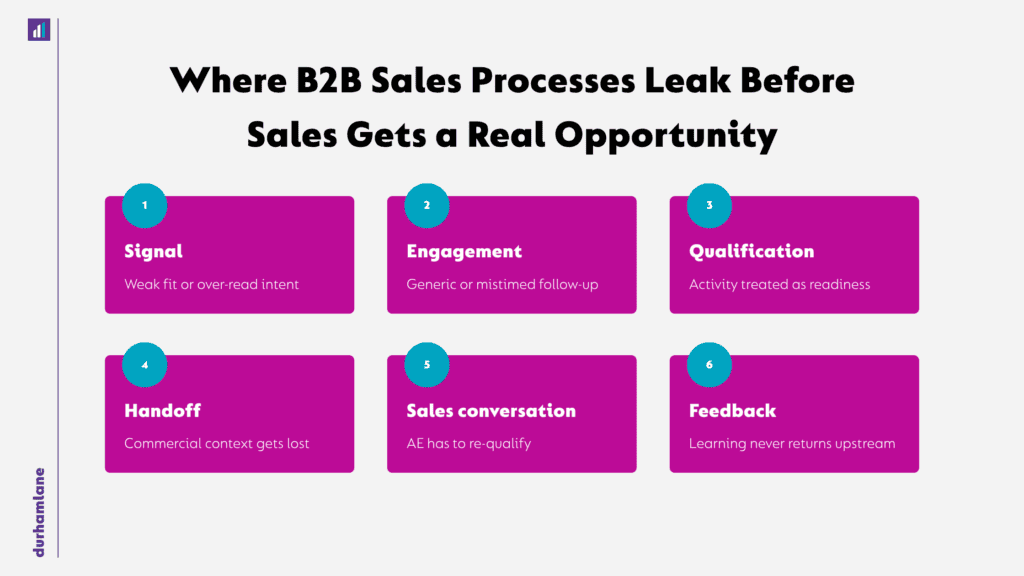
B2B sales processes tend to fail in predictable places.
The first failure is stage governance. A CRM may include stages labelled “qualified”, “discovery” and “proposal”. Without agreed entry and exit criteria, movement becomes subjective. One team’s qualified account becomes another team’s weak lead.
Marketing signals create another weak point. Content downloads, event attendance, page visits and email engagement can all be useful. They give the team a reason to investigate. They do not prove confirmed buying intent or sales readiness.
SDR measurement can distort the process as well. When booked meetings matter more than accepted, progressed or context-rich conversations, SDRs will optimise for the handoff point. The meeting looks successful, even if sales cannot move it forward.
Feedback is another common gap. AEs may reject leads without recording the reason. Sales says the leads are poor. Marketing says sales is not following up. Both may be partly right. Without a feedback loop, the process turns disagreement into blame instead of learning.
Tools create a different kind of failure when they start to act like the strategy. A CRM, sales engagement platform, enrichment tool, intent source or AI assistant can support the workflow. They can make weak process easier to see. They do not decide what a good account looks like. They do not repair vague qualification, weak messaging, poor coaching or handoffs that leave sales guessing.
Timing also matters. A buyer who has just shown high-intent behaviour should not receive the same generic sequence as a cold prospect. An event lead, referral, website enquiry and target-account outbound prospect may each need different follow-up logic.
The process also weakens when post-sale feedback never returns to the front end. Closed-won and closed-lost learning should sharpen ICP, messaging, qualification and handoff. If that learning stays with AEs or customer success, the process cannot improve.
A structured diagnostic can help here. durhamlane’s Sales Audit & Diagnostic page focuses on identifying where sales processes, pipeline and resources are underperforming. That is the right starting point for process improvement. Inspect the operating system before assuming the answer is more leads, more software or more headcount.
How to improve a B2B sales process without rebuilding everything
Improving a B2B sales process does not always mean rebuilding the CRM, adopting a new sales methodology or launching a major transformation project. The most useful changes are often narrower. They sit in the places where judgement, handoff and follow-up are currently too weak.
A good starting point is recent stage movement. Review a sample of leads or accounts that moved forward, stalled, were rejected by sales or disappeared after first engagement. For each one, look at the evidence available at the moment of movement. Did the team understand fit, problem, role, urgency, stakeholder context and next step? Or did the account move because a task had been completed?
Stage entry and exit criteria should then be tightened. The aim is not more bureaucracy. The aim is more honest progression. An interesting lead still needs proof. Qualification should happen only when the account meets the agreed evidence threshold.
Handoff quality needs the same scrutiny. Review recent SDR-to-AE handoffs and ask whether the AE could run a better first conversation because of the information provided. If the AE has to start again, the handoff is not sales-ready.
MQL definitions should also be compared with sales acceptance. Marketing may be passing leads because they engaged. Sales may need fit, role, timing and problem clarity before accepting them. That gap means the process is misaligned. The MQL definition has to change.
Follow-up rules are another useful place to look. Inbound enquiries, event leads, demo requests, target-account engagement and outbound replies should not all receive the same treatment. High-intent signals may need fast human response. Early signals may need nurture or research. Weak-fit accounts should be disqualified quickly.
The feedback loop is what keeps the process improving. Lost reasons, sales rejection reasons and no-show patterns should return to marketing, SDRs, RevOps and leadership. So should disqualification trends and closed-won learning. The process gets sharper when the business learns from what happens after the handoff.
A practical improvement sequence might look like this.
- Review a sample of recent stage movements.
- Identify where evidence was missing.
- Tighten qualification and handoff criteria.
- Repair MQL and SQL definitions.
- Adjust follow-up by channel and signal type.
- Update playbook guidance.
- Review acceptance, progression and disqualification patterns monthly.
This is where B2B sales process best practices should be treated carefully. There is no universal “best” B2B sales process. The right process depends on the buyer, sales motion, deal complexity, resources and commercial goals. The discipline is consistent across models. Movement should be evidence-led, ownership should be clear and feedback should be visible.
When outsourced SDR support fits into the B2B sales process
Outsourced SDR support fits when the front end of the B2B sales process matters, but the internal team cannot run it with enough consistency.
That problem can show up in several ways. Marketing may be creating demand, while inbound follow-up stays slow or uneven. Salespeople may be spending too much time chasing leads that were never properly qualified. Outbound may be active, but the conversations may lack depth. A company may be entering a new market and need better account intelligence before sales invests time. Internal SDR hiring, training, and management may also be lagging behind growth plans.
The warning sign is a request for “more calls” without a clearer process behind them. More activity can make a weak process fail faster.
Outsourced SDR support is most useful when the business needs a stronger operating layer at the front end of sales. That starts with account research and contact identification. It continues through phone-led outreach, supported by email, LinkedIn, events or inbound follow-up where relevant. Qualification then has to test the account against agreed commercial criteria. The final output is documented context and a clean handoff into sales.
durhamlane’s outsourced SDR teams support B2B companies that need proactive engagement to turn into qualified opportunities. Outbound activity has to earn its place in the process. The test is whether it creates conversations sales can actually progress. The emphasis is on account intelligence, phone-led conversation, qualification discipline and sales-ready handoff.
For businesses focused on net-new markets or complex acquisition motions, durhamlane’s customer acquisition services are also relevant. They connect SDR capacity with account targeting, decision-maker engagement and sales-ready opportunity creation.
The important boundary is clear. Outsourced SDR teams do not remove the need for a process. They need one. The ICP, messaging, qualification criteria, handoff rules, feedback loops and sales ownership still have to be clear.
A good outsourced SDR model strengthens the process at the point where many B2B companies leak effort. It adds capacity, execution rhythm, qualification discipline and structured learning to the front end of the workflow.
Conclusion
A B2B sales process is not a polished diagram. Its job is to turn sales and marketing activity into qualified commercial movement.
The practical test is whether each stage creates, tests and transfers evidence. The team should know why an account is moving forward. The next owner should understand the buyer’s problem, fit, urgency, stakeholder context and agreed next step. Tools should support that judgement, while feedback from sales should improve what happens earlier in the process.
When those things are missing, the process may still record activity. The real commercial work leaks out between stages.
For many B2B companies, the leakage happens near the front of the process. Outsourced SDR support can strengthen that front-end layer. It brings more discipline to account intelligence, follow-up, qualification and sales-ready handoff. That is what helps early movement become a real opportunity.
durhamlane supports that layer with outsourced SDR teams built around qualified conversations, clearer handoff and stronger front-end execution.
Is weak follow-up, inconsistent qualification, unclear handoff or limited SDR capacity holding back your sales process? durhamlane can help strengthen the path from first signal to sales-ready conversation.
Let’s talk about where your process is breaking and what it would take to fix it.
Frequently asked questions
What is a B2B sales process?
A B2B sales process is the repeatable workflow a business uses to move target accounts or leads from first signal or outreach towards a qualified sales opportunity. It covers qualification, sales conversation, opportunity creation, proposal, decision and feedback. A useful process also defines ownership, evidence, timing, tools, channels and handoff.
What are the typical B2B sales process steps?
Typical B2B sales process steps include targeting, prospecting or demand capture, first engagement, qualification and discovery. Later stages usually include opportunity creation, proposal or solution alignment, decision, close, handoff and post-sale feedback. The exact order should reflect the market, buyer journey, sales motion and deal complexity.
What is the difference between a B2B sales process and a sales funnel?
A sales funnel shows movement from broad demand to narrower opportunity and revenue stages. A B2B sales process explains the work behind that movement. The funnel shows where accounts appear to be. The process defines what has to happen, who owns it and what evidence justifies progression.
Why do B2B sales processes fail?
B2B sales processes fail when stages are vague, qualification is weak and tools record activity without enough evidence. They also fail when MQL and SQL definitions are misaligned, follow-up is inconsistent or handoffs lack commercial context. Sales feedback should improve targeting, messaging and qualification. Without that loop, the same problems keep returning.
How can you improve a B2B sales process?
Improve a B2B sales process by auditing recent stage movement and tightening entry and exit criteria. Then clarify qualification evidence, repair MQL and SQL definitions, and review where handoffs break down. The aim is better commercial judgement at each stage.
When should a company consider outsourced SDR support?
A company should consider outsourced SDR support when the front end of the sales process is under strain. Common signs include weak follow-up, poor MQL-to-SQL conversion and inconsistent outbound. Limited SDR capacity, thin account intelligence and handoffs that sales cannot progress are also strong indicators. The fit is strongest when SDR support improves qualification and sales-ready opportunity creation.