



Key Takeaways
- Choose the first sales skill from a recurring gap in real buyer conversations. Use confidence as one signal without making it the deciding measure.
- Turn broad areas such as discovery, listening or objection handling into one moment and one action the seller can practise.
- Choose the practice setting for the problem it has to solve, using call review for evidence, human role-play for adaptive pressure, and peer or AI-supported rehearsal for accessible repetition.
- Make feedback useful by pointing to one concrete change for the next attempt and keeping the seller’s personality outside the judgement.
- Use practice volume and scenario scores to track rehearsal. Judge reliability by whether the action holds across relevant buyer conversations.
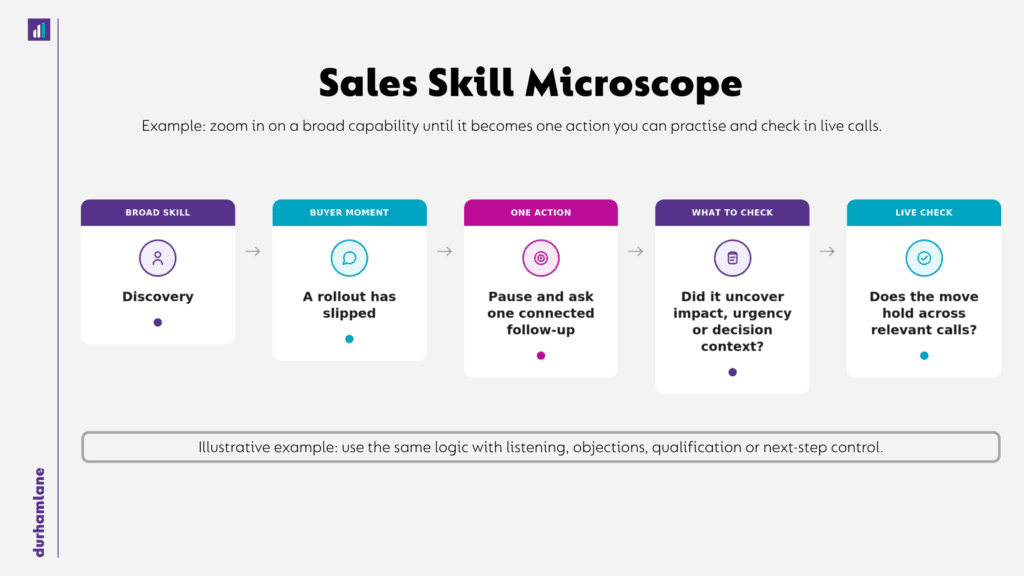
A buyer mentions that a planned rollout has slipped because the last internal change never gained traction. The seller acknowledges the answer, glances at the next question and moves on. Everything still sounds orderly, but the most useful commercial signal has gone unexplored.
That missed signal gives development a sharper starting point than a broad label such as confidence, discovery or communication. Instead of asking the seller to improve a whole category, focus on the next decision. What should happen when the same buyer signal appears again?
What Are Sales Skills?
Sales skills are the behaviours and abilities sellers use to move buyer conversations forward, including account research, listening, questioning, qualification, objection handling and agreeing useful next steps. They are different from product knowledge, sales techniques, training methods, tools and commercial outcomes, even though all of those can shape performance.
The Institute of Sales Professionals makes a similar distinction in its Sales Capability Framework, separating knowledge, skills, behaviours and tools. Each one develops differently. Product knowledge can be studied, a technique demonstrated, and a skill used in the moment.
Many B2B sales techniques are ways of applying a broader skill in a particular moment. Take active listening. The skill is understanding what matters in the buyer’s answer. One technique is to ask a connected follow-up question. Role-play creates a place to rehearse the moment, while a simulation platform can make extra attempts easier to arrange. A qualified opportunity is a later outcome shaped by account fit, timing, discovery, qualification and several other decisions.
A practical target sits close to the seller’s behaviour. “Improve conversion” is too distant to rehearse, while “clarify the business consequence before suggesting a next step” can be practised, heard and reviewed.
Which Sales Skills Should You Develop First?
Sales roles need different combinations of capability. A new SDR opening cold conversations has a different development priority from an account executive coordinating several stakeholders. Industry, sales motion and experience change the answer again.
Use the groups below to locate the area that deserves attention. Then make the target smaller. The first priority should appear often enough to observe, matter enough to change the conversation and remain narrow enough to practise.
| Skill area | What it covers | Example practice target |
| Commercial understanding | Customer context, business problems, value and commercial judgement | Summarise the buyer’s stated problem before introducing a solution |
| Conversation skills | Listening, questioning, clarity, tone and pace | Ask one follow-up tied to the buyer’s previous answer |
| Prospecting and discovery | Research, relevance, problem discovery and account hypotheses | Test one account assumption before moving into a generic discovery question |
| Qualification, objections and next steps | Fit, diagnosis, resistance, decision context and handoff judgement | Clarify what sits behind an objection before responding |
| Product and sales-process knowledge | Product knowledge, market context, CRM discipline, data and tools | Record the commercial reason behind the agreed next step |
| Reflection and resilience | Preparation, adaptation, review and consistency | Review one call without trying to change several things at once |
The mix reflects both the work sellers do and what employers currently expect them to handle. A 2026 analysis of European B2B sales job advertisements highlighted communication and digital application skills among current requirements, which is why both conversation skills and digital fluency appear in the map. The seller’s first priority comes from the recurring gap in their own conversations.
How to Develop a Sales Skill One Behaviour At a Time
Find the moment that needs to change
Confidence can point to discomfort without showing what happened in the conversation. A seller may feel nervous and still ask a strong question. Another may sound assured while missing the buyer’s main concern.
Start with the work. Review a real or recorded call, use a benchmarked role-play, or ask a manager or peer to observe against one clear criterion. Look at the moment before the conversation lost depth or direction. What did the seller do? What did the buyer say next? Which useful information was gained, and which was left untested?
One call can mislead. Check whether the same pattern appears across comparable interactions before choosing it as the priority. In the opening example, the seller’s concern might be confidence. The calls reveal something more precise – the seller moves on before developing a commercially useful answer.
Turn the skill into one action
“Listen better” still leaves too much room for interpretation. Give the seller a clear moment, action and review point.
| Active listening, under the microscope After a substantive question, allow the buyer to finish, identify one commercially relevant phrase and ask a connected follow-up. The moment starts after the buyer’s first answer, and the action is the follow-up. A reviewer listens for whether the next question reflects the buyer’s words or simply returns to the script. |
Short coaching cues are useful because a long checklist is hard to hold in mind while the buyer is speaking. Two of our Sales Mantras turn the standard into language that is easier to carry into the call. Mantra #3: Be Interested to Be Interesting keeps attention on the buyer’s meaning and away from the seller’s next line. Mantra #9: Respectful Silence protects the pause in which the buyer can think and add detail. Together they connect the principle to the move. Stay curious, then leave enough space to hear what matters.
Now the seller knows what to try, and the reviewer knows exactly what to listen for. The same structure works elsewhere. Before responding to an objection, for example, clarify what is really driving it.
Choose The Practice Setting That Solves The Problem
Whole-call practice can be useful, but it can also bury the skill that needs attention. The seller has to manage the opening, questions, notes, objections and close, so the target moment may appear only once.
Build a shorter drill around that moment. Keep the action constant while the buyer’s answer, level of detail or resistance changes. Add complexity after the seller can perform the action in the simpler version.
Set the review criterion before the first repetition. In the listening example, the reviewer isn’t scoring the whole conversation. They’re listening for whether the follow-up uses a phrase from the buyer’s answer. That shared standard keeps practice focused as the scenario becomes more difficult.
Need to see what actually happened? Review a real call against one agreed criterion. A recording provides the material, but the comparison and the next attempt create the learning. Strong examples help new sellers hear the difference between a missed moment and a better response.
Need adaptive pressure? Use human role-play. The other person can change direction, reveal new information or push back in ways a fixed script would miss. Keep the practice goal stable so the seller adapts to the buyer and avoids chasing a moving coaching target.
Need easier access to short repetitions? Use peer practice or automated rehearsal. Peer feedback needs a shared standard. Both people should judge the same agreed action. Automated practice can make repeated scenarios easier to arrange without requiring a manager or partner for every run.
Need to know whether the change holds? Return to a buyer conversation. Practice creates a safer place to work on the move. Real calls show whether the seller can use it when the context is less predictable.
Whatever the setting, design the scenario around the moment the seller needs to practise. A realistic background is useful if it helps the seller encounter that moment, make the decision and try the action again.
How Online Rehearsal Fits
Realistic role-play takes time from a manager, coach or colleague, which can limit how often a seller rehearses the same difficult moment.
Tools such as Hyperbound provide configurable AI buyer simulations based on a product, ideal customer profile and messaging, with scorecards and automated feedback. A seller can repeat a discovery, objection or opening scenario, inspect the response and try again while the moment is still fresh.
Online rehearsal makes extra repetitions easier to arrange between human coaching sessions. Managers still bring account context, role expectations and commercial judgement. The next buyer conversation shows whether the move fits the situation and holds under real pressure.
Use Feedback to Improve The Next Attempt
“Be more consultative” sounds like advice, but it gives the seller little to do differently. Useful feedback returns to the moment. What did the seller say? What did the buyer do next? Which action should change on the next run?
Take objection handling. “Be more confident” offers no workable change. “Before responding, ask one question to establish whether the concern is budget, timing or internal risk” gives the seller something specific to try.
CIPD’s evidence review on performance feedback shows why design matters. Feedback can improve performance or damage it. The most useful feedback keeps attention on the task and points to the next change.
Keep personality out of the judgement. “You didn’t sound confident” is hard to inspect. A timestamp, the seller’s question and the buyer’s response give both people something concrete to discuss. If several issues appear in the same call, sequence them. One clear change creates a cleaner next attempt than a catalogue of everything that went wrong.
Who gives the feedback matters as well. A manager may understand the role standard and account context, while a peer may notice wording or pacing that the seller missed. Either way, the comment should stay tied to the agreed action. Otherwise, feedback can drift into personal style or preference.
How to Know The Skill is Improving
The real test begins when the seller tries the new action in a relevant buyer conversation. Choose a call where the moment is likely to appear, then review what happened afterwards. Did the follow-up reveal clearer impact, urgency, decision context or risk? Did the seller understand the buyer better, even when the call created no immediate next step?
Keep the live test fair. A buyer who gives one-word answers offers a different listening opportunity from someone explaining a complex problem. The seller needs a relevant chance to use the action, and the reviewer needs enough context to judge what happened.
CDC guidance separates learning from learning transfer and recommends delayed follow-up to check whether a skill is used back at work. That distinction is useful in sales development too. A seller can understand the feedback and perform well in practice without using the action consistently with buyers.
practice → buyer conversation → repeated use → later business indicators
A practice result tells you what happened in the exercise. One good call shows that the move was possible once. Several comparable calls give a stronger view of reliability.
Review qualification quality, accepted opportunities and pipeline later and in context. Account fit, buyer timing, market conditions, management and other sales actions shape those outcomes, so treat any pipeline movement as a wider commercial result unless stronger analysis isolates the effect of the micro-skill.
Finish with a development decision. Repeat the same target if the action remains inconsistent. Raise the difficulty or vary the context once it is stable in simple situations. Move to the next skill when the action holds across relevant conversations.
How We Develop Sales Skills at durhamlane
Across the SDRs we train, development works best when it stays close to real conversations. That rhythm starts in onboarding and continues into live account delivery. Phone-led buyer conversations give managers concrete call moments to review. We use those moments to isolate a weak opener, a missed follow-up, an under-diagnosed objection or an unclear handoff, then rehearse that moment before the next call.
The learning cycle continues after the conversation. Qualification decisions, CRM notes and handoff context show whether the SDR understood enough for sales to continue with useful context. Repeated gaps become coaching themes the team can address together.
We use technology to support research, role-play, call review and data quality. SDRs remain responsible for relevance, listening and qualification judgement, while managers bring account context, role expectations and the standard the team is working towards.
For us, training stays inside execution. The sales playbook has to stay useful when SDRs are on calls, managers are coaching live behaviour and the sales team is reviewing qualification and handoff quality. Calls that create qualified opportunities also create coaching material, and the next account gives the SDR a chance to apply what changed.
Recommended Watch
AI Transforming Sales Training
In this short video, Jake Spence, our Managing Director, explains how we use AI role-play, including Hyperbound, to give SDRs repeatable buyer scenarios before live calls.
He shows how extra rehearsal works alongside manager coaching and the judgement an SDR still needs in a real buyer conversation.
Start With The Next Conversation
Sales skills become easier to develop once the target is small enough to hear. Start with a recent conversation and find one moment that matters. Define the action and choose a practice setting that gives the seller the right challenge. Then use feedback to improve the next attempt and look for the move again in real buyer conversations.
The aim is to make a useful action more reliable when the buyer, account and commercial context are real.
Where you need more SDR capacity or a more consistent coaching rhythm, explore our Outbound Sales Development teams. To discuss the right operating model for your team, talk with us.