


Key Takeaways
- Diagnose the performance gap before buying training. The same quota, conversion or qualification problem can arise from capability, management, data or workflow constraints.
- Define one observable behaviour for a specific role, buyer and sales motion before selecting content.
- Compare programmes through practice, feedback, manager preparation, live-work transfer and total cost.
- Treat managers as part of the intervention. Coaching quality and calibration matter more than frequency alone.
- Measure learning and live behaviour before attributing pipeline or revenue outcomes. AI belongs in bounded support tasks around preparation, practice and evidence handling.
A respected course, methodology or workshop can create energy, shared language and immediate learning. Those outcomes still leave the harder question of whether sellers will behave differently in live buyer conversations.
Many B2B sales training decisions begin with a visible performance problem and move too quickly to a programme. The team misses quota, discovery feels inconsistent or qualification standards drift, so leaders search for a course that promises improvement. The visible symptom doesn’t identify the constraint. Territory design, management, data, incentives, proposition, workflow and buyer access all shape the same commercial result.
Effective training begins before delivery and continues into the sales environment that follows. Leaders need to isolate a trainable capability, define the behaviour that should change, choose a programme fitted to the people and sales motion, and create the conditions for that behaviour to appear in real situations. Evidence also needs to reach live selling before revenue or ROI claims become credible.
What is B2B Sales Training?
B2B sales training develops defined knowledge, skills and behaviours for commercial work between organisations. Its scope spans prospecting, discovery, qualification, value communication, negotiation, account development and sales management. A useful definition separates training from the adjacent systems that help people perform.
Onboarding prepares someone for a role, company, market and operating environment. Product education develops solution knowledge. Coaching helps an individual apply and improve a capability over time. Sales enablement provides the wider content, process, data, technology and cross-functional support around the sales organisation. Salesforce’s 2026 revenue-enablement guide groups training with coaching, tools and data across the wider enablement system.
These distinctions sharpen the procurement decision. A course has a narrower job than CRM adoption, territory design, account intelligence and manager development. Leaders make a better choice when each intervention has a clear purpose.
The same distinction helps individual learners as well. A course is suited to foundational knowledge. Team calibration, manager observation and organisation-wide adoption require a wider programme in which several people apply common standards across different accounts and situations.
Start With The Performance Problem. Is Training The Right Intervention?
Training is appropriate when a defined knowledge, skill or judgement gap is materially limiting performance and the organisation has the conditions to support its use. A commercial symptom starts the investigation. The diagnosis requires evidence of a capability gap.
Begin by describing the problem precisely. “The team needs better discovery” is too broad. In a stronger diagnosis, enterprise account executives move into solution discussion before establishing the buying group’s operational problem, decision criteria and commercial consequence. That description gives leaders something observable to investigate.
CIPD’s 2025 learning-needs guidance treats learning-needs analysis as an ongoing process tied to current and future capability and business priorities, distinct from a one-off training-needs exercise. It recommends combining performance data with observations, interviews and stakeholder evidence, then checking whether formal learning is the appropriate response. Three questions turn that guidance into a practical sales diagnosis:
- Knowledge: Do people know what good performance looks like?
- Capability: Can they execute it in the required situation?
- Opportunity: Do the role, workflow, tools and management give them a realistic chance to do so?
Management quality, account allocation, territory potential, incentives, process, content, data, pricing, proposition and market conditions enable or block the same behaviour. Gartner’s seller-performance report adds a systems warning. Technology layered onto weak data, inconsistent workflows and outdated performance models increases complexity and leaves the performance system unrepaired.
Three teams can show the same weak conversion rate and require different responses.
- One lacks a clear proposition.
- Another has strong messaging alongside poor opportunity qualification.
- A third knows the required approach and still struggles because managers reward activity volume and review deals without developing judgement.
Training fits only part of that picture.
Repair structural constraints where they dominate. Training becomes a credible response when a capability gap remains and leaders state what a seller or manager should do differently. That diagnosis supplies the baseline for evaluation. Otherwise, leaders measure post-training activity without knowing whether the original constraint moved.
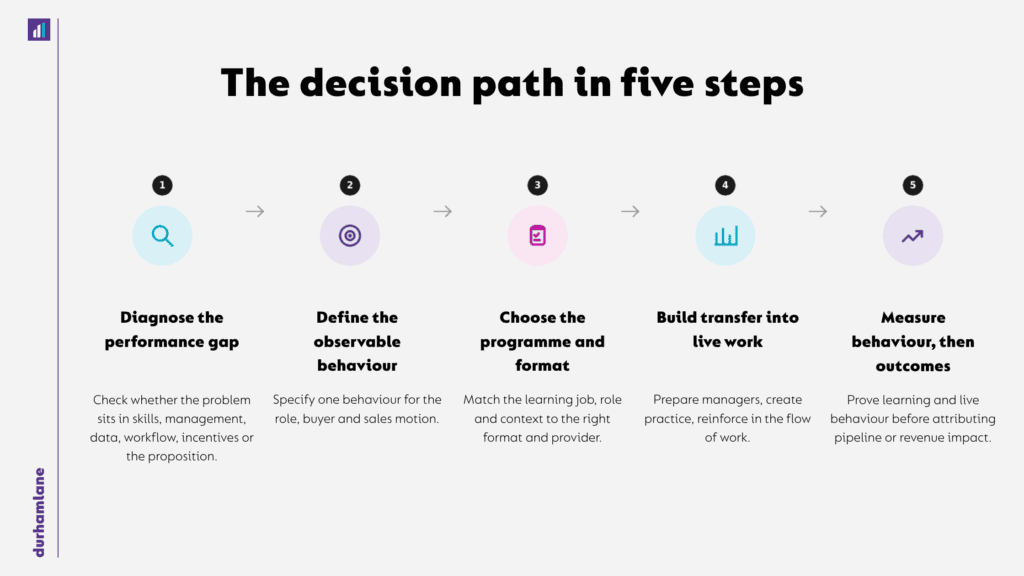
A B2B sales training decision begins with diagnosis and reaches commercial outcomes through live behaviour.
What Should a B2B Sales Training Programme Change?
Programme selection starts with a behavioural target and a defined cohort. Leaders can choose content more confidently when they know who should do what differently, in which commercial situation and with what evidence.
Choose the behaviour before the content
A credible training objective describes an observable action in context. Broad themes such as consultative selling, sharper objection handling or stronger discovery can frame a curriculum. Managers still need one observable action in a defined commercial situation.
Qualification shows the difference. A broad aim such as “improve qualification” needs to become a usable action. Before accepting an opportunity, SDRs establish the business problem, relevant stakeholder, current impact and agreed next step, then record the evidence required for a sales-ready handoff. The target defines the behaviour. The deal outcome remains open.
LinkedIn and Ipsos research identifies validation, credibility, attentiveness and respect as visible trust-related behaviours in B2B buying. That changes what training has to specify. A programme needs to prepare sellers to validate decisions, establish credibility, notice buyer context and adapt their approach. The programme should define how those behaviours appear in conversation.
Fit the programme to the role, buyer and sales motion
The same programme will produce different value across roles and cohorts. An SDR preparing for phone-led prospecting needs different depth, practice and evidence from an enterprise account executive managing a buying group or a manager coaching several roles.
Programme fit should account for current mastery, tenure, product complexity, deal length, buying-group structure, geography, manager capacity and access to relevant work. 6sense’s 2025 buyer research describes experienced buying groups that complete substantial selection work before seller contact. In that environment, validation, contextual judgement and credible commercial conversation carry more value. In a transactional motion, rapid pattern recognition and disciplined execution carry more weight. Complex-account work demands deeper stakeholder understanding and adaptation.
Shared standards matter. Personalisation changes examples, sequencing, practice difficulty and support without dissolving the common language needed for qualification, coaching and handoff. Most teams need a common behavioural core with role-specific routes. The same qualification principles remain common while SDRs, account executives and managers practise different decisions and evidence standards.
How to Choose The Right B2B Sales Training Programme
Programme selection involves two connected decisions. Leaders need a format that suits the learning job and a credible explanation of how the intervention should lead to behaviour change. The choice becomes clearer when every component has a stated purpose, owner and evidence requirement.
Match the format to the learning job
The best delivery format depends on the learning job. Each option creates a different combination of access, interaction, practice, feedback and connection to live work. Forrester’s 2025 sales-learning guidance treats timing, delivery method and frontline-manager involvement as connected design choices. Selection should follow the practice, feedback and application the learner needs before, during and after delivery.
Sales training formats at a glance
| Format | Best suited to | What it needs to work |
| Self-paced online course | Foundational knowledge, terminology and accessible refreshers | Clear relevance, short modules, applied assignments and manager review |
| Live virtual cohort | Facilitated learning across distributed teams | Skilled facilitation, manageable cohorts, small-group practice and between-session work |
| In-person workshop | Intensive practice, shared focus and team alignment | Current-account exercises, follow-through and a defined post-session plan |
| Methodology programme | Common language and decision rules across the sales process | Adaptation to role and buyer context, live-opportunity use and manager reinforcement |
| Manager-led coaching | Contextual application and continued development | Manager skill, protected time, shared evidence, calibration and next-attempt feedback |
| Role-play or simulation | Rehearsal for difficult or infrequent situations | Realistic scenarios, rubrics, human review and comparison with later live behaviour |
| Structured sales academy | Sequenced development across a role or career stage | Readiness gates, field assignments, mentoring and manager checkpoints |
| Blended programme tied to live work | Combining knowledge, practice, application and review | Clear ownership, integrated learning, practice in live deals, reinforcement and measurement |
Most teams will combine formats. Each component should perform a distinct job within one coherent route from foundational knowledge to practice, field application and review.
Free courses support foundational learning or individual exploration. Certification records completion or performance within a stated assessment. Live-work evidence answers a separate question about whether the behaviour appeared in real selling situations.
Test the programme’s theory of change
A provider should be able to explain how its programme is expected to change behaviour. Forrester’s 2025 review of sales-training services highlights flexibility, reinforcement, buyer focus and AI-supported personalisation among leading offerings. Those features show how a programme intends to reach different sellers and continue beyond delivery. Selection depends just as much on the evidence a provider will make available in the client’s context.
Ask:
- How the performance problem will be diagnosed
- How the programme will adapt to roles and buyers
- What practice and feedback are included
- How managers will be prepared, and
- How learning will connect to real work
- Then ask the provider to show evidence for participation, learning and behavioural outcomes.
Good due diligence follows the intervention beyond delivery.
Ask:
- Who will update examples as the proposition changes
- How new hires enter the programme
- What happens when managers disagree about the standard, and
- How participants who struggle will receive additional support
These questions become operational as soon as the programme enters live work.
Pricing needs the same scrutiny. Compare the commercial model and what the quote includes. Per-seat course access, a live cohort and a customised team programme carry different cost structures. Check facilitation, cohort size, diagnostics, content adaptation, licensing or certification, platform access, scenario design, manager sessions, reinforcement, measurement, travel, implementation and programme administration. Internal costs matter too, especially seller time and manager capacity. A cheaper fee creates a higher total cost when the organisation has to build the missing transfer system itself.
What Makes Sales Training Hold Up in Real Work?
Transfer into live commercial behaviour is the central mechanism. Learning and practice scores show what happened under training conditions. A transfer claim begins when the target behaviour appears in relevant work.
Build practice and opportunity into the work
Transfer depends on practice, opportunity and support reaching the same behaviour in real work. A workshop can create useful learning and alignment in a day. Sustained behaviour depends on what happens around the event and in the work that follows.
A 2025 Social Sciences & Humanities systematic review of 31 workplace e-learning studies found no common transfer methodology, and self-reports were the most frequent measure. Define the live-work criterion, observer and evidence source before delivery, then compare field behaviour with the original baseline.
Practice should resemble the decisions sellers make in the field, while live performance supplies the transfer evidence. The behaviour has to show up in current accounts, calls and handoffs. Managers need enough visibility to observe it, and workflow, tools, data and incentives have to support the action being trained.
A transfer plan identifies where the behaviour will be practised, when live opportunities should arise, who will observe it, what evidence will be collected and how difficulty will increase. The sequence includes rehearsal, field application, review and another attempt, with each cycle responding to new evidence.
Infrequent situations need a separate route into practice. Simulation provides protected practice for a difficult executive conversation, objection or qualification judgement. Managers should still compare the simulated performance with later behaviour in real accounts.
Design feedback, observation and refresh
Reinforcement should connect evidence of the target behaviour to focused feedback and a clear next attempt. Frequency alone is a weak design principle.
A 2025 systematic review in Journal of Organizational Behavior found the field fragmented by competing definitions and insufficient attention to feedback valence. Positive feedback showed the most consistent performance benefit. Negative feedback depended on moderating conditions or a high-quality supervisor–employee relationship. Effective review needs to specify the behaviour, evidence, valence, source and next attempt. Treating every comment as equivalent weakens the feedback system.
Observation needs calibration. Call scorecards, manager notes and workflow data improve visibility. Metrics can reward surface compliance, particularly in complex conversations where timing, buyer context and commercial judgement shape quality. Qualitative review keeps the score connected to the work.
Refresh should answer a changing need. Revisit a behaviour when buyer objections change, a proposition evolves, evidence shows inconsistent application or AI alters part of the workflow. Universal forgetting percentages and fixed 30-, 60- or 90-day claims create false precision.
What Leaders And Managers Need to Do
Leadership owns the operating conditions around training. The programme supports capability development. Managers and senior leaders determine whether people have clear standards, practice opportunities, time, evidence and credible support.
Prepare managers before the programme starts
Manager readiness has to be designed before delivery because managers carry the programme into live work. Leaders should agree the performance problem, target behaviour, eligible cohort, observation criteria and responsibilities for application. Managers also require enough coaching skill to support development without turning every conversation into a forecast review.
MySalesCoach’s 2026 survey found that 34% of sales-leader respondents had received training or support to become more effective coaches.
*The report describes a global sample of hundreds without an exact sample total or sampling method, so the percentage should be read as a signal from the respondent group.
Manager preparation belongs inside the programme design:
- Prepare managers on the programme’s language, behavioural criteria and feedback approach.
- Protect time for observation and development.
- Resolve conflicts between the expected behaviour and incentives, workflow or management routines.
A seller-facing programme depends on managers being prepared to sustain it.
Calibration matters as well. Two managers hearing the same call sometimes reward different behaviours. Short calibration sessions using shared evidence make those differences visible and help managers align the standard. Leadership then gains a better view of where adjustment is needed across the programme, management layer and surrounding system.
Keep coaching separate from deal inspection
Deal inspection manages the opportunity. Developmental coaching builds the seller’s future capacity to handle relevant situations. Both activities serve a purpose, and each answers a different question.
A forecast conversation asks what is happening, what the next step is and where the deal could fail. Coaching examines the seller’s reasoning and behaviour, then supports improvement that transfers to other opportunities. A 2025 Journal of Personal Selling & Sales Management study of 350 US B2B sales professionals found that managerial willingness to admit mistakes, express uncertainty and seek critique was associated with stronger coachability through the coaching relationship, feedback coping and openness to learning. The same behaviour also had a direct negative association with learning effort. Coaching quality therefore depends on relational conditions and trade-offs that session frequency can’t capture.
A recurring coaching slot doesn’t guarantee useful coaching. Leaders need to know who will coach the target behaviour well and how the organisation will develop that capability. In our guide to why sales coaching isn’t working, I separate coaching from deal management, call for a shared definition of the behaviour being developed, and connect manager development with deliberate peer learning and leading indicators. Those conditions make coaching part of the transfer system, not a diary commitment.
Where AI Fits in B2B Sales Training
AI expands capacity across a capability programme when each use has a defined learning job. The strongest opportunities sit in preparation, protected practice, review and administration.
Where AI expands practice and review capacity
AI supports scenario generation and adaptation, low-stakes rehearsal, transcript review against a rubric, first-pass feedback, pattern detection and programme administration. Gong’s coaching-workflow documentation shows how call capture, timestamped comments, scorecards, AI-assisted review and a coaching inbox give managers more evidence to inspect. These workflows improve visibility. Later calls, accounts and handoffs show whether the behaviour changed.
AI operates inside the surrounding data, workflow and management system. Sales training needs the same discipline. Define the task, evidence standard, review process and point at which judgement returns to a manager or seller.
Scale increases access to practice. A 2025 quasi-experimental SSRN working paper involving almost 2,000 salespeople found no significant average treatment effect from AI role-play, alongside positive effects for some subgroups. Assign AI practice to a defined cohort, then compare simulation performance with later field behaviour.
Data quality and governance belong in the design. AI feedback inherits the quality of the transcript, rubric and examples supplied to it. Teams should define who has access to call data, how recommendations are checked and which judgements require a manager or coach before the tool becomes part of regular development.
What leaders, managers and sellers need to own
Leaders, managers and sellers own the decisions that require context, judgement and accountability. That includes diagnosing the performance problem, setting priorities, assessing feedback quality, handling high-stakes developmental conversations and interacting with buyers.
AI identifies patterns in the data supplied to it. Sellers and managers interpret hesitation, shifts in influence, strategic comments and account context, then decide how to respond. An automated recommendation can conflict with the sales motion, the relationship or the capability being developed.
In my Human vs Machine article, I divide work by task:
- AI contributes speed, scale, data analysis and consistency.
- People notice nuance, ask the next question, build trust and remain accountable for the buyer relationship.
Applied to training, technology should accelerate preparation, rehearsal and review while the programme strengthens the judgement used in live conversations.
How to Measure Whether Sales Training Worked
Evaluation should begin with the original performance problem and target behaviour. As evidence moves from participation to commercial outcomes, the burden of interpretation rises.
Look for evidence of learning and live behaviour
Measure participation, learning and transfer separately. Completion and relevance feedback help assess delivery. A credible assessment supports a conclusion that someone learned the knowledge or demonstrated a skill under defined conditions. Live behaviour requires evidence from the work itself.
Relevant evidence includes observed calls, qualification records, workflow data, account plans and manager review. The criterion needs to match the behaviour set before training. A generic call score or self-reported confidence measure provides weaker evidence.
Baseline quality determines what leaders learn later. Leaders should establish how often the behaviour occurred before the programme, which cohort is being observed and which evidence standard will be used afterwards. A small, well-defined set of behaviours is usually more useful than a large dashboard with weak links to the original problem.
Interpret commercial outcomes, confounds and ROI
Commercial outcomes carry more weight when leaders connect them to the expected behavioural mechanism and examine other plausible causes. Market conditions, territory, account mix, pricing, proposition, managers, process, tools, data and incentives all change the interpretation of results.
A 2026 Journal of Workplace Learning systematic scoping review of 45 studies covering 24,096 participants found that training-transfer evaluation tools are heterogeneous and fragmented. Some instruments measured transfer outcomes, while others measured the conditions that enable or obstruct transfer. Evaluation needs separate measures for the behaviour and the environment around it.
A 2025 Journal of Management meta-analysis of 159 studies found a small positive association between organisational training and performance, with results varying by training dimensions, outcome type, measurement timing, industry, firm age and region. A tiered evidence model keeps learning, transfer and commercial attribution as separate questions.
Evidence levels and what they can and can’t show
| Evidence level | What to collect and what it tells you | What it does not establish |
| Participation and reaction | Attendance, completion and relevance feedback show reach, delivery quality and initial response | Learning, transfer or commercial impact |
| Learning | Assessment, demonstration or structured simulation show performance under defined conditions | Use in live buyer situations |
| Live behaviour | Call evidence, workflow records, manager observation and handoff quality show the target action in relevant work | That training alone caused the change |
| Commercial outcomes | Qualified-opportunity quality, conversion, sales-cycle and revenue measures show movement in the expected direction | Training’s contribution without a credible comparison and confound review |
| ROI | Incremental value compared with programme and internal costs supports an economic estimate when attribution assumptions are defensible | A universal return or causality from before-and-after revenue alone |
Commercial attribution requires credible comparisons, appropriate timing, stable definitions and transparent assumptions. Clean control groups are often impractical, so phased rollouts, matched cohorts, repeated baselines and comparisons with teams outside the intervention can improve interpretation.
A post-training revenue increase indicates movement in the desired direction. An ROI estimate needs attributable incremental value and total programme cost.
How We Develop Sales Capability at durhamlane
Treat sales capability as an operating responsibility. Training has to connect with the work people are expected to perform, the standards managers reinforce and the evidence available from real commercial conversations.
Role relevance comes first. New SDRs need the confidence and readiness to enter buyer conversations with a clear purpose. Experienced people still need deliberate development as markets, buyers and tools change. The programme should stay close enough to real work that those changes become new practice, coaching and review priorities.
Shared language helps teams apply judgement consistently. Two of our Sales Mantras are especially relevant here. #Be Interested to Be Interesting keeps attention on the buyer and the quality of the conversation. #Estimate Then Validate; Never Assume turns curiosity into a practical discipline. Together, they give teams shared language for curiosity and validation. Coaching and field evidence show how well those principles are used.
Within our Outbound Sales Development framework, trained SDRs operate inside manager-led teams. Account intelligence, phone-led outreach, qualification, sales-ready handoff and feedback loops connect development to execution. AI supports research, rehearsal, data quality and review. Human judgement remains central to the conversation and the commercial decision.
In practice, this brings development close to the conversation. Teams rehearse an opening, review the evidence from a call, test an assumption about an account and agree on the next behaviour to practise. Managers use that work to connect individual development with the standards required for qualified opportunities and reliable handoff.
That operating context changes the test for training. The useful evidence is the behaviour in use, the quality of manager development and the organisation’s response to what happens next.
Conclusion
A credible B2B sales training investment starts with a defined performance problem. Leaders then isolate a trainable capability, describe the behaviour required, fit the programme to the role and buyer environment, and create the conditions that support transfer into live work.
Format, coaching and AI each have a place once their jobs are clear. Evidence should move from delivery and learning towards live behaviour before commercial outcomes are interpreted. That sequence protects the organisation from buying an impressive event that never reaches the customer conversation.
At durhamlane, we build manager-led SDR teams in which learning, account intelligence, qualification and live execution reinforce one another. Get in touch to discuss the capability and operating model your team needs.
Get in touch
FAQ
How long should B2B sales training last?
Duration should follow the capability being developed and the opportunities available to practise it. A short workshop works for introducing a shared method or aligning a team. Sustained behavioural change depends on practice, live application, observation and review over a longer period. Ask what each phase is designed to achieve and when evidence from real work will be available. Programme length alone is a weak quality signal.
How often should coaching follow sales training?
Use coaching when managers have relevant evidence and the seller has another opportunity to apply the behaviour. A regular cadence supports consistency when each conversation is grounded in a specific call, opportunity or observed attempt. Its value depends on coaching quality. Each conversation should identify the target behaviour, examine credible evidence, explain the consequence and agree the next attempt. The right rhythm depends on opportunity flow, role complexity, manager capacity and how quickly new evidence appears.