

Key Takeaways
- Use outsourcing to solve a defined capacity, capability or market-entry problem. Keep commercial ownership and internal follow-up with the client.
- Agree the ICP, qualification evidence, meeting acceptance rules and sales-ready handoff before outreach scales.
- Treat the SLA as the operating constitution for roles, inputs, decisions, reporting, escalation, change and repair.
- A shared CRM creates visibility only when both teams share the same definitions and rules for field ownership and exceptions.
- Separate activity, quality, acceptance, progression, pipeline and realised revenue. A clear scorecard shows where drift begins and which part of the system needs repair.
The Real Work Starts at The Boundary Between Two Teams
Sales team outsourcing adds capacity, specialist execution and a management layer without requiring a company to build the full function internally. It also creates a new organisational boundary. Decisions, data and buyer feedback now cross between two businesses, and the quality of that boundary shapes the quality of the programme.
A 2026 Salesforce-hosted guide uses sales outsourcing as an umbrella term covering support from lead generation and customer acquisition through full-cycle selling. In complex B2B, the more useful question is narrower. Which part of the sales motion should an external team lead, what must the client continue to own, and how will both sides work from the same commercial evidence?
The strongest model behaves as one commercial system. The provider turns agreed scope into market execution, the client retains final commercial authority, and both sides use the same evidence to improve targeting, messaging, qualification and handoff.
What Sales Team Outsourcing Should Look Like in Complex B2B
Sales team outsourcing in complex B2B is an integrated, manager-led sales-development capability operating inside the client’s commercial system. Within the agreed scope, the external team leads account research, phone-led outreach, multichannel follow-up, early qualification and the preparation of sales-ready opportunities. The client retains commercial strategy, product truth, pricing, closing and internal follow-up.
Scope follows the problem. Market entry usually centres the work on research, outreach and early qualification. A proven motion often needs more capacity across selected accounts. A missing front-end function calls for a complete sales-development team with management, coaching, data and reporting.
That boundary determines the viability of the arrangement. The partner needs enough context and authority to execute well. The client needs enough visibility and retained capability to make decisions, support the team and act on what the market is saying.
Phone-led outreach sits at the centre of the motion. Email, social touches, account research and data support the work, while people remain responsible for judgement, relevance and buyer interaction.
Start With Fit, Scope And Ownership
Before execution begins, the client needs to define the problem and the responsibilities that remain inside the business.
1. Define the commercial problem and test readiness
Start by naming the commercial problem, such as capacity, access to specialist capability, entry into a new market, inconsistent execution or the absence of a managed SDR function. Then test the client’s ability to retain strategy, product truth, opportunity acceptance, internal follow-up and closing.
That diagnosis determines the engagement. External capacity helps a company execute a defined motion and exposes gaps in the offer, account strategy or internal follow-up. When nobody inside the business can explain why a segment matters, answer product questions or act on a qualified opportunity, the partner receives ambiguity and the buyer experiences it.
Cost follows the operating scope. The comparison needs to include market coverage, management, tooling, integration work and the responsibilities retained by the client. An internal SDR base salary and an outsourced-team fee describe different systems. A like-for-like assessment of sales outsourcing pricing and costs needs the full cost and responsibility picture.
Use the same operating questions when comparing providers. A credible partner should be able to explain how it will operate inside the client’s qualification, CRM, coaching, reporting and governance rules. Those answers are more revealing than a promise of meeting volume and give a sharper basis for choosing a sales outsourcing partner.
2. Fix retained ownership and decision rights
Outsourcing changes who performs the work. Commercial ownership has to sit with a named role.
Use the map to separate final authority, joint interpretation and day-to-day delivery. Every shared row should point to a named decision owner.
Decision-rights map for who decides, who shapes and who executes
| Responsibility | Client holds final authority | Jointly governed | Provider leads delivery |
| Strategy and offer truth | Growth priorities, positioning, pricing, claims and closing model | Convert strategy into campaign rules | Execute within scope and flag knowledge gaps |
| ICP and account priorities | Approve segments, exclusions and strategic accounts | Refine rules from market evidence | Research accounts and surface patterns |
| Messaging and change control | Protect brand and commercial boundaries | Select tests and approve revisions | Run outreach and capture buyer response |
| Outreach execution | Set channel and brand constraints | Agree coverage and quality expectations | Manage phone-led and multichannel activity |
| Qualification and acceptance | Define the sales-ready standard | Calibrate examples and resolve disputes | Qualify, document and prepare the handoff |
| CRM and data | Own the system of record and access policy | Define fields, workflows and exceptions | Log activity and maintain records |
| Handoff and follow-up | Own AE action, progression and closing | Run the acceptance, rejection and feedback loop | Provide context, verbal handover and meeting support |
| Coaching and quality | Supply product and commercial feedback | Calibrate standards and recurring gaps | Lead call review, coaching and improvement |
| Governance, change and exit | Sponsor the programme and hold final authority | Review evidence, change scope and agree repair | Report, recommend action and execute the agreed plan |
Use this as a starting allocation. The client holds final commercial authority, interpretation and change are governed jointly, and the provider leads agreed execution. Adjust individual responsibilities to the sales motion, product complexity and engagement scope.
The pattern is deliberately asymmetric. The provider can lead execution without owning the commercial standard used to judge that execution. Shared work covers interpretation and adaptation, while final authority over strategy, acceptance and internal action stays with the client.
The final decision owner has a practical job. Without one, messaging changes stall across meetings, disputed opportunities sit untouched and activity drifts toward the provider’s visible targets while the client is judging a different commercial outcome.
Align The Commercial Definitions Before Activity Scales
Targeting and handoff fail when the two teams use different criteria for relevance and readiness.
3. Agree ICP and account priorities
Agree a working ICP before outreach scales. That means target accounts, buying roles, exclusions, priority signals and the route for changing them. Speed alone can drag the team into the wrong market.
That means moving beyond a broad sector label. The working ICP should cover the commercial characteristics that make an account relevant, the people likely to experience the problem, the evidence that raises or lowers priority, and the situations that disqualify an account. Strategic accounts need a separate route when their research, access and internal ownership differ.
The ICP shouldn’t freeze at launch. An outsourced team will hear objections, discover role differences and see where account assumptions break down. The programme needs a controlled route for turning those observations into revised priorities.
Material changes remain client-owned. The provider brings evidence, explains the pattern and proposes what to test next.
4. Define qualification, meeting acceptance and sales-ready handoff
A booked meeting records an event. A sales-ready handoff carries enough evidence for the internal seller to continue a commercial conversation.
Both teams should agree what that evidence includes. Common elements are account fit, the buyer’s role, the commercial context, the reason for the conversation, attendance expectations, relevant notes and the next action. The internal team also needs a clear way to accept the handoff, reject it with a reason, or return it for further qualification.
If the engagement is measured only by booked meetings, the evidence needed for a commercial handoff disappears. Appointment setting and sales development diverge at exactly this point. Sales development carries context, qualification and a route into the next commercial action.
Definitional drift is common even inside one company. In a 2025 Gartner survey of 243 CSOs and senior sales leaders, 49% said sales’ definition of a qualified lead differed greatly from marketing’s. The finding diagnoses a hidden operating problem. The same label can conceal different thresholds for fit and readiness. The label itself can’t create alignment. In an outsourced programme, “qualified” has to be translated into observable rules for account fit, buyer role, problem evidence, meeting readiness, acceptance and rejection.
Rejection data matters as much as acceptance. Repeated reasons such as weak fit, wrong role, limited context or missed follow-up show where the system needs attention.
Build One Operating System Across Both Teams
Execution is easier to govern once roles, messages, data and change routes sit inside one working system.
5. Create an operating SLA and governance model
An operating SLA gives the relationship a working system for roles, inputs, definitions, reporting, escalation, change and repair.
Activity commitments sit inside that system. The agreement also has to settle the practical questions that decide day-to-day control:
- Who approves a new segment?
- Who resolves a disputed opportunity?
- How are message changes introduced?
- Which issue triggers a recovery plan?
- What returns to the client when the engagement ends?
GovS 008, the UK Government’s 2026 commercial standard, sets out management mechanics such as traceable accountabilities, proportionate measures, regular review, risk and issue logs, corrective action, controlled change and transition planning. In an outsourced sales programme, those mechanics establish who decides, who accepts, how evidence is reviewed and how drift is repaired.
Those mechanics form the structural half of governance. The relational half appears when priorities shift, a handoff is disputed or performance falls. WorldCC’s 2026 relational governance guide centres collaboration, accountability and the management of tension in long-term customer-supplier relationships. Together, the two approaches turn the SLA into a working constitution for decisions made under pressure.
Recommended watch
In my conversation with Gabe Larsen, then VP of Marketing at InsideSales.com and host of the Sales Secrets podcast, we explored what changes when an external team becomes part of a client’s sales operation. We discussed why the programme has to be designed together, how the partner learns the client’s culture and talk track, and why a company with a strong internal SDR system sometimes has no reason to outsource.
That conversation makes integration a design decision made before launch. The client needs clear ownership, access to the right people and a way to turn market evidence into controlled changes.
6. Govern messaging as a learning loop
A message library is a starting hypothesis. Real conversations reveal where it holds, where it creates confusion and where the market sees the problem differently.
The team should capture recurring objections, unexpected buyer language, missing proof and changes in account context. Those signals then need a route into decision-making. The provider identifies a pattern and proposes a test. The client protects brand claims and product truth. Both sides agree what changes, which accounts receive the test and how the result will be reviewed.
Buyer relevance gives the learning loop a commercial purpose. In a 2025 Gartner survey of 632 B2B buyers, 73% said they actively avoided suppliers that sent irrelevant outreach, while 69% reported inconsistencies between website and seller information. Those are two different failures:
- The first concerns targeting and relevance
- The second concerns message governance across channels
Buyers still preferred seller input when deciding if an offering fitted their organisation, so an external team needs the same current product truth as the internal team and one route for approved changes.
Call review makes the loop observable. Gong Labs’ 2025 analysis of 326,000 sales calls found that high performers were more consistent and generated more buyer interaction, while calls on lost deals included more questions on average. That pattern shifts coaching away from a universal ratio and toward buyer participation, relevance and repeatable behaviour.
7. Integrate CRM, data, permissions and tooling
A shared operating model needs one source of truth. Decide where account records live, who can create or edit them, which activities must be captured, how ownership changes and who resolves sync or data-quality errors.
Set those rules before technology is selected.
Alignment can look stronger in the boardroom than it does in the operating system. KPMG’s 2025 survey of 286 US TMT leaders found that 72% believed their front-office work was mostly aligned, yet 51% reported data silos that blocked a unified customer view. Lack of sales-process discipline was the leading challenge to maintaining and using accurate customer data. A client and provider risk the same mistake, agreeing strategically while operating through conflicting records and workflows.
Handoff is where the visibility problem shows up first. LeanData and LXA’s 2026 survey of 201 enterprise B2B leaders found that 29% had no visibility after the marketing-to-sales handoff and 42% cited qualification alignment as a significant gap. An outsourced team adds another handoff, so the CRM design has to make ownership, acceptance and downstream feedback visible.
Once those decisions are made, integration automates routine capture and reconciliation. Salesloft’s CRM Sync for Salesforce supports call and email logging, bidirectional synchronisation of Leads, Contacts, Accounts and Opportunities, automation rules, sync logs and field-priority controls. Administrators remain responsible for deciding which system wins when records conflict and who resolves the exception.
Permissions should follow the work. Reps need enough access to research, contact and document accounts. The client retains control of sensitive information, field ownership and approval rules.
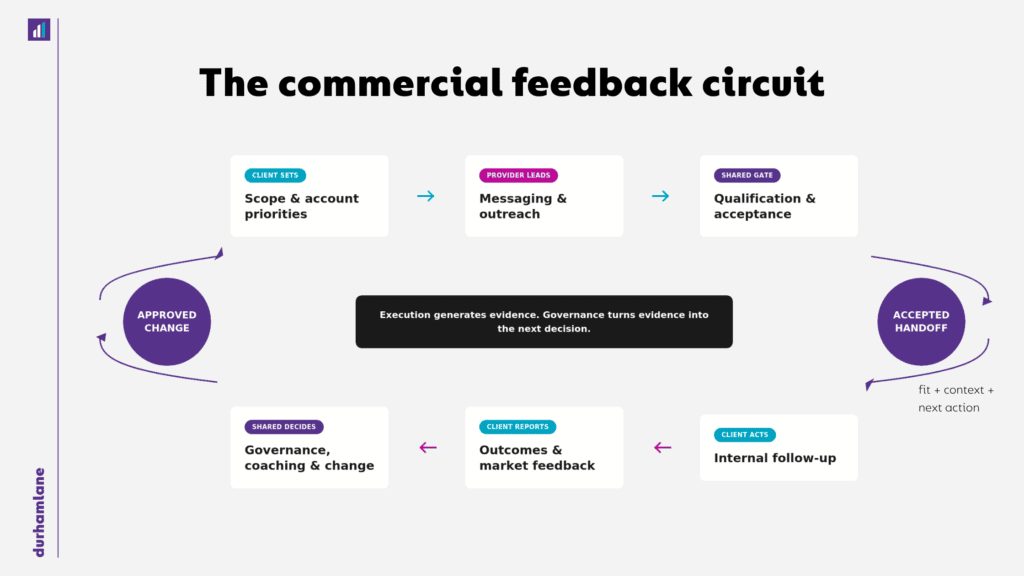
A well-governed outsourced sales programme runs as a closed feedback circuit. Provider-led execution creates market evidence, and shared governance turns that evidence into controlled changes for the next cycle.
Manage The External Team As One Commercial Function
After launch, quality depends on continued integration, observation and repair.
8. Onboard the team into the wider commercial system
Onboarding establishes the initial operating baseline. Continuing integration keeps the external team aligned as product, market and client priorities change.
The external team needs access to the people and context that keep the motion current. That access may include sales leaders, account executives, marketing, product experts and customer-facing teams, depending on how the motion is structured. Product changes, new proof, lost deals and shifts in account priority all affect the conversation.
A strong onboarding process establishes the initial proposition, market, buyer roles, qualification rules, messaging, systems and working cadence. After launch, the team needs recurring access to knowledge. Expert sessions, call reviews, account feedback and shared planning prevent the team from operating on an old version of the business.
Launch timing follows operational readiness. The team is ready for live outreach when access, data, messaging, qualification rules, CRM workflows and handoff owners work in practice.
Use capability as the completion test. The team should be able to explain the offer accurately, recognise relevant accounts, use the agreed systems and hand over an opportunity with enough context for sales.
Initial sales outsourcing onboarding should leave the team able to use the proposition, qualification rules, systems and working rhythm in live conversations. Recurring access to knowledge, account evidence and feedback keeps that capability current.
9. Manage quality through coaching and call review
Pipeline review tells a manager where opportunities are moving. Call review shows how the team is creating, qualifying and handing them over. Each asks a different management question.
A manager reviews calls to assess how well the rep understands the account, asks commercially useful questions, listens to the answer, handles resistance accurately and applies the agreed qualification standard. Coaching then gives the rep feedback, practice and reinforcement. The same review also reveals broader system issues, such as a weak proof point, unclear ICP rule or handoff field that nobody uses.
The same evidence should inform message governance and client feedback. The right response to a repeated objection depends on the cause. It may require coaching, a revised message, more product context or a change in targeting. Treating every issue as a rep problem wastes the learning.
Conversation technology gives managers a searchable record of calls, transcripts and recurring patterns. The manager remains responsible for interpretation and development. Dashboards earn their place when they help diagnose behaviour, decide what to coach and show if the change held in later conversations.
10. Separate the metrics and agree how to repair drift
A credible scorecard keeps different stages of the commercial process separate:
- Activity confirms that the planned work happened.
- Conversation and qualification quality show the relevance of the engagement.
- Meeting acceptance records the internal team’s response to the handoff.
- Progression records subsequent movement, and pipeline records potential commercial value.
- Realised revenue arrives later and depends on work beyond the external team’s scope.
- ROI sits at the end of that chain and should be calculated from the programme’s full cost and realised, attributable outcomes over an agreed period.
Collapsing those stages hides the source of a problem. High activity with weak acceptance points toward targeting, messaging or qualification. Strong acceptance with limited progression points toward internal follow-up, opportunity quality or a wider offer issue. Good conversations with poor data capture understate the programme’s contribution and block useful diagnosis.
In the 2026 State of the BDR from 6sense and MarketOne, outreach volume nearly doubled while average self-reported quota attainment remained statistically unchanged. Among 872 respondents, most working in technology or services, only 36% reported completing the full handoff sequence of qualification, notes, booking and attendance. The evidence separates workload from transfer quality. More activity doesn’t tell the client if the right commercial context reached sales.
The SLA should define the repair route. Start by locating the stage where drift appears. Review evidence from calls, CRM records and downstream feedback. Then correct the relevant part of the system, whether that means data, targeting, message, coaching, scope or internal ownership. Escalation, scope change and exit should already have named owners.
From Market Signal to Sales-Ready Handoff at durhamlane
At durhamlane, the first call is the first visible result of several joint decisions. We work with the client to define the market, account priorities, proposition, qualification standard and the point at which an opportunity is ready for the internal sales team. Product truth, commercial strategy and closing ownership remain visible throughout the programme.
That design becomes a phone-led operating rhythm. Our SDRs combine account research with other channels to create a relevant reason to speak. They then use our Selling at a Higher Level approach and Magic 35 qualification framework to assess the opportunity across seven core criteria. The framework gives both teams a shared picture of the buyer’s situation, commercial fit and next-step readiness before anything is handed over.
The management layer turns those conversations into improvement. Managers review live call evidence, coach the rep, calibrate qualification and bring recurring objections or market signals back to the client. AI supports research, role-play, preparation and data quality behind the scenes. Buyer interaction, interpretation and coaching remain human responsibilities.
The handoff completes the circuit. Salesloft activity flows into the client’s CRM so both teams see the account history and agreed next action. When an opportunity is ready, we provide a verbal handover, support the initial meeting and keep the SDR close enough to learn what happened. Acceptance, rejection and progression feedback then return to targeting, messaging and coaching.
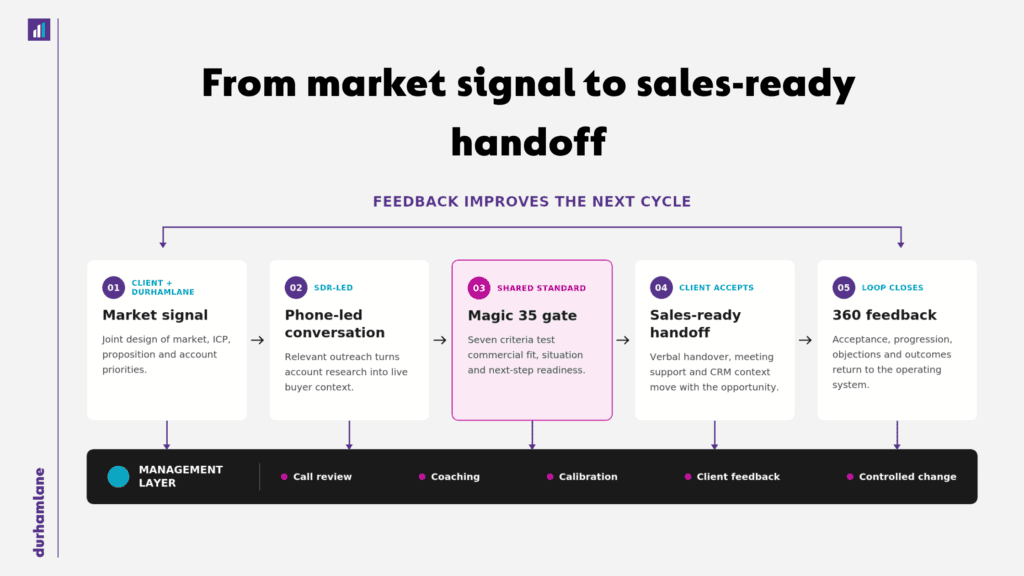
The durhamlane operating spine links joint market design, phone-led conversations, Magic 35 qualification, sales-ready handoff and 360 feedback. Management and systems keep the evidence connected across every stage.
That closed loop is the operating idea behind our outsourced sales development teams. Market signal becomes a commercial conversation, the conversation becomes a sales-ready handoff, and downstream evidence improves the next cycle.
The Operating Model is The Real Outsourcing Decision
The real outsourcing decision is the operating system that will sit between the two teams.
A strong partner adds capacity, management, market insight and disciplined execution. The client still needs to own the commercial choices that shape the work and the internal actions that turn a handoff into revenue. Both sides need shared definitions, connected systems, visible evidence and a practical route for changing course.
Those conditions reinforce one another:
- Clear ownership gives qualification a decision-maker.
- Shared definitions give the CRM meaningful data.
- Call review gives messaging a learning route.
- Separated metrics show whether the issue sits in activity, quality, handoff, progression or the internal sales response.
Build the operating model before activity scales. That is how an external team becomes a genuine extension of the commercial system.
If you’re weighing up SDR outsourcing, the operating model matters more than the pitch. Book a call to see how durhamlane’s outbound sales development teams handle ownership, qualification and handoff from day one.