


Key Takeaways
- Diagnose the constraint before you outsource sales calls. That diagnosis should point to bounded call execution, a managed SDR capability, or an in-house or hybrid repair.
- A calls-only scope fits when target accounts, data, messaging, qualification, CRM handling and internal follow-up already work.
- Outsourcing changes the internal workload. Strategy, product truth, compliance, opportunity acceptance and downstream sales action still need named owners.
- Expand the scope when excluded work blocks results. Repair it when the scope is right and governance, data or handoff has broken down. Reduce or end it when the need or contribution changes.
- Compare the same scope and the same outcome clock. A launch date, an SDR ramp benchmark and time to realised revenue describe different events.
When the business wants more sales conversations, the service specification has to identify the gap. It may be phone capacity, a wider sales-development capability or a commercial motion that is still being learned.
Choosing well begins with two questions:
- What work is missing?
- What work is the business ready to own?
The answers determine the route, the risk and the outcome clock used to prove value.
That diagnosis has a commercial consequence. A narrow purchase may execute well and still create little business value when internal teams lack the capacity to act on the evidence it returns. At the wrong time, a broader capability can also add unnecessary dependency to an internal system that already works. The purchase should cover the missing operating component and leave the rest deliberately owned.
Start by Diagnosing Why You Need More Calls
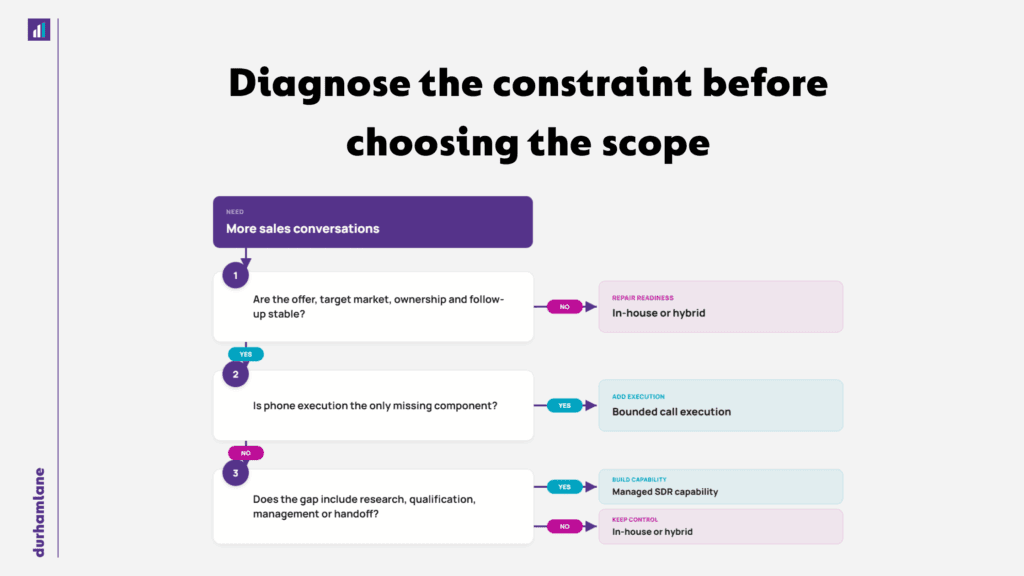
Before you outsource sales calls, identify the real constraint. Three distinct problems can produce the same quiet top of funnel.
An execution-capacity gap exists when the surrounding outbound system is stable. The business knows which accounts matter, has usable contact data, has tested the message and applies qualification consistently. Internal sellers are ready to act, so disciplined phone execution is the missing component.
A capability gap is wider because work around the call is also missing. Research and prioritisation shape who the team approaches. Multichannel engagement and qualification shape the conversation. Management, coaching and data stewardship then make the sales handoff usable. Treating this as a dialling shortage leaves the client responsible for an operating system it lacks the people or management depth to run.
A readiness or ownership gap sits upstream or downstream of execution. The offer is changing. Account selection still relies on assumptions that haven’t survived buyer conversations. Internal teams disagree about qualification, or nobody owns rapid follow-up. Extra activity exposes those weaknesses faster and puts more pressure on an unstable process.
Test the whole chain:
- Who owns account selection?
- Who approves message changes?
- What turns a conversation into an accepted handoff?
- How quickly does sales act?
Any missing answer changes the service required and the fair measure of provider performance.
The first mismatch appears when a business buys call volume before the surrounding strategy is clear. A quiet top of funnel makes activity look like the fastest intervention, while the harder decisions remain unresolved. Which market deserves attention, what do buyers need to hear and how should sales respond to the conversation?
Define the required output as part of the diagnosis. Completed calls, accepted meetings and sales-ready opportunities are different outcomes. A buyer that needs call coverage has a narrower problem than one that needs account intelligence, structured qualification and a dependable route into sales.
The performance pattern adds another clue.
- Strong conversion from substantive conversations to accepted handoffs, paired with low overall activity, points to an execution-capacity gap.
- Adequate activity with inconsistent qualification or handoff points to a capability and management gap.
- Repeated uncertainty about the offer, account fit or next step shows that the motion is still being learned.
- Healthy accepted handoffs alongside a stalled pipeline shift the diagnosis further down the sales process.
The commercial evidence separates these cases even though each one presents as a shortage of calls.
Three Routes And The Readiness Test For Each
The route matches the work that is missing and the work the buyer already controls. The UK Government’s 2026 Sourcing Playbook frames delivery as a make, buy or mixed-model decision, with individual service components assessed separately. For outsourced sales calls, the missing component comes before the supplier label.
Salesforce’s March 2026 guide uses sales outsourcing broadly enough to cover part or all of a sales operation. HubSpot’s SDR glossary defines the role around research, outreach, qualification and handoff. Together, those definitions show why a narrow calling purchase and a managed SDR capability need to be compared through the work around the call.
1. Outsource sales-call execution when the surrounding system is already controlled
Choose bounded call execution when phone capacity is the missing operating component and the buyer already controls the surrounding system. The provider performs agreed outreach against defined accounts and message boundaries, records outcomes accurately and returns agreed next-step information for internal action.
The scope is clearest when the buyer states the call objective, the message boundaries and the information required from a substantive conversation. That makes execution observable without confusing call volume with opportunity quality.
Readiness extends beyond a contact list. The buyer needs to set account priorities, maintain usable data and keep the value proposition current. It also needs to define qualification and CRM disposition, make the compliance decisions, and assign both handoff and downstream follow-up. The provider refines execution through live feedback without taking ownership of commercial strategy.
The buyer retains targeting, message approval and quality standards. Coaching direction, opportunity acceptance and the sales response also remain internal. This route adds capacity while preserving those responsibilities. Fragility appears if the buyer expects research, qualification, management or handoff repair from a scope that excludes them.
A calls-only engagement still needs a defined feedback path. The people who control targeting and messaging need to receive the evidence from objections, unreachable segments and weak account data. Without that feedback, the provider completes the activity and the next wave repeats the same avoidable problems.
Quality review also needs a named client owner. The provider surfaces patterns and improves delivery, while market, proposition and qualification decisions stay with the business. When nobody has authority to act on the learning, the programme reports the same problems and leaves them unresolved.
2. Use a manager-led SDR capability when the gap is wider than calling
Choose a manager-led SDR capability when the gap includes the operating work that turns phone activity into qualified commercial conversations. Account research and multichannel engagement shape the outreach. The same system also manages qualification, coaching, data and handoff.
This model fits when internal leaders set commercial direction and lack the day-to-day management layer. The provider builds repeatable execution around the agreed thesis and makes the resulting market evidence visible to the client.
The client supplies commercial direction and product truth, while risk decisions, opportunity acceptance, internal follow-up and closing remain with the business. Those inputs allow the external management layer to direct daily execution, develop SDRs, review call quality and carry market evidence back into targeting and messaging decisions.
Completed calls are an activity measure. The required output is an accepted meeting with useful context or a sales-ready opportunity supported by shared qualification and account intelligence. Integration with sales, marketing, product and revenue operations makes that possible. A wider scope also creates greater dependency, so system visibility, knowledge and decision rights need active governance across both teams.
Call review, coaching and message iteration sit close to execution. That shortens the distance between what buyers say and what the team does next. Strategic changes still need client approval. Provider fit therefore shows up in operating behaviour as well as output, through management quality, response to evidence, call-quality transparency and handoff reliability.
3. Keep the motion in-house or hybrid when readiness or existing capability points there
Keep the motion in-house, or use a narrow hybrid supplement, while the commercial foundations are still being learned or when internal capability already solves the problem.
Early buyer conversations often shape the offer, target market and message. At this stage, that learning carries greater value when it stays close to product and sales leaders. The same applies when ownership is unclear or internal sellers don’t follow up consistently. Bringing in external execution too early adds coordination before the business has defined what good execution should produce.
Specialised or fast-changing offers also strengthen the in-house case when each early conversation teaches the company something about product, market or positioning. A later external scope becomes easier to define after that learning has become a stable operating model.
In-house ownership also suits a mature operation with sufficient capacity, strong management, reliable data, disciplined follow-up and a working improvement loop. Hybrid support adds temporary capacity for a segment, territory or campaign while internal leaders preserve direct control of learning and qualification. Reconsider the route when evidence reveals a stable call-capacity shortage or a wider capability gap the internal team lacks capacity to absorb.
How long does it take to outsource sales calls?
Proposals often use phrases such as “launch in two to four weeks” or “30/60/90-day ramp plan”. Before comparing them, identify the event that starts the clock and the event being timed.
A credible proposal also shows the assumptions behind the operational clock. Data approval, message approval, system access, team preparation and compliance readiness are dependencies that shape elapsed time. Comparing dates without those assumptions rewards the shortest promise over the strongest plan.
Treat the launch date as an operational milestone. Data is loaded, messaging is approved, the team is prepared and live calling is under way. Accepted meetings, qualified opportunities, pipeline and realised revenue sit on later clocks. A 30/60/90-day plan is most useful as a review cadence for inputs, conversations and early conversion.
A calls-only programme reaches live execution with fewer integration steps when targeting, data, messaging, qualification, CRM disposition and follow-up are already in place. Managed SDR delivery mobilises research, systems, coaching and handoff alongside calling. The wider scope takes more coordination because it’s building more of the operating capability.
The Bridge Group’s 2025 survey of 351 B2B companies reported an average internal SDR ramp of 3.0 months, from a sample that was 78% North American and 83% B2B SaaS. That figure belongs to an internal-SDR productivity clock. Provider mobilisation, first accepted meeting and time to pipeline are different milestones. For a buyer, the benchmark provides context for internal SDR productivity, while the commercial milestones keep their own clocks.
Compare providers on the same clock. Ask what starts it, what outcome stops it, which service scope is included, which client inputs must already work and who owns the dependencies after the call. Report readiness, live calling, first accepted meeting, first qualified opportunity and downstream pipeline as separate milestones.
Make ownership visible at each stage. Readiness delays often sit with the client, live execution with the provider, and accepted opportunities or pipeline with both teams. A single blended time-to-value number hides that distribution.
Compare the three routes for outbound sales development
A useful comparison brings scope, retained ownership, proof and change triggers into the same view.
| Decision factor | Bounded call execution | Managed SDR capability | In-house or hybrid |
| Use when | Stable system where phone capacity is the constraint. | Research, engagement, qualification, management and handoff are missing. | Foundations are still forming, or internal capability already works. |
| External scope | Calling, disposition and conversation evidence. | Research, multichannel outreach, coaching, qualification and handoff. | Selective external capacity by segment, territory or campaign. |
| Buyer retains | Targeting, messaging, qualification, compliance and follow-up. | Product truth, commercial direction, acceptance and closing. | Design, management, learning, systems and downstream action. |
| Proof | Reliable execution and usable call evidence. | Accepted handoffs with qualification and account context. | Direct learning or restored capacity. |
| Change trigger | Excluded work blocks the outcome. | Integration cost exceeds contribution, or capability moves in-house. | A stable capacity or broader capability gap emerges. |
How Scope Changes The Benefits, Drawbacks And Risks
The wider the scope, the more operating work moves with the call. This adds capability and reduces day-to-day client execution. It also increases the need for shared systems, clear decision rights and a reliable route for learning.
Scope decides how much work moves to the provider and how much dependency the client accepts. A narrower scope keeps more work and control inside the business. A broader scope moves more daily execution and learning to the provider, so both teams have to operate through shared data, reviews and decision rights.
What moves with the call
Bounded call execution adds phone capacity against a system the client already controls. Targeting, messaging, qualification, compliance, acceptance and follow-up stay inside the business. The provider’s value is disciplined execution and evidence from live conversations.
A managed SDR capability carries more of the operating layer. Research and multichannel engagement shape outreach, while coaching, data, qualification and handoff connect execution to sales. Its value lies in turning buyer responses into changes in targeting, messaging and rep behaviour, keeping learning close to delivery.
In-house or hybrid ownership keeps that learning closest to product and sales leaders. It works when the internal system already performs, when commercial foundations are still being learned or when selective external capacity is enough.
Trace the desired outcome back to the work it depends on. A buyer seeking qualified opportunities has a built-in scope gap when research or qualification sits outside the agreement. A buyer that retains follow-up yet responds slowly leaves the downstream delay untouched, even under a broader external model.
Where control and risk sit
The route changes where risk concentrates. Three forms matter most:
- Scope risk: The agreement excludes work that the desired outcome depends on.
- Coordination risk: Approvals, data, handoff or follow-up move too slowly across the boundary.
- Measurement risk: Call activity or booked meetings are treated as proof of commercial value.
Brand and knowledge risk follow the same pattern. A calls-only provider works inside client-defined message boundaries, so weak guidance remains visible in the calls. A managed team helps refine the motion as shared access and knowledge transfer become more important. In-house ownership keeps learning closest to product and sales, and the company has to sustain the management discipline.
Judge each route at the level of output it owns. Reliable execution and usable conversation evidence are the proof points for calls-only. Accepted handoffs with qualification and account context are the proof points for a managed SDR capability. The in-house or hybrid test is whether direct learning or selective capacity is solving the diagnosed problem.
Quality control belongs where the route hands evidence to the next owner:
- For calls-only, that means accurate disposition and usable conversation evidence.
- For a managed SDR capability, it adds qualification context and a sales-ready handoff.
The client then needs a consistent acceptance decision and timely downstream action.
GovS 008, the UK Government’s 2026 commercial standard, keeps contract ownership, risk, performance review and transition with the buying organisation. In sales development, that places client ownership on scope, data, compliance, handoff and change decisions.
ICO guidance for live UK B2B marketing calls requires organisations to screen applicable preference services, identify the caller and provide contact details. Those controls belong in the operating model. The client defines the market and approval rules, and the provider applies them consistently in execution. Other jurisdictions require their own controls.
The flow keeps returning to the same practical distinction between activity and capability.
Recommended listen
Lee Durham and I revisit the lessons that have shaped our approach to outbound. Three connect directly to this decision:
1 → activity needs a strategy,
2 → better questions create better commercial conversations, and
3 → a meeting becomes valuable when it carries the right qualification and context.
The discussion on technology adds the final boundary. AI and tools strengthen preparation and learning, while people retain the live buyer conversation. Together, those lessons show why extra call coverage solves a capacity problem and a managed SDR capability solves a wider operating problem.
When To Expand, Repair, Reduce, Or End The Outsourced Scope
When results are weak or circumstances change, diagnose the cause before changing the contract. Calendar stages provide review points. Evidence from each review determines whether the scope should expand, be repaired, be reduced or end. Widening scope after weak results often moves an unresolved offer or follow-up problem into a larger contract.
- Expand the scope when research, multichannel follow-up, qualification, coaching or handoff work outside the agreement repeatedly blocks the desired outcome. Expansion solves a demonstrated boundary problem and gives the added work a clear owner.
- Repair the model when the scope is right and ownership, data, message governance, CRM use, acceptance rules or feedback have broken down. Fix the failing connection, then observe the performance change before adding more work.
- Reduce the scope when the client has built the capability internally, demand has narrowed or external work no longer adds a distinct contribution. A planned reduction preserves useful knowledge and avoids keeping an engagement in place after its commercial job has changed.
- End the engagement when agreed remedies fail to restore the service, data and knowledge cannot be transferred safely, or coordination cost has overtaken the value created. Account history, call outcomes, message learning, data permissions and unresolved opportunities need a defined destination.
The 2026 Sourcing Playbook also treats transition and data return as part of the delivery model. In sales development, CRM history, account status, scripts, learning and ownership need a defined destination before the scope is reduced or the relationship ends.
Low conversion has several possible origins, including the service, input data, offer, handoff or internal response. Diagnose the failing boundary first, then change the part of the model the evidence identifies. Separate provider execution from client dependencies and buyer response so accountability remains precise across the relationship.
Judge The Model By The Right Outcomes And Whole-Life Cost
A launch date shows when an operational milestone occurred. The date does not show what commercial result followed. Judge the model at the outcome level the business needs, then compare the complete operating system required to produce it.
Measure the level you actually need
Define the programme at the outcome boundary the business needs, such as activity, substantive conversation, accepted meeting, qualified opportunity, pipeline or realised revenue. Each level needs its own denominator, time window and owner.
At each level, define what counts and who accepts it. A substantive conversation needs a consistent threshold. An accepted meeting needs internal sales confirmation. A qualified opportunity needs agreed evidence of fit, need and commercial readiness. These definitions keep the chain auditable while recognising that responsibility shifts across stages.
The handoff rule changes with the required output. A booked meeting and a sales-ready opportunity carry different evidence. A booked meeting confirms availability and interest. A sales-ready opportunity adds fit, context and commercial readiness. That distinction is why appointment setting and sales development need different handoff criteria.
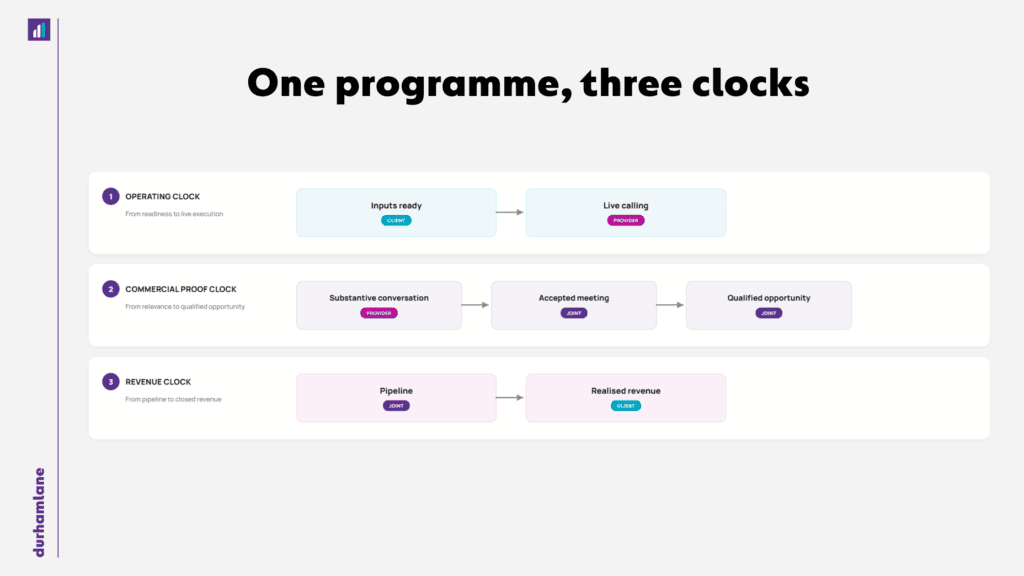
Early stages mainly show provider execution.
Later stages depend increasingly on buyer response, sales-cycle length and internal sales action. Preserve visibility across the chain, and hold each party to the stage it influences.
Use the sequence to locate drift. Strong conversation volume with weak meeting acceptance points to qualification or targeting. Accepted meetings with few opportunities point to handoff quality, sales follow-up or buyer readiness. Pipeline without realised revenue belongs to later sales execution and sales-cycle dynamics.
Compare whole-life cost across the full system
Compare complete systems. GovS 008 defines whole-life cost across direct and indirect costs, including the buyer’s own contract-management work. In sales development, that means counting the people and management required, the data and technology used, mobilisation and governance effort, and the internal follow-up that still remains.
An internal model includes recruitment, management, tools, data and the effort required to maintain the capability.
An outsourced model includes the service, implementation, retained governance, systems work, internal follow-up and transition.
A hybrid comparison needs both sides because selective external support still relies on internal operating capacity.
Use the same comparison period across all routes. Internal recruitment and ramp costs arrive differently from provider mobilisation and retained governance. Transition also carries cost when the relationship changes or ends.
A salary and a provider fee cover part of each system. Launch promises and ROI calculators also become misleading when the routes use different scopes, start events and outcome definitions. Keep the company-specific assumptions visible.
Cost per meeting has meaning inside one defined model. Cross-model comparison requires the unit to match the work purchased. One route may deliver a meeting. Another may deliver qualification, account context and management.
Once scope, retained work and the intended output are fixed, a detailed sales outsourcing pricing model compares complete costs at the same outcome level.
How a Managed SDR Team Turns Calls Into Better Commercial Decisions
A broader capability earns its place when it closes the learning loop around the call. Buyer responses need to change the next account list, the next message, the next qualification decision and the quality of the handoff.
The loop works when call evidence changes management action. Managers use it to coach behaviour and challenge assumptions. Sales and marketing use the same evidence to improve account choices, messaging and acceptance. The phone remains the point of human interaction, while AI accelerates preparation and workflow around it.
At durhamlane, manager-led, phone-led SDR teams work through that loop. Account research and stakeholder mapping guide who the team approaches. Selling at a Higher Level gives live conversations a consultative, question-led structure. Magic35 provides a shared qualification standard before an opportunity is handed to sales. Account intelligence and the feedback loop across SDR, sales and marketing then refine targeting, messaging and opportunity acceptance.
- The client keeps product truth, commercial direction, opportunity acceptance and closing.
- AI supports research, preparation, data quality, role-play and workflow.
- People retain live buyer interaction, coaching and qualification judgement.
That broader model fits a gap that spans capability and learning. If the operating system already works and phone capacity is the missing input, bounded call execution remains the cleaner decision.
Conclusion: Match The Scope To The Constraint
Outsource sales calls when phone execution is the missing component and the surrounding system is ready. Choose a managed SDR capability when the gap also includes research, qualification, management, coaching, data or handoff. Keep the work in-house or hybrid while the offer, target market, ownership or follow-up remains unstable.
Name the work that stays inside the business and the outcome clock that will prove value. The strongest decision matches scope, ownership and evidence from the start.
Planning the right scope for your outbound motion? Get in touch to work through the decision.
Let’s talk about where the sales development motion is breaking and what it would take to fix it.