

Sales process outsourcing means handing specific parts of your sales cycle to an external partner instead of outsourcing the whole function. The best place to start is by identifying where your team is struggling, whether that is prospecting, lead follow-up, qualification or pipeline creation, then deciding which parts an external team can take on without weakening the buyer experience or creating more work for your sellers.
Key takeaways
- Start with the problem in your sales process, then decide what to outsource.
- Different parts of the sales cycle need different levels of human judgement, product knowledge and sales experience.
- AI works well for research, data and repetitive tasks, while complex buyer conversations still need people.
- Outsourcing sales development can give AEs and BDMs more time to focus on discovery, proposals, negotiation and closing.
- Measure success through qualified opportunities, pipeline and revenue, rather than calls, emails or meetings alone.
Sales outsourcing can sound like an all-or-nothing decision. You either build an internal sales team or hand the job to somebody else.
In reality, enterprise and mid-market businesses don’t need to make such a black-and-white choice.
You probably already have great salespeople and customer knowledge. The issues are more likely to sit somewhere within the sales process. For example, AEs might spend too much time prospecting. Marketing may generate leads that nobody follows up properly. Your sales development reps may struggle to engage senior buyers. Or your growth plans may require more pipeline than your existing team can create.
Sales process outsourcing gives you the option to hand over the parts causing the problems, while keeping the areas your team already handles well.
Your challenge is deciding where to draw the line.
What is sales process outsourcing?
Sales process outsourcing means using an external provider to manage one or more stages of your sales process. This includes:
- account and prospect research
- outbound prospecting
- inbound lead conversion
- sales qualification
- appointment setting
- sales development
- customer expansion
- or, in some cases, the whole sales cycle through to close
The key is to be clear about what the external team owns and when your internal team takes over.
If your AEs convert qualified opportunities well but struggle to create enough of them, outsourcing closing would solve the wrong problem. If marketing generates plenty of leads but sales follow-up takes several days, engaging a lead generation service that grows your prospect database will simply create more leads for the team to miss.
Start with the problem first.
Which parts of the sales process can you outsource?
You can outsource almost every stage of the sales cycle, although some parts are easier to hand over than others.
| Sales activity | Suitable for outsourcing? | Human judgement required |
| Account research and data | High | Low to medium |
| Prospecting and outreach | High | Medium to high |
Inbound lead conversion | High | Medium to high |
| Qualification | High | High |
| Low barrier appointment scheduling (demos, simple products, etc.) | High | Low |
| High barrier appointment scheduling (complex product, long sales cycle, etc.) | High | Very high |
| Complex discovery | Sometimes | Very high |
Negotiation and closing | Sometimes | Very high |
| Customer expansion | High | High |
Where you draw the line will depend on your deal size, sales cycle, buying group and the strength of your internal team.
1. Account and prospect identification
Prospect identification is one of the easiest parts of the sales process to outsource.
An experienced external team can profile accounts, understand structure and priorities, identify targets, find the right people, enrich CRM records and help decide which prospects deserve attention first.
AI and sales tech are useful here too. They can process large amounts of information quickly and save sellers from spending hours digging through company websites, LinkedIn profiles and databases.
The important thing is the quality of the output.
A database with 10,000 contacts means nothing if half of them sit outside your Ideal Customer Profile (ICP) or have no influence over the buying decision. What matters is whether your sales team has the right accounts and the right people to contact.
2. Outbound prospecting
Outbound prospecting is one of the clearest areas for sales process outsourcing because it takes time, discipline and consistency.
An outsourced SDR team can handle:
- account prioritisation
- prospect research
- calling
- email outreach
- LinkedIn activity
- follow-up
- early buyer conversations
- objection handling
- qualification
- securing meetings
A multi-channel approach reflects how B2B buyers behave. McKinsey’s B2B Pulse found that buyers use an average of 10 interaction channels during the buying journey.
This works particularly well when your AEs or BDMs are strong closers but spend too much of their week creating their own pipeline.
If a senior seller is responsible for six-figure deals, you need to ask whether several hours of their week should go into finding contacts and chasing first conversations.
In many cases, the answer is no.
An outsourced SDR team can handle that front-end work and give your closers more time to focus on discovery, proposals, negotiation and closing.
For example: When Siemens Healthineers needed additional capacity and specialist expertise to convert prospect engagement into qualified opportunities at scale, they partnered with durhamlane to pilot a hybrid sales and marketing model. In the first 24 months, we accomplished close to ten million dollars in white space markets – a 2559% ROI.
3. Inbound lead conversion
Some businesses don’t need more leads. They need to make better use of the ones they already have.
When a prospect fills in a form, downloads a guide or attends an event, but nobody follows up quickly enough, you lose their attention. Recent B2B research shows how much room there still is to improve lead follow-up. Workato’s 2026 study of 114 B2B companies found that only 31% responded to leads by phone, with an average response time of 14 hours and 29 minutes.
You can outsource this part of the sales process too.
An external sales development team can contact inbound leads, understand why they engaged, qualify them and pass the right opportunities to the right seller.
This also gives marketing useful feedback.
If SDRs repeatedly speak to leads that have little need, no buying intent or poor fit, marketing gets clearer evidence about which campaigns and audiences are producing pipeline and which are simply producing form fills.
Fluke Corporation faced exactly this problem. Its marketing activity generated 100–200 MQLs every month, but the existing team didn’t have enough capacity to qualify all of them. durhamlane took on inbound lead conversion for six months and generated 48 SQLs, twice the agreed target, with an estimated sales pipeline of $18.30 per $1 invested.
4. Sales qualification
You don’t need me to tell you that poor-fit meetings waste your sellers’ time.
Every weak opportunity that reaches an AE takes their efforts away from stronger ones. If that happens often enough, your closing team spends its week running discovery calls with people who were never likely to buy.
Good sales qualification goes further than asking a fixed list of questions.
An SDR needs to understand why the buyer agreed to speak, ask follow-up questions, handle objections and work out whether there is enough need and potential to move the conversation forward.
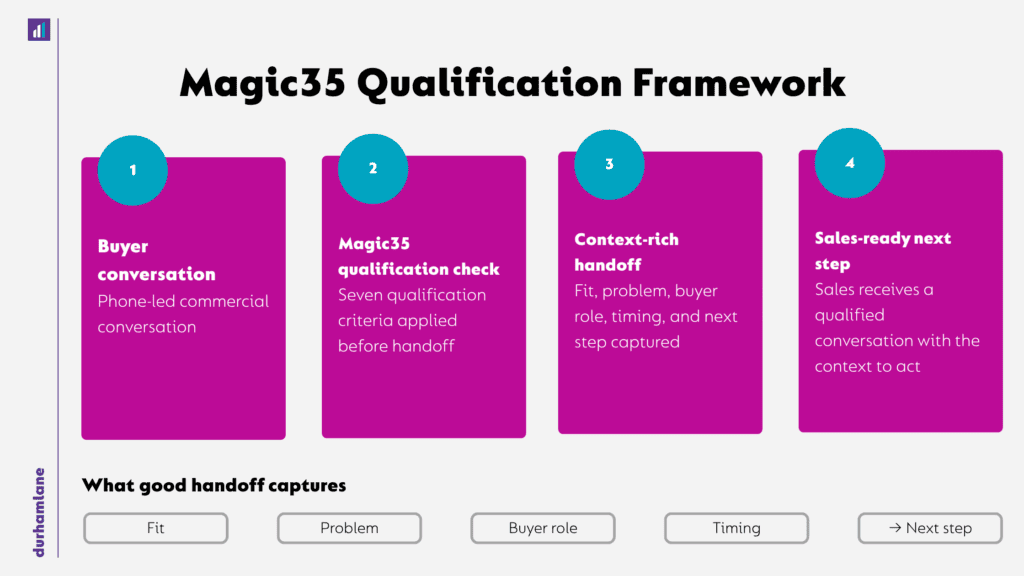
At durhamlane, we combine ‘Selling at a Higher Level’, which is our consultative approach to sales conversations, with our ‘Magic35 qualification framework’ to give SDRs a clear way to qualify opportunities while still allowing them to have a proper sales conversation.
If you operate in a technical or complex market, buyers will not always give you neat answers that fit into a CRM field, so having the skill and framework to discern a true opportunity is vital.
5. Appointment setting
You can outsource appointment setting, although I would separate the act of booking a meeting from the commercial value of the meeting itself.
Scheduling software can put a call into a diary. AI can do the same. An appointment-setting team can generate calendar volume for low-barrier-to-entry products and services, such as demos or simple services.
But what happened before the meeting was booked?
For a straightforward, high-volume proposition, basic appointment setting may provide exactly what the business needs. For enterprise sales, which is far more complex, a booked call with somebody who agreed to “hear more” can create more work and waste everybody’s time if there wasn’t an established need, fit or buying context.
If you outsource appointment setting in any context, agree what qualifies someone for a meeting before the campaign starts.
| RELATED LISTEN Why Siemens Healthineers Is Rethinking Demand Generation  In this Inside the Funnel episode, Rosanne Darrow and Richard Lane discuss: How a volume-led demand model can overload sales; Why SDRs can act as a qualification layer between marketing and sales, and How stronger nurturing and handoff help turn interest into commercial opportunity. |
6. Discovery and opportunity development
As an opportunity progresses, businesses typically default to internal ownership.
Complex discovery can require detailed product knowledge, commercial judgement and an understanding of how your organisation can solve a specific problem. Several stakeholders may join the process, each with different priorities.
That complexity is increasing. Gartner says the average B2B buying group now contains 11 active members, each with their own view and ability to block a decision.
At this point, the seller often needs the authority to discuss solution design, implementation, pricing or commercial trade-offs.
That doesn’t mean businesses can never outsource this part of the sales process.
Experienced sales development reps, like those at durhamlane, are skilled at selling into complex industries and working with internal BDMs to develop opportunities. For us, it’s not a case of ‘sales handoff and now forget about it’.
Full-cycle sales outsourcing also has valid applications, particularly for relatively transactional service contracts or upsell and cross-sell of products, i.e. additional parts for a machine.
7. Closing
You can outsource closing, although you should think about whether it’s actually the part of your process that needs fixing.
Complex B2B deals can involve procurement, legal teams, security reviews, pricing decisions and several senior stakeholders.
Internal sellers often find it easier to manage those stages because they have direct access to the right people inside the business and more authority to make commercial decisions.
If your team already closes good opportunities well, leave that part alone.
Look further up the funnel and ask whether they have enough good opportunities to work on in the first place.
8. Customer expansion
Sales outsourcing can also help you grow existing client accounts.
Account managers often balance service, retention and commercial responsibilities, which means proactive expansion work gets pushed down the list.
An outsourced team can support:
- dormant account reactivation
- stakeholder mapping
- cross-sell and upsell conversations
- identifying new teams or departments
- introducing additional services
- arranging meetings for account owners
Konica Minolta shows how this can work alongside new-business activity. As its relationship with durhamlane expanded, dedicated SDRs began approaching existing Managed Print customers about digital services alongside prospecting into new markets. The wider partnership has now generated 1,459 qualified opportunities and an estimated £60 million in pipeline across multiple business units.
The same rule applies as it does with new business. Be clear about what the outsourced team handles and when the account manager takes over.
Where should AI sit within sales process outsourcing?
AI already has a useful role in sales development. It works well for tasks such as:
- researching companies
- enriching CRM data
- summarising account information
- drafting online outreach
- sequencing follow-ups
- sorting responses
- scheduling meetings
McKinsey research found that 19% of B2B sales forces were implementing generative AI use cases, with another 23% experimenting. The question is where it helps and where you still need a salesperson.
When it comes to human versus machine, humans are still needed when a conversation requires judgement.
That includes:
- calling senior decision-makers
- asking the right follow-up question
- handling objections
- understanding what the buyer actually means
- spotting issues inside the organisation
- working out whether an opportunity is worth pursuing
- qualifying complex requirements
Forrester’s 2026 buyer research reaches a similar conclusion: AI increasingly shapes how buyers research suppliers, while human interaction remains important when buyers need to validate information and make complex decisions.
At durhamlane, we use AI-powered sales tech to help our SDRs work more efficiently. The technology helps with research, preparation and admin, which gives our sellers more time to speak to prospects.
If you sell something complex, your buyer still expects a proper conversation with somebody who understands what they are asking. The relationship-building element of sales can’t be replaced by a robot.
What is the most effective way to outsource sales?
The best way to approach sales process outsourcing is to work backwards from the problem.
A simple process looks like this:
1. Map your sales process.
Look at how accounts move from target list to closed business.
2. Find where things are going wrong.
You may have too little prospecting, poor response rates, weak qualification, slow lead follow-up or too few opportunities reaching your closers.
3. Outsource that part.
Do not hand over more of the process than you need to.
4. Agree the handover point.
Both teams should know exactly when the outsourced team stops and your internal seller takes over.
5. Define a qualified opportunity.
Agree what has to be true before an opportunity reaches your sales team.
6. Share feedback.
Your outsourced team needs to know which meetings turn into opportunities, which ones stall and why.
7. Measure what happens next.
Calls and emails help you understand activity, but qualified pipeline and revenue tell you whether the model works.
If you’re unsure which parts of the sales process are holding you back, you can work with a provider to run a sales audit and diagnostic, which uncovers where your pipeline is leaking, where sellers are underperforming, and whether you have the resources to hit revenue targets.
Leading SDR firms will also support you with developing a go-to-market strategy.
Lastly, consider whether an outsourced provider can help you transition to an inside sales model over time.
PwC took this approach when launching a new flexible legal resourcing service. durhamlane ran the front end of the sales process, generating 54 qualified opportunities in 120 resource days, while also training PwC’s internal team in ‘Selling at a Higher Level’. PwC finished the campaign with a live pipeline and the internal capability to continue the work.
How does sales outsourcing pricing work?
How you pay a provider depends on what you ask them to deliver.
Common models include:
- monthly managed-service fees
- pay per database lead
- pay per booked meeting
- commission
- hybrid pricing
If you pay per booked meeting, the provider gets paid when somebody appears in the calendar, so you need clear rules about qualification.
If you pay commission on closed business, the provider needs enough control over the sales process to influence whether that deal closes.
As a managed SDR partner, durhamlane works on a performance-based model based on business KPIs, such as sales-accepted leads (SALs), pipeline opportunities, and revenue won.
When you compare outsourcing with hiring internally, remember to include the full cost of the in-house option: salary, recruitment, management, training, data, sales tech, ramp time and staff turnover.
Read next: Sales Outsourcing Pricing & Costs – All You Need to Know
Where does durhamlane fit?
durhamlane provides managed, human-led but AI-powered sales development for enterprise and mid-market businesses with complex B2B sales cycles.
We support clients across outbound prospecting, inbound lead conversion, new customer acquisition and customer expansion.
Our teams combine experienced SDRs with sales management, enablement, data, technology and our ‘Selling at a Higher Level’ methodology.
Our goal is simple: create more good sales opportunities without expecting expensive internal sellers to spend more of their week prospecting or qualifying. We give clients more pipeline while keeping commercial negotiation and closing with the people best placed to handle it.
If you are considering sales process outsourcing and want to work out which part of your sales operation makes sense to hand over, book a meeting with durhamlane to talk through where the problem sits and what support would make the biggest difference.